
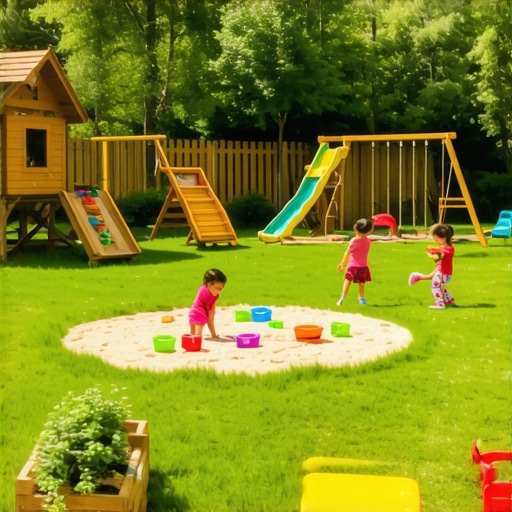
5 Ways to Create a Kid-Friendly Backyard Without Plastic Swing Sets
Designing for Durability and Biology in the Modern Backyard
To create a kid-friendly backyard without plastic, you must integrate natural elements like grade-adjusted berms, hardscape boulder scrambles, and high-traffic turf that withstands heavy footfall through superior soil biology and root depth management. I always drill into my new crew members: if you don’t fix the soil grading first, every plant you put in the ground is just expensive compost. I saw a guy last year spend five figures on a custom wood fort, only for the entire structure to rot within 24 months because he didn’t understand hydrostatic pressure and let water pool at the footings. We don’t do that here. We build for the next thirty years, not the next thirty days. If you want a space where your kids can actually play without looking like a primary-colored eyesore, you have to look at the yard as an integrated ecosystem. This means managing soil compaction, choosing native plant species with high tensile strength, and engineering drainage that keeps the play area dry 20 minutes after a storm.
1. Engineering Topographical Play: The Art of the Berm
A topographical berm is a controlled elevation change created by importing clean fill and compacting it to a specific density, typically 90 percent to 95 percent on the Modified Proctor Test, to provide a natural climbing and sliding surface. Most DIYers just pile up dirt and call it a hill. That is a recipe for a muddy mess. A professional berm requires a 4-inch base of 2A modified gravel for stability, followed by lifts of soil that are mechanically compacted. This prevents the hill from slumping during the first heavy frost. By creating a 3-to-1 slope ratio, you provide a safe but challenging grade for children to climb, roll, or slide down without the need for a plastic staircase. We cap these berms with high-density turf or rubberized mulch if the fall height exceeds 30 inches.
“Soil compaction is the most common cause of plant failure in urban landscapes, as it reduces the pore space necessary for oxygen and water movement.” – Penn State Extension
This is why we never use heavy machinery over the finished root zones of nearby trees while building these mounds.
2. High-Traffic Turf Management and Rhizome Density
Standard lawn care routines will fail a backyard full of kids; you need a turfgrass management plan that focuses on rhizomatous growth and aggressive recovery. To maintain a lawn that can handle a soccer game without turning into a dust bowl, you must maintain a soil pH between 6.2 and 6.8 and apply nitrogen in a 4-1-2 ratio during the peak growing season. We focus on cultivars like Rhizomatous Tall Fescue (RTF) or Kentucky Bluegrass hybrids that literally knit themselves back together after damage. You should be aiming for a root depth of at least 6 inches, which is only possible if you stop the “mow-and-blow” habit of scalping the grass. Keep it at 3.5 inches. This provides a soft landing and shades the soil, reducing water evaporation. If you have heavy clay, we perform deep-core aeration twice a year to prevent the soil from turning into concrete under the pressure of running feet.
3. Hardscaped Scrambles and Boulder Engineering
A boulder scramble uses weathered fieldstone or limestone blocks to create a natural climbing wall that doubles as a retaining wall to manage yard slope. Unlike a plastic swing set, stone does not UV degrade or crack in the winter. We bury the bottom third of every boulder to ensure it cannot tip or shift under a 200-pound load. This is a hardscaping fundamental: gravity and friction are your best friends if the base is solid. We use 6 inches of compacted 2B stone as a footer for these boulders to allow for vertical drainage. This prevents the freeze-thaw cycle from heaving the rocks out of alignment.
“A retaining wall doesn’t fail because of the stone; it fails because of the water trapped behind it.” – Hardscape Engineering Axiom
We integrate perforated pipe (French drains) behind these stone features to ensure the play zone stays dry and the structural integrity remains intact for decades.
How do I build a natural climbing area for children?
Building a natural climbing area requires sourcing non-stratified boulders, such as granite or basalt, and embedding them into a 6-inch compacted gravel base to prevent shifting. You must ensure all edges are rounded and the fall zone is covered with 9 inches of engineered wood fiber or pea gravel to meet safety standards. We look for stones with natural “steps” and avoid any rock that flakes or shatters under impact. The goal is to provide a sensory experience that teaches balance and risk assessment, something a plastic ladder simply cannot do. We also check the solar orientation; we don’t place dark stones in direct southern sun where they will become too hot for small hands to touch.
4. Living Architecture: Willow Tunnels and Arboriculture
Instead of a plastic playhouse, we use arboriculture techniques to build living structures like willow tunnels or hornbeam alleys. By planting Salix viminalis whips in a trench filled with 12 inches of nutrient-rich loam, we can weave a structure that grows and strengthens every year. This is sustainable garden design at its best. These structures provide shade and a sense of enclosure without blocking airflow. Maintenance is simple: a yearly pruning to keep the shape and ensuring the drip irrigation system delivers 1 inch of water per week to the root zone. Because these are living plants, they contribute to the local ecosystem rather than sitting in a landfill one day. We avoid any species with brittle wood or poisonous berries, focusing strictly on high-tensile, flexible hardwoods.
5. Sensory Paths and Non-Toxic Plant Palettes
A sensory garden path utilizes various textures, such as Mexican beach pebbles, smooth flagstone, and fragrant groundcovers like Thymus serpyllum (Creeping Thyme), to create an exploratory loop. We avoid the typical boxwood hedges that offer nothing but a green wall. Instead, we use plants like Stachys byzantina (Lamb’s Ear) for its fuzzy texture and Carex species for their soft, flowing blades. Safety is the priority; we cross-reference every plant against the ASPCA and nursery toxicity lists. No oleander, no foxglove, and no thorny barberry. The path itself is engineered with a 2 percent cross-slope to ensure water runs off into a bioswale or rain garden, preventing the accumulation of slippery moss or algae that could lead to falls.
Natural Play Material Comparison
| Material | Drainage Rate | Life Span | Compaction Risk |
|---|---|---|---|
| Engineered Wood Fiber | High | 3-5 years | Moderate |
| Pea Gravel | Very High | 10+ years | Low |
| High-Traffic Turf | Low | Seasonal | High |
| River Rock | High | Indefinite | None |
What are the best plants for a kid-friendly garden?
The best kid-friendly plants include Creeping Thyme for ground cover, Lamb’s Ear for texture, and Serviceberry for edible, non-toxic fruit and structural interest. Avoid plants with thorns, such as certain roses or hawthorns, and stay away from toxic species like Yew or Azalea if you have toddlers. We focus on plants that can withstand being stepped on occasionally, such as Mazus reptans. These species are selected for their durability and low-maintenance requirements, ensuring the garden remains functional for play while providing ecological value to the property.
Natural Backyard Safety Checklist
- Check all boulders for stability by applying a 200lb lateral force.
- Ensure 9 inches of loose-fill surfacing under any climbing feature higher than 30 inches.
- Verify that no plants in the play zone are on the regional toxicity list.
- Inspect the grading to ensure water moves away from play structures at a 2 percent minimum slope.
- Test soil pH to ensure the turf has the nutrients required for high-traffic recovery.
![Build a $150 2026 Cedar Planter for Patios [Easy Project]](https://lawnmajesty.com/wp-content/uploads/2026/07/Build-a-150-2026-Cedar-Planter-for-Patios-Easy-Project.jpeg)
![Build a $300 Boulder Fire Pit Circle [2026]](https://lawnmajesty.com/wp-content/uploads/2026/06/Build-a-300-Boulder-Fire-Pit-Circle-2026.jpeg)