How to Stop Weeds from Growing Between Your Flagstone Pavers
Why Weeds Invade Flagstone Patios
Weeds invade flagstone joints when organic debris and wind-blown silt accumulate in the gaps, creating a nutrient-rich growing medium. When the original jointing material fails or erodes, it allows hydrostatic pressure to push moisture up, feeding dormant seeds trapped within the aggregate base. I recently got called out to tear up a $30,000 patio that was sinking because the previous contractor used stone dust as a base for irregular flagstone. The joints were a forest of dandelions. Within three years, the silt had clogged the drainage, and the freeze-thaw cycle turned that beautiful Pennsylvania bluestone into a series of jagged, uneven trip hazards. It was a classic autopsy of a failed hardscape. The contractor had ignored the fundamental physics of water movement. Stone dust is a sponge for moisture, and where there is moisture and trapped silt, there is life. Weeds are not the problem, they are the symptom of a failing foundation. To stop them, you have to engineer the environment to be inhospitable to biological growth while maintaining the structural integrity of the stone. This requires a shift from superficial fixes like vinegar sprays to deep-layer remediation.
“A retaining wall doesn’t fail because of the stone; it fails because of the water trapped behind it.” – Hardscape Engineering Axiom
The Science of Joint Failure and Silt Accumulation
Hardscape joints fail primarily due to sub-surface erosion and the use of improper infill materials that lack the tensile strength to resist water washout. When joints lose their density, they become traps for airborne organic matter, providing a substrate for weed seeds to germinate and thrive. Most homeowners make the mistake of thinking the weeds are coming from the dirt underneath the patio. In reality, about 95 percent of weeds in flagstone come from seeds that blew in from the top. They land in the microscopic crevices of old, cracked sand. If you have standing water or high humidity in those joints, you have created a nursery. You must understand the 2A modified gravel base. This base layer should be compacted to a minimum of 95 percent Proctor density. If the base isn’t solid, the stones move. When stones move, the joints crack. When joints crack, the weeds move in. Don’t skip the compaction phase. It is the most critical step in the entire engineering process. Every inch of stone requires a solid foundation of angular, crushed aggregate that locks together under pressure.
How much modified gravel do I need for a patio base?
For a stable flagstone patio, you need a minimum of 4 to 6 inches of compacted 2A modified gravel for pedestrian traffic. If the soil is heavy clay, you must increase this to 8 inches and include a geotextile fabric to prevent the aggregate from sinking into the subgrade. Many hacks will tell you two inches of sand is enough. They are wrong. It will shift. It will heave. It will fail. You need the mass of the crushed stone to distribute the weight and provide drainage paths for water. Without this, the water stays in the joints, creates a slurry, and invites every weed seed in the county to take root.
Can you put polymeric sand over regular sand?
No, you cannot layer polymeric sand over regular sand because it requires a full-depth bond of at least 1 inch to achieve structural integrity. Capillary action will pull moisture through the old sand, preventing the polymers from curing and causing the new layer to flake off. This is the most common DIY failure I see. People want a shortcut. They sweep a thin layer of the expensive stuff over the old dirt and wonder why it peels up like a scab after the first rain. You have to excavate the joints completely.
“Jointing materials in segmental pavements must maintain a balance between permeability and structural integrity to mitigate sub-base erosion.” – ICPI Tech Spec No. 2
Materials Comparison for Flagstone Joints
Choosing the right material is a matter of civil engineering, not aesthetics. Here is how the common options stack up in the field. | Material | Lifespan | Permeability | Best Use Case | | :— | :— | :— | :— | | Stone Dust | 1-2 years | Low | Temporary paths only | | Polymeric Sand | 5-8 years | Moderate | Professional patios | | Resin-bound Sand | 10+ years | High | High-drainage zones | | Polymeric Dust | 5-7 years | Low | Wide-joint irregular stone |
The Hardscape Maintenance Checklist
- Inspect joints annually for hairline fractures or washout.
- Remove organic debris with a leaf blower, do not let it decompose in the joints.
- Check the patio pitch to ensure water is shedding at 1/4 inch per foot.
- Clean the stone with a pH-neutral cleaner to prevent etching.
- Refresh polymeric sand only after deep cleaning and complete drying.
The Professional Remediation Process
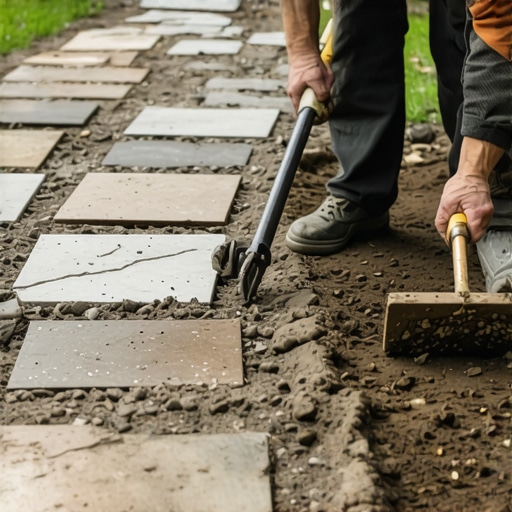
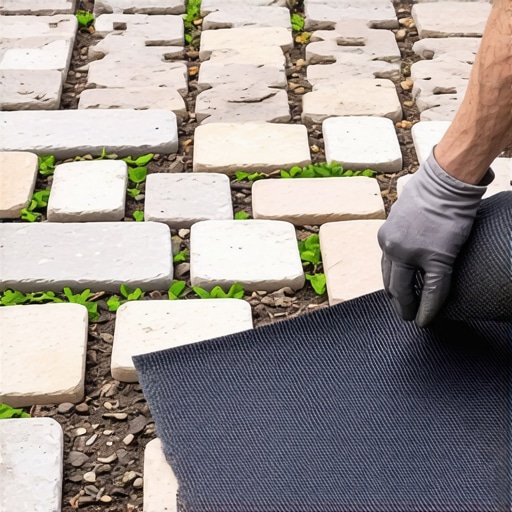
The process of stopping weeds permanently involves the complete mechanical removal of existing joint material followed by the application of high-performance polymeric sand. This creates a semi-permeable, hardened barrier that resists seed penetration and stabilizes the stones against lateral movement and frost heave. Step one is the power wash. But be careful. If you angle the wand wrong, you will blast out the bedding sand and undermine the stones. You need to clean the joints to a depth of at least one inch. Once cleaned, the patio must be bone dry. I mean desert dry. If there is a hint of moisture in the stone, the polymeric sand will haze, and you will have a white, cloudy mess that is nearly impossible to remove. Once dry, sweep in the sand. Use a vibrating plate compactor with a protective mat. This settles the sand to the bottom of the joint. Most people forget this. They just sweep it in and wet it. That leaves air pockets. Air pockets mean weak joints. Weak joints mean weeds. After compacting, sweep off every single grain of excess sand. Then, mist it. Do not flood it. You want to trigger the chemical reaction, not wash the glue out. The polymers need to cross-link. This creates a flexible yet tough bond. It is biology meets engineering. Stop treating your patio like a garden and start treating it like a structure.