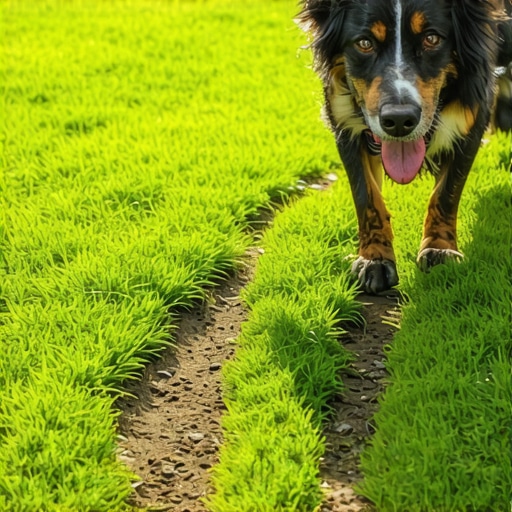
Stop Muddy Dog Paws with This Fast-Growing Groundcover
Understanding the Physics of the Backyard Mud Pit
Stop muddy dog paws by installing fast-growing, high-traffic groundcovers like Microclover or Kurapia that stabilize soil through dense root structures and stoloniferous growth. These living carpets increase the shear strength of your topsoil, preventing the churn that occurs when a 70-pound Labrador makes a sharp turn on saturated turf.
The Apprentice Lesson: Soil Grading is Non-Negotiable
I always drill into my new crew members: if you don’t fix the soil grading first, every plant you put in the ground is just expensive compost. Last spring, a homeowner begged us to ‘just throw some seed down’ to stop the mud. I refused. Why? Because the grade was pitching back toward the foundation at a 3 percent slope, and the bulk density of the soil was approaching that of concrete. If the water has nowhere to go, even the most aggressive groundcover will drown in anaerobic conditions. We spent three days excavating the top four inches, installing a French drain with a 1 inch per 10 foot drop, and amending the clay with coarse sand and organic matter before a single seed touched the dirt. You cannot out-plant a drainage failure. It will rot. Do not skip the prep work.
“Soil compaction is the most common cause of poor plant growth in urban landscapes, increasing bulk density and reducing the pore space needed for oxygen and water infiltration.” – Cornell University Turfgrass Program
The Science of Stoloniferous Groundcovers
When selecting a groundcover to handle canine traffic, you are looking for plants that spread via stolons (above-ground runners) or rhizomes (underground stems). Unlike traditional bunch-type grasses that grow from a single crown, stoloniferous plants weave a literal web across the soil surface. This web acts as a structural reinforcement layer. When a dog’s paw strikes the ground, the pressure is distributed across the network of stems rather than focused on a single point of soil. This is basic civil engineering applied to botany. Microclover (Trifolium repens ‘Pipolina’) is the current gold standard for this. It is 30 percent smaller than standard white clover, but it grows twice as fast. It fixes nitrogen from the atmosphere into the soil, essentially fertilizing itself while it chokes out the mud-producing bare spots.
How much modified gravel do I need for a patio base?
For a standard pedestrian or dog-run patio, you need a 4-inch minimum base of compacted 21A or 57 stone, which translates to roughly 0.5 tons of gravel per 100 square feet of area. If you are integrating groundcover between pavers, you must use a ‘structural soil’ mix that allows for root penetration while maintaining a 95 percent Proctor density compaction rating to prevent settling. Most contractors fail here. They use standard topsoil which compacts into a brick, killing the groundcover and creating a muddy mess between the stones.
Groundcover Performance Comparison
| Species | Traffic Tolerance (PSI) | Growth Rate | Root Depth (Inches) | Drought Resistance |
|---|---|---|---|---|
| Microclover | High | Aggressive | 4 to 6 | High |
| Kurapia | Extreme | Very Fast | 10 to 15 | Very High |
| Creeping Thyme | Moderate | Moderate | 3 to 4 | High |
| Silver Carpet | Low | Slow | 2 to 4 | Extreme |
The Installation Protocol for Durable Dog Runs
To establish a dog-resistant groundcover, you must follow a rigid mechanical process. First, perform a percolation test. Dig a hole 12 inches deep, fill it with water, and see how fast it drains. If it takes more than 4 hours, you have a compaction crisis. You need to aerate to a depth of at least 3 inches using a core aerator. Do not use spike aerators; they actually increase compaction by pushing soil sideways. Once aerated, top-dress with 1/4 inch of compost to introduce microbial life. This biology is what keeps the soil ‘fluffy’ and porous. When seeding, use a drop spreader to ensure a density of at least 2 pounds per 1,000 square feet for Microclover. Water for 10 minutes, three times a day, for the first 14 days. If the soil surface dries out, the tender sprouts die. It is that simple.
“Clover can supply its own nitrogen through a symbiotic relationship with Rhizobium bacteria, often providing up to 2 to 3 pounds of nitrogen per 1,000 square feet annually.” – University of Minnesota Extension
What groundcover is safe for dogs to eat?
Microclover and Creeping Thyme are non-toxic to dogs and can withstand occasional grazing without health risks or significant damage to the plant. Always avoid species like English Ivy or certain spurges, which can cause skin irritation or gastric distress. Stick to the ‘Legume’ family for the best balance of safety and durability. Clover is the safest bet because it does not have the high oxalate levels found in some other fast-growing creepers.
Essential Maintenance Checklist
- Monthly Soil Check: Use a screwdriver to probe the soil; if it cannot penetrate 4 inches easily, you need to aerate.
- pH Monitoring: Maintain a pH between 6.0 and 7.0 to ensure nutrient bioavailability.
- Mowing Height: Keep Microclover at 2.5 to 3 inches to encourage lateral spreading rather than vertical growth.
- Hydration: One inch of water per week, delivered in one or two deep sessions to force roots downward.
- Pet Waste Removal: Remove solid waste immediately to prevent ‘nitrogen burn’ from high urea concentrations.
The Reality of High-Traffic Recovery
No plant is invincible. If you have three Great Danes running the same fence line every day, they will eventually win. The goal of using fast-growing groundcover is not to create an indestructible surface, but to create a self-repairing one. When a dog tears a small patch of Kurapia or Clover, the surrounding stolons should fill that void within 7 to 10 days during the growing season. If you use standard fescue, that hole stays bare for months, turns into a mud puddle, and then becomes a weed patch. We call this the ‘Death Spiral of Turf.’ By switching to a high-metabolism groundcover, you are investing in a biological system that fights back against the wear and tear. Your dog gets a place to run, and you get to keep your carpets clean. Stick to the science. Prep the soil. Follow the water schedule. It works.
![Why Your 2026 Grass Seed Kills Your Budget [Fix]](https://lawnmajesty.com/wp-content/uploads/2026/06/Why-Your-2026-Grass-Seed-Kills-Your-Budget-Fix.jpeg)