![Why Your 2026 Hydrangeas Won't Bloom [3 Common Reasons]](https://lawnmajesty.com/wp-content/uploads/2026/05/Why-Your-2026-Hydrangeas-Wont-Bloom-3-Common-Reasons.jpeg)
Why Your 2026 Hydrangeas Won’t Bloom [3 Common Reasons]
The 2026 Bloom Failure: A Diagnosis of Neglect
To understand why your 2026 hydrangeas won’t bloom, you must look at failed pruning timing, nitrogen toxicity from lawn runoff, and improper root flare depth. Hydrangeas are biological machines that set their reproductive buds nearly a year in advance; if you disrupt their metabolic cycle now, you kill next year’s show. I always drill into my new crew members: if you don’t fix the soil grading and chemistry first, every plant you put in the ground is just expensive compost. I’ve seen guys charge thousands for ‘garden design’ while planting Hydrangea macrophylla three inches too deep in heavy clay. By the time the homeowner realizes there are no blooms, the contractor is long gone with his check. You cannot cheat the biology of a woody shrub. Most homeowners treat their landscaping like furniture they can just dust off, but your 2026 blooms are actually being decided right now by the moisture levels in your soil and the specific N-P-K ratios you’re dumping on your turf grass. It is a game of civil engineering and plant physiology.
Reason 1: The Nitrogen Overdose from Improper Lawn Care
Nitrogen toxicity occurs when high-nitrogen lawn fertilizers leach into garden beds, forcing the plant to prioritize vegetative leaf growth over reproductive bud development. This results in massive, dark green leaves but zero flower heads for the 2026 season. I’ve walked onto dozens of properties where the lawn looks like a golf course because some ‘mow-and-blow’ hack is dumping heavy urea-based fertilizer every four weeks. That nitrogen doesn’t stay on the grass. It migrates. When it hits your hydrangea roots, it signals the plant to stay in a juvenile growth state. It refuses to enter the reproductive phase. You want blooms? You need phosphorus and potassium. Stop feeding the leaves if you want the flowers.
“High nitrogen levels in the soil favor vegetative growth at the expense of flower bud initiation in many woody ornamentals.” – Penn State Agricultural Extension
Reason 2: Pruning the ‘Old Wood’ at the Wrong Moment
Pruning hydrangeas at the wrong time of year removes the terminal buds that were set during the previous growing season, effectively cutting off the 2026 flowers before they ever emerge. If you have Bigleaf or Oakleaf varieties, they bloom on ‘old wood.’ This means the buds for next year are formed by August or September of this year. If you hire a ‘landscaping’ crew that comes in with power shears in November to ‘tidy up,’ they are decapitating your 2026 season. You must identify your species before you touch a pair of loppers. Hydrangea paniculata can handle a late winter haircut because it blooms on new growth, but do that to a macrophylla and you’ll be looking at nothing but green sticks next July. It is a mechanical error with permanent consequences for the season.
Reason 3: Soil Saturation and Hydrostatic Pressure Issues
Hydrangea root rot caused by poor soil drainage and hydrostatic pressure in heavy clay prevents the plant from absorbing the nutrients required to trigger the bloom cycle. Most garden design ignores the invisible reality of the soil. If your house has a ‘bowl’ grade where water sits for more than four hours after a rain, your hydrangea roots are suffocating. Roots need oxygen for cellular respiration. Without it, the plant enters survival mode. It won’t flower if it’s struggling to breathe. I see this constantly in new builds where the soil is compacted to 95 percent Proctor density for the foundation, then they slap two inches of mulch on top and call it a garden bed. It is a death trap.
| Hydrangea Type | Bloom Wood | Optimal Prune Window | Sun Requirement |
|---|---|---|---|
| Bigleaf (Macrophylla) | Old Wood | Immediately after bloom | Partial Shade |
| Panicle (Paniculata) | New Wood | Late Winter / Early Spring | Full Sun |
| Smooth (Arborescens) | New Wood | Late Winter | Partial Sun |
| Oakleaf (Quercifolia) | Old Wood | After bloom in Summer | Sun to Shade |
How much modified gravel do I need for a patio base?
For a standard patio base, you need six inches of compacted 2A modified stone to ensure proper drainage and structural integrity beneath your pavers. If you skip the compaction or use ‘clean’ stone without fines, your patio will heave within two winters, and the resulting drainage shift will likely drown your nearby landscaping and hydrangeas. Use a plate compactor. Do it in two-inch lifts. Don’t be lazy.
How does soil pH affect hydrangea flower color?
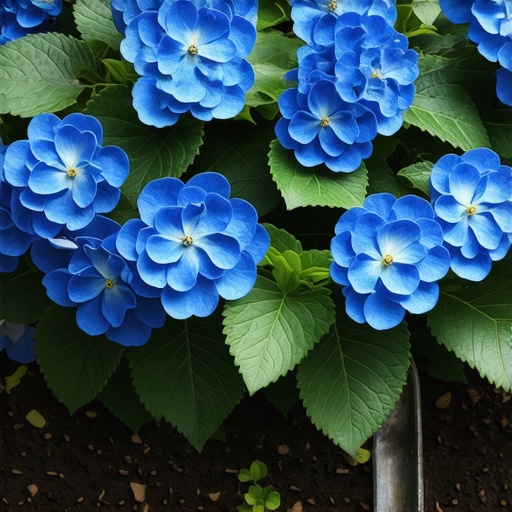
Soil pH dictates the bioavailability of aluminum ions, which directly changes the pigment of Hydrangea macrophylla flowers from pink to blue. A pH of 5.5 or lower results in blue flowers because the acidity allows the plant to take up aluminum, whereas a pH of 6.5 or higher locks that aluminum away, resulting in pink blooms. This is pure chemistry. You can’t just wish for a color; you have to engineer the soil. Use elemental sulfur to drop the pH or lime to raise it. It takes months to shift, so start now for 2026.
“The physical properties of the soil, including pore space and drainage capacity, are more critical to plant health than supplemental fertilization in 90 percent of residential cases.” – ICPI Hardscape Manual
2026 Bloom Prep Checklist
- Conduct a professional soil test to check N-P-K and pH levels.
- Identify if your hydrangea species blooms on ‘old wood’ or ‘new wood.’
- Clear away mulch volcanoes from the root flare to prevent stem rot.
- Install a drip-irrigation system to ensure deep, infrequent watering.
- Stop all high-nitrogen lawn fertilization within 10 feet of the drip line.
Stop looking for a magic spray. There is no ‘bloom booster’ that can fix a plant that has been pruned incorrectly or drowned in clay soil. You have to respect the architecture of the plant. If you want those heavy, dinner-plate sized blooms in 2026, you have to stop the ‘mow-and-blow’ mentality. Focus on the soil. Respect the buds. It is not complicated, but it is hard work. Put the shears down and pick up a soil probe. That is how you win.