3 Rules for Planting 2026 Privacy Hedges in Clay Soil
3 Rules for Planting 2026 Privacy Hedges in Clay Soil: The Professional Engineering Approach
I always drill into my new crew members: if you don’t fix the soil grading and chemistry first, every plant you put in the ground is just expensive compost. Last season, I watched a competitor drop fifty Skip Laurels into an unamended clay trench. Six months later, those trees were brown sticks because they had basically been planted in a series of subterranean bathtubs. The homeowner lost twenty thousand dollars because the contractor didn’t understand soil physics. You cannot fight biology, and you certainly cannot fight the structural reality of heavy clay. If you want a privacy screen that survives until 2026 and beyond, you have to stop thinking like a gardener and start thinking like a civil engineer. Success is not about the green stuff on top: it is about the microscopic pore space in the dirt below.
Rule 1: Mechanical Remediation of High-Density Clay Structures
To plant privacy hedges in clay soil, you must prioritize soil structure by incorporating expanded shale or gypsum to break up compacted layers. This prevents the bathtub effect where water pools around root balls, leading to root rot and anaerobic conditions during high-rain seasons.
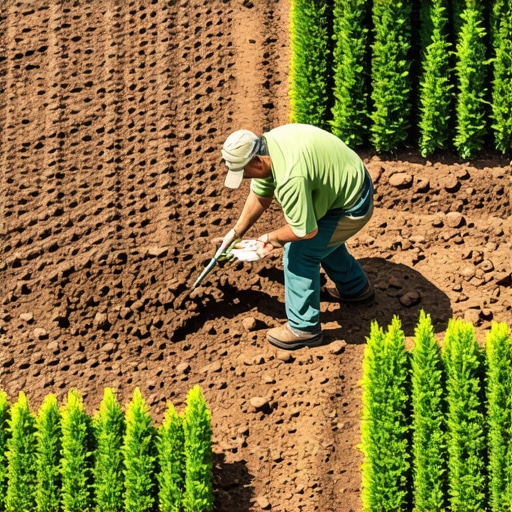
Clay soil is composed of microscopic, flat platelets that stack tightly together. This leaves zero room for oxygen. In the landscaping world, we call this a lack of ‘macro-pores.’ When you dig a hole in heavy clay and fill it with nice, loose potting soil, you have created a bowl that will hold water until the roots drown. The first rule is that you never plant in a hole; you plant in a system. You must break the glazing on the sides of the hole. When a backhoe or an auger digs in clay, it creates a smooth, polished surface. Root tips hit that wall and spin in circles like they are in a plastic pot. This is root girdling. You take a mattock or a hand spade and you scarify those walls. You make them jagged. Give those roots a mechanical advantage to penetrate the native soil. Use expanded shale to provide permanent aeration. Unlike organic matter, shale does not decompose. It stays there, keeping those clay platelets apart for decades.
“Clay soils require careful management of bulk density to ensure adequate gas exchange. High clay content often leads to restricted drainage, which is the primary cause of woody ornamental failure in urban landscapes.” – Penn State Agricultural Extension
How do I amend clay soil for privacy hedges?
Avoid the temptation to just add sand. Adding sand to clay without massive amounts of organic matter creates something similar to low-grade concrete. Instead, focus on a 60-40 split between native soil and a high-quality compost or leaf mold. You want to increase the cation exchange capacity (CEC) of the soil. This allows the soil to hold onto nutrients like potassium and magnesium rather than letting them wash away. We are building a biological engine. If the engine cannot breathe, the hedge will stall. I have seen Green Giant Arborvitaes put on three feet of growth in a single year just because the soil was fractured properly before installation. It is about the PSI of the soil: roots cannot penetrate soil that has a high penetration resistance. Soften the ground through chemistry and mechanics.
Rule 2: Precision Root-Flare Alignment and Grade Management
Proper planting depth is the most critical factor for long-term hedge health, requiring the root flare to be slightly above the finished grade. Burying the stem tissue leads to adventitious rooting and phloem compression, which slowly chokes the vascular system of the tree.
If you see a tree that looks like a telephone pole sticking out of the ground, it is planted too deep. Every tree has a flare: the spot where the trunk widens as it meets the roots. That flare needs to breathe. It is not designed to be submerged in soil or mulch. In clay soil, I tell my guys to plant ‘high and dry.’ We sit the root ball about two inches above the surrounding grade. We then mound the soil up to the edge of the root ball. This creates a natural gravity drain for the trunk. If you bury that flare, the bark will stay moist, rot will set in, and the tree’s ability to transport sugars from the leaves to the roots will be severed. It is a slow death. It might take three years, but the tree is a goner the second you shovel dirt over that flare. Stop the mulch volcanoes. Mulch should look like a donut, not a mountain. It should never touch the bark. This is non-negotiable in the professional world.
| Hedge Species | Clay Tolerance | Growth Rate (Annual) | Critical Requirement |
|---|---|---|---|
| Green Giant Arborvitae | High | 3 to 5 Feet | Requires 1 inch water/week |
| Emerald Green Thuja | Medium | 6 to 12 Inches | Must avoid standing water |
| Skip Laurel | High | 1 to 2 Feet | Needs acidic soil pH |
| Nellie R. Stevens Holly | Very High | 2 to 3 Feet | Needs well-drained top 6 inches |
What are the best privacy trees for wet clay soil?
If your yard feels like a marsh, you need to look at species that can handle ‘wet feet.’ The American Arborvitae (Thuja occidentalis) is a swamp-dweller by nature, making it a prime candidate for clay. However, even these will fail if the soil is compacted to the point of being a brick. Another sleeper hit for clay is the Willow Hybrid, though they are aggressive and can be messy. For a refined look, certain cultivars of Holly are champions in heavy soil. They have tough, waxy leaves that resist the transpiration stress that occurs when roots are struggling in dense clay. Always check your USDA Hardiness Zone before buying. A plant that thrives in Georgia clay might shatter in an Ohio winter.
Rule 3: The Hydration-Oxygen Paradox in Heavy Substrates
Managing irrigation in clay landscapes requires deep, infrequent watering to encourage geotropic root growth. Excessive watering frequency in clay leads to pore-space saturation, effectively suffocating the micro-rhizae necessary for nutrient uptake and plant survival.
Clay holds water like a sponge. If you water your hedges for ten minutes every single day, you are killing them with kindness. The top inch of soil stays wet, the roots stay shallow, and the bottom of the root ball turns into an anaerobic swamp. You want to water deeply: once or twice a week, maximum. You want that water to penetrate twelve inches down. Then, you stop. Let the soil dry out. This forces the roots to grow downward in search of moisture. Deep roots are the only thing that will save your privacy screen during a July drought. Use a drip irrigation system with pressure-compensating emitters. This delivers water slowly, allowing the clay to absorb it rather than having it run off the surface like water off a windshield.
“Over-watering in heavy clay is the leading cause of Phytophthora root rot. Irrigation should be based on soil moisture sensors rather than a fixed timer to prevent saturation-induced hypoxia.” – Texas A&M Agrilife Extension
How much modified gravel do I need for a patio base?
While this article focuses on planting, many people install privacy hedges next to new hardscaping. If you are building a patio nearby, you need at least 6 inches of compacted 21A or CR-6 modified gravel for a pedestrian walkway, and up to 12 inches for a driveway. Do not let the gravel dust migrate into your planting beds. The high pH of stone dust can spike the soil alkalinity, which will turn your evergreens yellow. This is known as iron chlorosis. Keep your hardscape engineering and your horticultural biology separate. Use a landscape fabric barrier between the gravel base and the planting soil to prevent leaching.
Before you start digging, follow this checklist to ensure you are not wasting your investment:
- Call 811 to mark underground utility lines.
- Perform a percolation test: dig a hole, fill it with water, and see if it drains within 12 hours.
- Check the soil pH: most evergreens prefer a slightly acidic 6.0 to 6.5.
- Remove all burlap and wire cages from the top half of the root ball.
- Install a 2-inch layer of organic mulch, keeping it 3 inches away from the trunk.
- Set up a dedicated drip zone for the new installs.
It will rot if you ignore the drainage. Clay is not a death sentence for a landscape, but it is a strict master. Treat the ground with the respect it deserves, focus on the engineering of the soil, and your 2026 privacy hedge will actually be around to see 2036. Don’t be the homeowner who has to call me in two years to rip out a line of dead trees. Do it right the first time.
![4 Shade-Loving Groundcovers for 2026 Clay Soil [Fast]](https://lawnmajesty.com/wp-content/uploads/2026/05/4-Shade-Loving-Groundcovers-for-2026-Clay-Soil-Fast.jpeg)