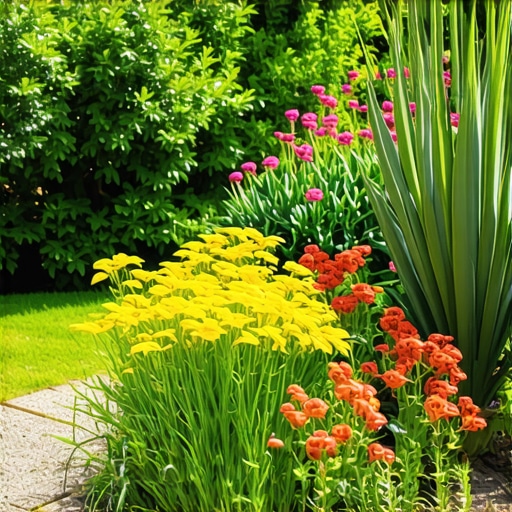
5 2026 Best Perennials for Sandy Front Yards
The Physics of Sand and the Failure of High-End Design
I always drill into my new crew members: if you don’t fix the soil grading first, every plant you put in the ground is just expensive compost. I have seen it a thousand times. A designer draws up a beautiful plan, the homeowner buys the stock, and three months later, I am called in to perform a forensic autopsy on $5,000 worth of dead plant material. The culprit is almost always a fundamental misunderstanding of soil mechanics. Sandy soil is not just ‘dirt that drains well.’ It is a substrate with a high macropore fraction and a pathetic Cation Exchange Capacity (CEC). In layman’s terms, it cannot hold a charge, and it cannot hold a meal. If you do not select plants biologically engineered for these specific rigors, you are throwing money into a sieve. We are moving into 2026 with a focus on resilient, high-performance landscapes that do not require a constant IV drip of synthetic fertilizers.
“Sandy soils have a low cation exchange capacity (CEC), meaning they hold fewer nutrients like potassium, calcium, and magnesium, which are often leached away by heavy rainfall or irrigation.” – University of Florida IFAS Extension
Why Soil Texture Dictates Your 2026 Garden Success
The best 2026 perennials for sandy front yards include Asclepias tuberosa, Baptisia, and Eryngium, which excel because their deep taproots and physiological adaptations allow them to thrive in low-CEC, high-drainage environments where standard garden plants suffer from nutrient leaching and desiccation. You cannot fight the geology of your site. If you have sand, you have a site that warms up fast in the spring but starves plants in the summer. We look for ‘deep-diver’ species. These are plants that spend their first two years building a structural anchor rather than top-heavy foliage. This is the difference between a landscape that survives a July heatwave and one that requires you to stand outside with a hose for three hours every night. Stop looking for ‘pretty’ and start looking for ‘functional.’
1. Asclepias tuberosa (Butterfly Weed): The Taproot Specialist
This is not the floppy milkweed you see in ditches. The 2026 cultivars of Asclepias tuberosa are bred for a tighter, more mounded habit that fits a professional front yard aesthetic without sacrificing its biological engine. Its primary asset is a massive, woody taproot that can descend several feet to find moisture layers that surface-level grasses cannot reach. When you plant these, you get one shot. Because of that taproot, they do not transplant well. You set them, you leave them, and you let them work. They are the definition of ‘low maintenance’ once established. In sandy soil, they are virtually bulletproof because they actually prefer the lean, gritty environment that would kill a Hosta in forty-eight hours.
2. Baptisia australis (False Indigo): The Nitrogen Factory
Baptisia is a powerhouse for sandy front yards because it is a legume. It has a symbiotic relationship with Rhizobium bacteria, allowing it to fix nitrogen from the atmosphere. In sandy soils where nitrogen leaches out after every rainstorm, Baptisia creates its own fertilizer. It grows into a shrub-like form that provides the structural weight usually reserved for woody or hardscape elements. By year three, the root system is so dense it acts as its own retaining mechanism for the surrounding soil. It is a slow starter, but it is a finisher. If you are tired of your front yard looking ‘thin,’ this is your anchor plant. It does not want your triple-mix or your peat moss; it wants sun and space to breathe.
3. Eryngium yuccifolium (Rattlesnake Master): The Structural Engineer
This plant looks like it belongs in a high-end architectural digest, but it is a native workhorse. Its silver-blue foliage is covered in a waxy cuticle that prevents transpiration. This is a survival mechanism for high-heat, high-drainage environments. Most homeowners make the mistake of planting delicate, thin-leaved perennials in sandy sun-traps. They desiccate. Eryngium thrives. It adds a verticality and a texture that breaks up the monotony of traditional flower beds. It is also a magnet for beneficial predatory insects, which helps manage your pest load without a chemical sprayer. It is pragmatic beauty at its finest.
4. Perovskia atriplicifolia (Russian Sage): The Drought-Hardy Veteran
While technically a sub-shrub, we treat it as a perennial in garden design. The reason it makes the 2026 list is its sheer refusal to die in poor soil. Its silver stems reflect sunlight, keeping the internal temperature of the plant lower during peak UV hours. In sandy soil, its root system spreads horizontally to catch every drop of surface moisture. I have seen Russian Sage thrive in gravel pits where the soil pH was north of 8.0. It is a tank. The key is to prune it hard in the late winter to keep the base from becoming leggy and brittle. If you want a blue-hued screen that doesn’t need a sprinkler system, this is your candidate.
5. Gaillardia x grandiflora (Blanket Flower): The Heat-Sync
Gaillardia is for the ‘hell strip’—that patch of sandy soil between the sidewalk and the street that gets baked by the sun and reflected heat from the asphalt. It is a short-lived perennial, but it reseeds itself with vigor. Its metabolic rate is tuned for high temperatures. In sand, it maintains a compact form, whereas in rich clay, it often gets ‘floppy’ and dies from root rot. It is a plant that thrives on neglect. If you fertilize it, you kill it. That is the kind of efficiency we need in modern landscaping. It provides constant color from June through September without requiring a single gallon of supplemental water once the roots have hit the 6-inch mark.
How do you prepare sandy soil for perennials?
Preparation of sandy soil involves incorporating high-quality organic matter like leaf mold or compost to a depth of 12 inches to increase water retention and CEC. Do not use sand-on-sand amendments; you need ‘black gold’ to create a biological sponge that holds nutrients near the root zone during the establishment phase.
| Amendment Type | Impact on Sandy Soil | Longevity |
|---|---|---|
| Leaf Mold | High moisture retention, adds biology | 1-2 seasons |
| Biochar | Permanent CEC increase, nutrient storage | Decades |
| Sphagnum Peat | Acidifies soil, moderate retention | 2-3 seasons |
| Composted Manure | High nitrogen, low structural change | 1 season |
What grows best in sandy soil in full sun?
Plants with silver foliage, deep taproots, or succulent-like leaves grow best in sandy full-sun conditions. These species, such as Eryngium and Sedum, are evolved to minimize water loss while maximizing light absorption for photosynthesis, making them ideal for high-drainage, high-UV environments common in front yard landscapes.
- Step 1: Test soil pH and nutrient levels before buying stock.
- Step 2: Excavate a hole twice as wide as the root ball but no deeper.
- Step 3: Ensure the root flare is visible and at grade; never bury the ‘neck’ of the plant.
- Step 4: Backfill with a 70/30 mix of native sand and organic compost.
- Step 5: Apply a 2-inch layer of wood chip mulch to regulate soil temperature.
“A retaining wall doesn’t fail because of the stone; it fails because of the water trapped behind it.” – Hardscape Engineering Axiom
While that quote is about hardscaping, the logic applies to planting. In sandy soil, the ‘failure’ is the opposite: the water leaves too fast. Your garden design must account for this exit speed. You are not just planting flowers; you are managing a hydraulic system. If you choose the right 2026 perennials, you are building a system that works with the land instead of fighting it. Avoid the ‘mow-and-blow’ mentality. Focus on the biology beneath the surface. That is how you get a front yard that actually lasts. Don’t skip the site prep. It will rot if you do.
![Stop Winter Salt Damage on 2026 Roadside Hedges [Fix]](https://lawnmajesty.com/wp-content/uploads/2026/05/Stop-Winter-Salt-Damage-on-2026-Roadside-Hedges-Fix.jpeg)