5 2026 Best Shrubs for Zero Maintenance Privacy
Why Most Privacy Screens Fail Before Year Three
Successful privacy screening in 2026 requires more than just digging a hole and dropping in a root ball; it demands a deep understanding of soil mechanics, nitrogen cycles, and USDA hardiness zones. Most homeowners fail because they prioritize fast growth over structural integrity, leading to girdling roots or fungal pathogens that decimate the screen within three seasons. To build a wall that lasts, you must account for site-specific drainage and the micro-climate of your property. Planning is eighty percent of the work. If you do not test your soil’s bulk density and pH levels first, you are essentially burying money. I always drill into my new crew members: if you don’t fix the soil grading first, every plant you put in the ground is just expensive compost. I have seen too many ‘expert’ installs where the root flares were buried six inches deep, effectively suffocating the tree’s lenticels and inviting Phytophthora root rot. We do it differently. We look at the mycorrhizal fungi levels and the capillary action of the soil before a single spade hits the dirt. This guide breaks down the elite cultivars for 2026 that balance privacy density with biological resilience.
“A retaining wall doesn’t fail because of the stone; it fails because of the water trapped behind it.” – Hardscape Engineering Axiom
How do I choose the right shrub for my soil type?
Selecting the right cultivar requires matching the plant’s transpiration rate and root morphology to your specific soil profile, whether it is heavy expansive clay or sandy loam. Using the wrong species for your drainage capacity will lead to anaerobic soil conditions and plant death. Check your soil’s cation exchange capacity (CEC) to ensure it can actually hold the nutrients you are applying.
1. Thuja occidentalis ‘American Pillar’ (The Compact Powerhouse)
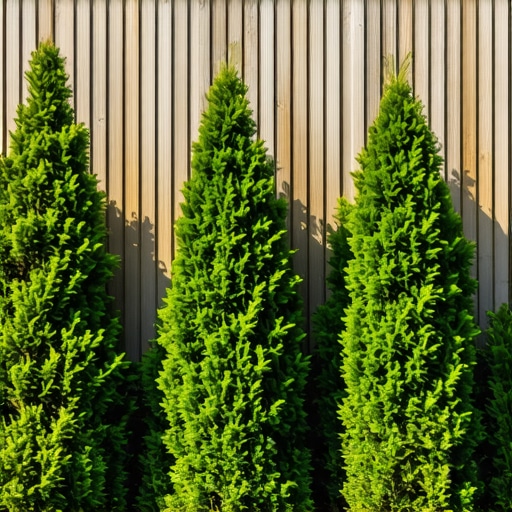
The American Pillar Arborvitae is the definitive 2026 choice for narrow property lines because it provides a dense evergreen screen while maintaining a slim footprint of only four feet wide. Unlike the ‘Green Giant’ which can aggressively outgrow suburban lots, the American Pillar focuses its energy into vertical elongation and foliage density. It is highly resistant to snow load damage due to its tighter branch structure. When planting these, spacing is critical. You want them close enough to knit together but far enough apart to allow airflow. Staggered rows are always superior to a single line. This prevents cross-contamination of pests and allows for better photosynthetic efficiency across the entire canopy. We install these with a slow-release 10-10-10 fertilizer incorporated into the backfill, ensuring we don’t burn the tender feeder roots.
| Shrub Variety | Growth Rate | Mature Width | Soil Preference |
|---|---|---|---|
| American Pillar | 3ft / Year | 4 Feet | Well-drained Loam |
| Nellie R. Stevens | 2ft / Year | 12 Feet | Heavy Clay Tolerant |
| Taylor Juniper | 1ft / Year | 3 Feet | Dry / Alkaline |
| Chestnut Hill Laurel | 1.5ft / Year | 5 Feet | Part Shade / Acidic |
2. Ilex x ‘Nellie R. Stevens’ (The Heavy Clay Specialist)
The Nellie R. Stevens Holly is the workhorse of southern landscaping and mid-atlantic garden design because it thrives in the heavy red clay that chokes out lesser species. This shrub is parthenocarpic, meaning it produces its signature red berries without needing a male pollinator nearby. It creates an impenetrable wall of glossy, spiked leaves that deter both trespassers and deer. The key to success with Nellie Stevens is managing hydrostatic pressure in the planting hole. In clay soil, a dug hole can act like a bucket, drowning the plant. We always plant these ‘high and proud,’ with the root flare two inches above the finished grade. This ensures the crown stays dry while the taproot seeks out moisture. Do not use wood chip mulch right up against the trunk. That is a recipe for borers and rot.
“Soil compaction is the single greatest barrier to urban plant health, reducing pore space and halting the gas exchange necessary for root respiration.” – Penn State Agricultural Extension
How far apart should I plant shrubs for a privacy fence?
To calculate planting intervals, take the mature width of the cultivar and multiply by 0.75 for a dense screen or 1.0 for individual specimens. For American Pillar, a 3-foot on-center spacing is standard, whereas a Nellie R. Stevens requires at least 6 to 8 feet to avoid foliage dieback from overcrowding. Proper spacing ensures adequate sunlight penetration to the lower branches, preventing the ‘naked bottom’ look often seen in poorly planned hedges.
3. Juniperus virginiana ‘Taylor’ (The Vertical Solution)
The Taylor Juniper is the 2026 solution for arid climates and alkaline soils where traditional evergreens struggle with chlorosis. It mimics the look of an Italian Cypress but possesses the hardiness to survive Zone 4 winters. This is a drought-tolerant specimen that requires almost zero pruning to maintain its pencil-thin silhouette. It is the ultimate ‘plant it and forget it’ privacy screen. However, it hates ‘wet feet.’ If your yard has standing water, you must install a French drain or a swale before considering this Juniper. We often use decomposed granite as a mulch for these to keep the humidity low around the base. It thrives in full sun and resists the cedar-apple rust that plagues many other native junipers. It is a structural masterpiece for modern minimalist landscapes.
- Step 1: Dig a hole twice as wide as the root ball but no deeper.
- Step 2: Scarify the sides of the hole to prevent glazing in clay soils.
- Step 3: Remove all burlap, twine, and wire cages—never leave them on.
- Step 4: Backfill with native soil; do not over-amend, or roots won’t spread.
- Step 5: Water deeply to settle the soil and remove air pockets.
4. Prunus laurocerasus ‘Chestnut Hill’ (The Shade-Tolerant Screen)
If you are dealing with a low-light environment or understory privacy, the Chestnut Hill Cherry Laurel is your best bet for 2026. Unlike the standard Skip Laurel, which is highly susceptible to shot hole disease (a bacterial pathogen), the Chestnut Hill cultivar has been bred for superior disease resistance and a more compact, mounded habit. It features deep green, leathery leaves that provide an excellent backdrop for garden design elements. When planting these in shaded areas, you must monitor evapotranspiration rates. They won’t dry out as fast as plants in the sun. Over-watering in the shade is a death sentence. Use a drip irrigation system with pressure-compensating emitters to deliver water directly to the soil, keeping the foliage dry to prevent leaf spot.
5. Viburnum dentatum ‘Chicago Lustre’ (The Native Powerhouse)
For those prioritizing biodiversity and native landscapes, the Chicago Lustre Arrowwood Viburnum is the premier choice. It offers multi-seasonal interest: creamy white flowers in spring, metallic blue berries in fall, and a dense branching structure that provides privacy even after the leaves drop. It is incredibly resilient, handling everything from road salt to drought. It does not require the heavy chemical inputs that many ornamental shrubs demand. The stem strength is legendary—Native Americans used the straight shoots for arrows. In a 2026 sustainable landscape, this plant provides bird habitat while shielding your backyard from the neighbors. It’s a win-win. Just watch out for the Viburnum leaf beetle; a quick application of dormant oil in early spring usually keeps them in check. Don’t use heavy pesticides that kill your beneficial insects.
The Maintenance Truth: It’s Not ‘No Maintenance,’ It’s ‘Smart Maintenance’
Even the most low-maintenance shrubs require a settling-in period. During the first twelve months, the goal is root establishment, not top growth. If you see rapid vertical shoots but weak lateral roots, you have a structural problem. We recommend a root stimulant containing humic acid and seaweed extract during the first two waterings. This triggers the auxin hormones in the plant to prioritize subterranean development. Once the roots are established—usually by year two—you can back off the water and let the plant’s natural genetics take over. Stop scalping your lawn near your shrubs; the mechanical damage from string trimmers is the leading cause of canker in young privacy screens. Give them a wide mulch ring and let them breathe. It is that simple. Don’t over-complicate it with synthetic boosters that lead to weak cellular walls. Grow it right, or grow it twice.