5 2026 Shade-Tolerant Hedges for Narrow Side Yards
Why Side Yard Planning Fails Before the First Shovel Hit
Planning for narrow side yards requires precise calculations of solar exposure and soil drainage capacity because these corridors often function as wind tunnels or drainage basins for the rest of the property. I always drill into my new crew members: if you don’t fix the soil grading first, every plant you put in the ground is just expensive compost. Most homeowners see a 6-foot wide strip and think ‘privacy screen,’ but they ignore the three-dimensional reality of root expansion and the foot-traffic compaction that kills oxygen levels in the soil. You cannot just dig a hole and hope. You have to engineer an environment where a woody perennial can survive on 3 hours of dappled light without rotting in a literal swamp of runoff.
I’ve spent two decades fixing ‘professional’ installs where the contractor threw in some Leyland Cypresses in a 4-foot gap. It’s a death sentence. By year three, the roots have nowhere to go, the interior of the tree is a brown mess of fungal spores, and the fence is leaning because the trunk diameter is pushing against the post-and-rail. We don’t do that here. We analyze the bulk density of the soil and the hydrostatic pressure against the foundation before we even look at a nursery catalog. If your side yard stays wet for more than 24 hours after a rain, your hedge project is actually a drainage project in disguise.
“A retaining wall doesn’t fail because of the stone; it fails because of the water trapped behind it.” – Hardscape Engineering Axiom
Evaluating Soil Compaction and Drainage for Narrow Corridors
Assessing soil compaction levels and percolation rates is the mandatory first step for installing hedges in narrow side yards to prevent root rot and anaerobic soil conditions. In these tight spaces, construction equipment often packs the soil to a density resembling concrete. You need a penetrometer or a simple rebar test to see what you’re dealing with. If you can’t push a rod 12 inches into the ground with moderate pressure, your hedges will fail. The roots won’t penetrate the ‘pot’ you’ve dug, leading to a girdled root system and a plant that blows over in the first heavy wind storm.
How do I stop my side yard from becoming a swamp?
You must address the grade and swale mechanics of the site by ensuring a 2% slope away from the foundation and potentially installing a French drain. This involves excavating a trench, lining it with 4-ounce non-woven geotextile fabric, and using clean 1-inch crushed stone to move water toward the street or a rain garden. Don’t skip the fabric. Without it, your drainage stone will silt up in two seasons. It will fail. I see it every month.
Top 5 Shade-Tolerant Hedges for 2026
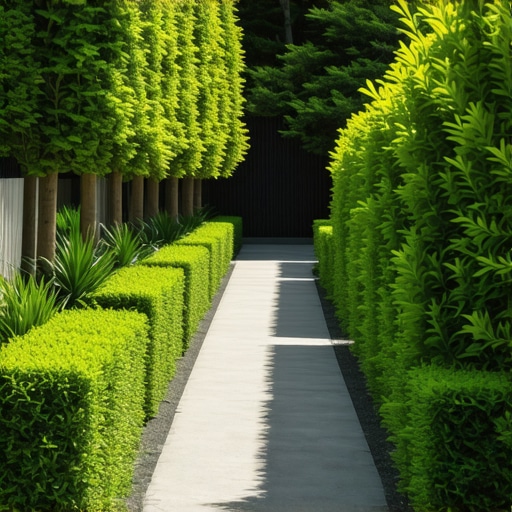
Selecting cultivars specifically bred for verticality and low-light photosynthesis ensures your narrow side yard remains functional and healthy without constant aggressive pruning. We are looking for ‘fastigiate’ or ‘columnar’ forms. These plants naturally grow up, not out, which is critical when you only have 36 to 48 inches of planting width. In 2026, we are seeing a shift toward cultivars that handle the ‘urban heat island’ effect better while maintaining deep shade tolerance.
| Hedge Species | Max Width | USDA Zone | Growth Rate | Soil Preference |
|---|---|---|---|---|
| Hicks Yew (Taxus x media) | 3-4 ft | 4-7 | Slow | Well-drained/Sandy |
| Sky Pencil Holly (Ilex crenata) | 2 ft | 6-9 | Medium | Slightly Acidic |
| Japanese Plum Yew (Cephalotaxus) | 3 ft | 6-9 | Slow | Moist/Loam |
| Dee Runk Boxwood (Buxus) | 2.5 ft | 5-8 | Slow | Neutral pH |
| Chestnut Hill Laurel (Prunus) | 4 ft | 6-9 | Fast | Adaptable |
1. Taxus x media ‘Hicksii’ (Hicks Yew)
This is the gold standard for structural shade. It is a biological tank. It handles heavy pruning and survives in deep, north-facing shadows. However, it hates ‘wet feet.’ If you have standing water, this plant will die in weeks. We always plant these on a slight mound—about 2 inches above the surrounding grade—to ensure the root flare stays dry.
2. Ilex crenata ‘Sky Pencil’
If you have a zero-lot-line situation, this is your plant. It stays naturally narrow, rarely exceeding 2 feet in diameter. It looks like a green exclamation point. The trade-off is its root system; it is sensitive to extreme cold in Zone 6 if the soil is too dry during winter. Water it deeply before the ground freezes.
3. Cephalotaxus harringtonia ‘Fastigiata’ (Japanese Plum Yew)
Think of this as the ‘deer-proof’ alternative to the standard Yew. It has a coarser texture and a deeper green hue. It thrives in the kind of shade where even moss struggles. We use this for high-end residential designs where the client wants a more ‘architectural’ look than a standard hedge. It is slow-growing. Be patient.
4. Buxus sempervirens ‘Dee Runk’
This is a columnar boxwood that actually stays columnar. Most boxwoods eventually bulb out at the base, but ‘Dee Runk’ maintains a tight vertical habit. It is more resistant to boxwood blight than older cultivars, but we still treat the soil with systemic fungicides if we’re in a high-humidity microclimate. Don’t crowd them; airflow is your best defense against blight.
5. Prunus laurocerasus ‘Chestnut Hill’
When you need a screen fast, this is the one. Unlike the ‘Otto Luyken’ which spreads wide, ‘Chestnut Hill’ is more compact. It has glossy, dark green leaves that reflect what little light reaches the side yard, brightening the space. It handles salt spray well if you’re near the coast, but it can be susceptible to ‘shot hole’ fungus if you use overhead irrigation. Use drip lines only.
“Standard nursery stock often arrives with a 3-inch layer of excess soil over the root flare; if you plant it at that depth, the bark will eventually decay and the vascular system will fail.” – International Society of Arboriculture (ISA) Best Practices
The Installation Process: Engineering the Root Zone
Properly excavating a continuous trench rather than individual holes prevents the ‘pot-bound’ effect and encourages lateral root expansion across the entire hedge line. When you dig individual holes in heavy clay, you create underground buckets that collect water and drown the plant. A continuous trench, amended with 10% high-quality leaf compost, creates a ‘highway’ for roots. We don’t use more than 10% amendments; we want the roots to adapt to the native soil, not become dependent on a pocket of potting mix.
How wide should a hedge trench be?
A hedge trench should be at least twice the width of the root ball to allow for uncompacted soil expansion, but the depth must never exceed the height of the root ball itself. Planting too deep is the number one cause of hedge failure I see. The root flare—where the trunk widens into the roots—must be visible at the soil surface. If it’s buried, the tree is suffocating. Don’t do it.
- Check the Grade: Ensure water moves away from the house.
- Trench Excavation: Dig 2x the width of the root balls.
- Scarify the Walls: Use a pickaxe to break up the smooth ‘glaze’ left by shovels in clay soil.
- Set the Height: Place plants so the root flare is 1-2 inches above the soil line.
- Backfill and Tamp: Use your hands or light foot pressure. The tamper should literally bounce off the compacted base, but don’t crush the roots.
- Initial Irrigation: Water heavily to remove air pockets, not just to wet the soil.
Post-Installation: The First 365 Days
Success in 2026 landscaping is about precision moisture management using smart irrigation controllers that account for the rain-shadow effect caused by your home’s roofline. In a narrow side yard, your hedge might stay bone-dry even in a thunderstorm because the eaves of the house block the rain. You cannot rely on nature here. Check the soil moisture 4 inches down with your finger. If it’s dry, water it. If it’s muddy, stop. Most people over-water their hedges into an early grave. It’s a balance of PSI and patience. Once the roots are established—usually after two full growing seasons—you can back off, but that first year is a contract between you and the plant. Don’t break it.