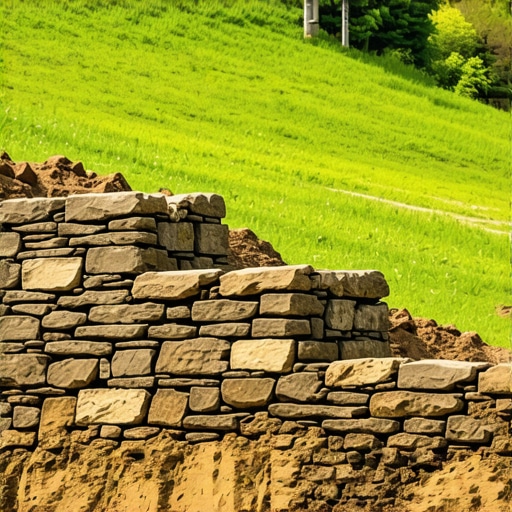
Stop Hillside Washouts with This Stacked Stone Trick
The Anatomy of a Hillside Failure: A Hardscape Autopsy
I recently got called out to tear up a $30,000 patio that was sinking because the previous contractor thought stacking heavy rocks was the same thing as engineering a slope. It wasn’t. The entire structure was leaning four inches out of plumb, and the base of the hill had turned into a literal soup of silt and 2B gravel. This happens when you ignore the invisible force: hydrostatic pressure. Most ‘mow-and-blow’ outfits see a hill and think about aesthetic tiers. I see a hydraulic piston of saturated soil waiting to punch through a decorative facade. To stop a washout, you don’t build a wall; you build a drainage system that happens to have a face. It is about managing the angle of repose and the sheer weight of water-logged earth.
The Secret of the Deadman Anchor Trick
Stopping a hillside washout requires the installation of ‘deadmen’—long, structural stones placed perpendicular to the wall face and buried deep into the hillside. This technique utilizes the weight of the hill itself to anchor the wall, preventing lateral earth pressure from causing a structural blowout during heavy rain.
How much modified gravel do I need for a patio base?
For a standard hillside retaining wall or patio, you need a minimum of 6 inches of 2A modified gravel for the base, plus enough to fill a 12-inch drainage chimney behind the wall. Calculation: (Length x Width x Depth in feet) / 27 = Cubic Yards. Don’t eyeball it. Use a calculator. If you are short by even half a ton, the compaction levels will suffer. Every inch of lift needs to be vibrated with a plate compactor to hit 95% Proctor density. Anything less is just loose rocks in a trench. I’ve seen 4-inch bases turn into mud because the installer skipped the vibratory plate. It will settle. It will fail.
| Material Type | Friction Coefficient | Drainage Rating | Primary Use Case |
|---|---|---|---|
| Fieldstone (Round) | Low | Medium | Decorative edging only |
| Angular Stacked Stone | High | High | Structural hillside retention |
| Timber/Sleepers | Medium | Low | Low-traffic, 5-year lifespan |
| Concrete Segmental Blocks | High | Medium | Engineered walls over 4ft |
“A retaining wall doesn’t fail because of the stone; it fails because of the water trapped behind it.” – Hardscape Engineering Axiom
The Science of Soil Displacement and Pore Pressure
When rain hits a slope, it doesn’t just sit there. It moves through the soil pores. If your stacked stone wall doesn’t have a clear exit path for that water, the pore pressure builds until it exceeds the friction holding the stones together. This is when the ‘washout’ occurs—often taking the lawn with it. I use 1-inch clean stone for the drainage backfill. Why? Because it has a higher void space than modified gravel. It allows water to drop vertically to the base drain before it can push against the wall face. Most contractors use dirt as backfill. That is pure negligence. Dirt expands when wet; clean stone does not. You are fighting physics, and physics never takes a day off.
Is dry stack stone better than concrete for hillsides?
Dry stack stone is superior for most residential hillsides because it is inherently flexible and permeable. Unlike rigid concrete which cracks under the stress of the freeze-thaw cycle, dry stack stone can shift slightly and ‘self-heal’ without losing structural integrity. It allows water to weep through every joint rather than forcing it to a single failure point. I’ve seen concrete walls snap like toothpicks because the weep holes got clogged with clay. A dry stack wall is a living filter. Use it.
The Hardscape Inspection Checklist for Hillside Stability
- Verify Base Depth: Minimum 6 inches of compacted 2A modified gravel below the frost line.
- Check the Batter: The wall should lean back into the hill at a 1:6 ratio (1 inch back for every 6 inches of height).
- Identify Deadmen: Ensure one anchor stone is placed every 4-6 linear feet in the middle courses.
- Drainage Tile: A 4-inch perforated PVC pipe (SDR-35) must be daylighted at the ends of the wall.
- Geotextile Separation: Use a non-woven filter fabric to keep silt from clogging your clean stone drainage chimney.
“Soil stabilization on slopes requires an understanding of the internal friction angle; ignoring this leads to catastrophic shear failure.” – Agricultural Engineering Handbook
Soil Mechanics: Why Your Grass Can’t Save the Slope
People think planting some Kentucky Bluegrass will stop a hill from sliding. It won’t. Turf grass roots only penetrate about 3 to 6 inches deep. That is a surface-level band-aid for a deep-tissue problem. If the soil pH is off or the compaction is too high, those roots won’t even go that deep. You need deep-rooted native perennials and shrubs to knit the subsoil together. But even then, the biology is secondary to the civil engineering. You have to grade the area to move water away from the toe of the slope. If water pools at the bottom of your stacked stone wall, it saturates the base and turns the ‘hard’ scape into a ‘soft’ scape. Use a transit level. Verify your percentages. A 2% grade is the bare minimum for drainage. Do not guess. If you see standing water, you’ve already lost the battle. The ‘trick’ is simply respecting the volume of water your property sheds during a 100-year storm event. Build for the flood, not the drizzle. It is expensive to do it right, but it is twice as expensive to do it twice.
![Build a $200 Modern Trellis for 2026 Privacy [DIY]](https://lawnmajesty.com/wp-content/uploads/2026/06/Build-a-200-Modern-Trellis-for-2026-Privacy-DIY.jpeg)
![Build a $500 Timber Retaining Wall [Step-by-Step]](https://lawnmajesty.com/wp-content/uploads/2026/09/Build-a-500-Timber-Retaining-Wall-Step-by-Step.jpeg)