Stop 2026 Soil Erosion on Slopes with Jute Matting
I always drill into my new crew members: if you don’t fix the soil grading and mechanical stabilization first, every plant you put in the ground is just expensive compost waiting to wash into the storm drain. I remember a job back in ’08 where a homeowner spent twelve grand on nursery stock for a 35-degree incline, only to watch it all slide into their neighbor’s pool after a three-inch rain event. They didn’t listen when I told them about the physics of shear strength. Gravity doesn’t care about your curb appeal. If you are planning for the 2026 growing season, you have to understand that erosion control isn’t just about covering dirt; it is about hydraulic management and structural reinforcement. Using jute matting is the standard for high-end landscaping because it works with biology, not against it.
The Physics of Slope Failure and the Jute Intervention
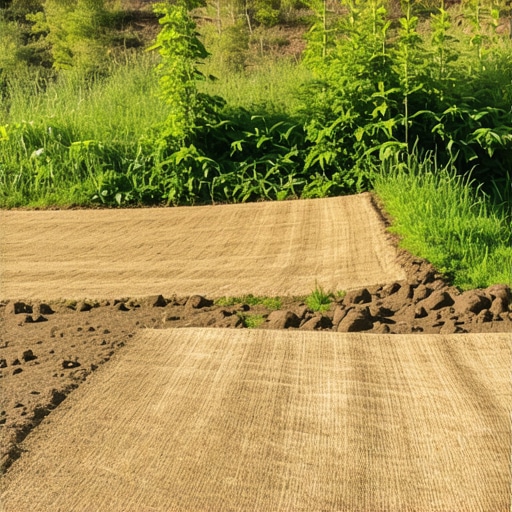
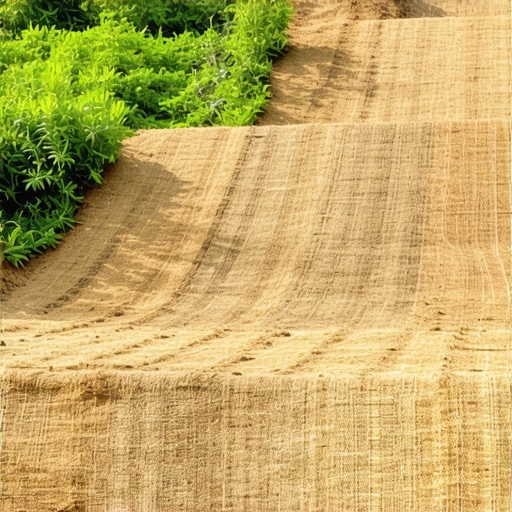
Soil erosion on slopes occurs when gravitational force exceeds the shear strength of the soil, usually triggered by hydrostatic pressure and surface runoff. Jute matting provides immediate mechanical stabilization by increasing surface roughness, which breaks the velocity of sheet flow and prevents rill formation while vegetation establishes. Unlike plastic netting, jute is an organic geotextile that integrates into the soil profile as it decomposes.
When rain hits bare soil, it acts like a hammer, dislodging particles. On a slope, those particles move downhill instantly. Jute mesh creates thousands of micro-dams. These dams catch sediment and hold it in place. This isn’t just theory; it’s civil engineering applied to your backyard. You need to look at the slope as a structural challenge. The angle of repose for most loose soils is around 30 to 45 degrees. Anything steeper requires serious mechanical intervention. Jute is your first line of defense.
“A retaining wall doesn’t fail because of the stone; it fails because of the water trapped behind it, and slopes are no different—saturated soil without reinforcement is essentially a liquid.” – Hardscape Engineering Axiom
How much jute matting do I need for a 1:2 slope?
Calculating the total surface area of a slope requires measuring the slope length (the hypotenuse) rather than the horizontal distance. For a 1:2 slope, you must factor in a 15% overlap margin for the jute rolls to ensure that water cannot find a path between the seams of the erosion control blanket.
The Ground-Up Build: Engineering the Slope
Most contractors fail because they treat jute like a carpet. It is not a carpet; it is a structural component. You start at the top. If you don’t anchor the top of the mat in a trench, the first heavy rain will simply flow underneath the matting, lifting it up and washing the seed away. We call this ‘piping’ and it’s the mark of a hack job. You need a 6-inch deep by 6-inch wide anchor trench at the crest of the hill. You lay the top of the jute in that trench, staple it every foot, and then backfill it with compacted soil.
| Material Type | Longevity (Months) | Best Use Case | Biodegradability |
|---|---|---|---|
| Standard Jute Mesh | 12-24 | Moderate Slopes (2:1) | 100% Organic |
| Coir (Coconut) Fiber | 36-48 | High-Flow Areas | Slow Decomposition |
| Straw Blankets | 6-10 | Flat Areas/Lawn Repair | Fast Decomposition |
| Synthetic Turf Reinforcement | Permanent | Extreme Grades | Non-Biodegradable |
While the internet tells you to just roll the matting out, the professional reality is that you must prepare the seedbed to a specific texture. You want a firm, not compacted, surface. Use a heavy rake to create horizontal grooves. These grooves catch seed. If the soil is too smooth, the jute won’t have anything to ‘bite’ into. Soil pH should be tested before the mat goes down. If you need to add lime to raise the pH from 5.5 to 6.5, do it before you roll the jute. You won’t get a second chance once the mesh is pinned down.
Installation Protocol: The Staple Pattern and Overlaps
The secret is in the staples. We use 11-gauge steel staples, at least 6 inches long. If you’re working in sandy loam, you better use 12-inch staples or they’ll pull right out. You need a ‘U’ pattern. Don’t be stingy. We typically use 2 to 3 staples per square yard on the face of the slope and double that at the seams. Every seam must overlap by at least 4 to 6 inches, with the uphill piece over the downhill piece. This is ‘shingling.’ It ensures water flows over the transition instead of under it.
- Trenching: Dig a 6×6 inch anchor trench at the top of the slope.
- Seeding: Apply high-quality, deep-rooted native seed mixes before laying the mat.
- Stapling: Drive staples flush with the soil surface. High staples catch mower blades.
- Check: Ensure 100% soil-to-mat contact. Air pockets are the enemy.
What is the best staple pattern for erosion control?
The optimal staple density for slope stabilization is a staggered diamond pattern, with staples spaced every 18 to 24 inches. On critical grades, increase the density to one staple every square foot to prevent mat tenting, which allows hydrostatic pressure to build underneath the jute fibers.
“Effective erosion control blankets must maintain intimate contact with the soil to prevent water from flowing beneath the liner, which can cause subsurface scouring.” – Penn State Agricultural Extension
The Biological Advantage: Mycorrhizae and Carbon
Here is a piece of data the big-box stores won’t tell you: Jute is a carbon source. As it breaks down over 18 to 24 months, it feeds the microbial life in your soil. Specifically, it encourages the growth of mycorrhizal fungi. These fungi form a symbiotic relationship with plant roots, effectively extending the root system’s reach. This creates ‘glomalin,’ a natural protein that acts as a soil glue. By the time the jute has rotted away, the biological glue and the root mass have taken over the work of the matting. This is the difference between a landscape that lasts and one that fails in three years.
Do not use ‘photo-degradable’ plastic netting. It’s garbage. It breaks down into micro-plastics that kill soil health and tangles up in your weed whacker. Jute is superior because it becomes the soil. It adds organic matter. In a typical 1000-square-foot application, you’re adding roughly 100 pounds of organic fiber to the topsoil as it degrades. That is a massive boost to your soil structure.
The 2026 Maintenance Horizon
Don’t walk away after the staples are in. The first 90 days are critical. You need to inspect the matting after every major rain event. Look for ‘washouts’ or areas where the mat has lifted. If you see a void, fill it immediately with topsoil and re-staple. By 2026, the vegetation should be thick enough that you can’t even see the jute. If you see brown spots, it means your soil compaction was uneven. Core aerate the surrounding areas to ensure oxygen is reaching the roots. It will rot if you don’t manage the water. But it will rot into gold for your plants.
![Build a $250 Stone Retaining Wall [DIY 2026]](https://lawnmajesty.com/wp-content/uploads/2026/06/Build-a-250-Stone-Retaining-Wall-DIY-2026.jpeg)