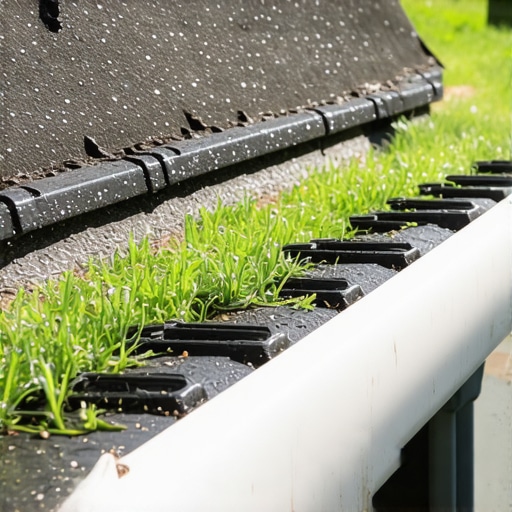
Stop 2026 Gutter Washout with These $30 Splash Blocks
The Anatomy of a Foundation Failure and the $30,000 Lesson
A gutter washout occurs when concentrated stormwater discharge erodes the soil adjacent to a foundation, leading to hydrostatic pressure buildup and structural instability. By using $30 splash blocks, you redirect this kinetic energy away from the load-bearing soil, preventing costly hardscaping failure and basement seepage. I recently got called out to tear up a $30,000 patio that was sinking because the previous contractor ignored a single downspout exit. The water had carved a subterranean void under the pavers, washing out the 21A modified gravel base. Over three years, the constant saturation liquefied the subgrade. The pavers didn’t fail because they were cheap; they failed because the soil beneath them became a slurry. This is why drainage is the first law of civil engineering in any backyard. If you don’t control the exit point of your gutters, you are essentially hydraulic mining your own foundation.
The Physics of Stormwater: Why Your Lawn is Losing the War
Stormwater velocity from a standard residential downspout can reach speeds of 10 feet per second during a heavy downpour, creating enough shear stress to displace several pounds of soil per minute. For every inch of rain that falls on a 1,000 square foot roof, approximately 623 gallons of water are funneled through your gutter system. When that volume hits a 4 inch downspout opening, it exits with significant kinetic energy. Without a splash block or a piped emitter, that water strikes the ground and initiates a process called scouring. This is not just about aesthetics. It is about the soil bulk density and the angle of repose of your landscape beds. When the soil becomes saturated beyond its field capacity, it loses its structural integrity. You aren’t just losing dirt; you are losing the compaction that holds your house still.
“A retaining wall doesn’t fail because of the stone; it fails because of the water trapped behind it.” – Hardscape Engineering Axiom
How much water comes off a roof during a storm?
To calculate your drainage load, multiply your roof square footage by 0.623 per inch of rainfall. A 2,000 square foot home produces 1,246 gallons of water in a single 1 inch rain event. This volume must be managed via splash blocks or subsurface French drains to avoid soil liquefaction near the footer. Most homeowners underestimate this volume until they see a 12 inch deep hole carved into their fescue by Monday morning. It is a simple matter of fluid dynamics. If you don’t provide a non-erodible surface for that water to land on, it will create its own path, usually toward your basement or under your walkway.
Comparing Splash Block Materials: Concrete vs. Polymer
Choosing between concrete splash blocks and high-density polyethylene (HDPE) versions involves evaluating durability, mass, and UV resistance. Concrete blocks offer the necessary weight to resist shifting during high-velocity discharge, while polymer options are easier to maneuver for lawn maintenance.
| Material Type | Typical Weight | Service Life | Primary Benefit |
|---|---|---|---|
| Pre-cast Concrete | 25 to 40 lbs | 15+ Years | Mass resists movement in storms |
| Recycled Plastic | 2 to 5 lbs | 5 to 8 Years | Easy to move for mowing |
| Natural Stone | 50+ lbs | Indefinite | Aesthetic integration |
| Composite Resin | 8 to 12 lbs | 10 Years | Balance of weight and cost |
Concrete is king for permanent installs. Plastic is for people who like to move things every week. If you choose the lightweight plastic versions, you must anchor them. A 5 pound plastic block will float away in a 3 inch rain event, leaving your soil exposed at the exact moment it needs protection most. I prefer heavy architectural concrete with a textured surface to break up the water flow.
How far should splash blocks extend?
A standard splash block should be at least 24 inches long and placed on a 2% downward slope to ensure positive drainage. In areas with heavy clay soils, which have low percolation rates, you may need to extend the discharge point at least 5 feet from the foundation using a downspout extension before the splash block. The goal is to move the water past the backfill zone. The soil immediately surrounding your house was excavated and replaced during construction, meaning it is less compacted than the native soil further out. This backfill zone is a sponge. If you dump water into it, you are inviting a wet basement.
The Installation Blueprint: Grading and Soil Compaction
Proper splash block installation requires a level base of compacted screenings or gravel to prevent the block from sinking into the turf over time. Do not just drop the block on the grass. You need to excavate approximately 2 inches of soil, install a piece of geotextile fabric, and backfill with crushed stone before setting the block. This ensures that the water exiting the block doesn’t simply erode the ground underneath it. The block must be slightly wider than the downspout to catch all overspray. I have seen countless DIY jobs where the block is too narrow, and half the water misses the target, creating a trench right next to the block. It is a waste of 30 bucks if you don’t align it with the flow vector.
- Excavate: Remove 2 to 3 inches of soil in the shape of the block.
- Level: Use a torpedo level to ensure a 2% slope away from the house.
- Base: Add 1 inch of 3/4 inch clean stone or coarse sand.
- Set: Place the block and check for gaps between the downspout and the entry point.
- Secure: If using plastic, use 6 inch sod staples to pin it to the ground.
“Soil erosion is a quiet thief; by the time you see the damage, the structural cost is already in the thousands.” – USDA Soil Conservation Service Technical Manual
Soil Mechanics: Why Red Clay and Sandy Loam React Differently
The soil texture triangle dictates how you manage gutter runoff; expansive clays require much longer diversion distances than sandy loams due to their tendency to swell and exert lateral pressure on foundation walls. In a clay-heavy environment like Georgia or parts of the Midwest, water doesn’t soak in; it sits. This creates a saturated state where the soil loses all frictional strength. Conversely, in sandy soils, the water disappears quickly but can carry fine particles away, leading to piping erosion. Understanding your soil pH is irrelevant here; it is all about pore space and hydraulic conductivity. If you live in a high-clay area, your splash block is just the beginning. You likely need a pop-up emitter system tied into a 4 inch SDR-35 pipe. Stop thinking like a gardener and start thinking like a plumber. The yard is a series of pipes and basins.
The Maintenance Schedule: Year-Round Erosion Control
Maintaining your erosion control measures involves more than just looking at them; you must periodically check the grading and remove organic debris that can redirect water flow. Every spring and fall, inspect the splash blocks for settlement. If the back of the block has sunk, water will run back toward the foundation. This is a common failure point. Lift the block, add more crushed stone, and reset it. Also, check for thatch buildup at the end of the block. A thick layer of grass can act as a dam, backing water up the block and over the sides. Keep the discharge area clear of heavy mulch, which can wash away and clog your drainage swales. Use river rock (3 to 5 inch diameter) at the end of the splash block to further dissipate energy if you have a steep grade. It works. Don’t skip this. [IMAGE_PLACEHOLDER]