5 2026 Best Perennials for Sandy Coastal Soil
The Physics of Coastal Planting: Why Sand Requires Biological Engineering
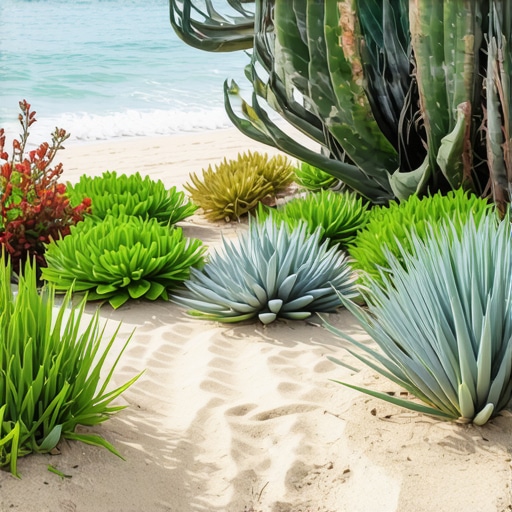
To succeed in sandy coastal environments, you must select perennials that exhibit halophytic traits and deep taproot systems. These plants must withstand osmotic stress from salt spray and nutrient leaching caused by high soil porosity. Professional garden design in 2026 prioritizes native cultivars that can survive in low Cation Exchange Capacity (CEC) environments without heavy chemical intervention.
I always drill into my new crew members: if you don’t fix the soil grading first, every plant you put in the ground is just expensive compost. I once saw a rookie crew install three dozen expensive perennials on a 15-degree slope leading toward a beach bulkhead. Within three months, the nitrogen had leached through the sand, the salt spray had desiccated the leaf cuticles, and the plants were literally starving in a desert of their own making. You have to respect the biology of the salt. Sand isn’t just ‘loose dirt.’ It is a collection of silica particles with almost zero ability to hold onto the positively charged ions that plants need for photosynthesis. If you treat a coastal yard like a suburban lot in the Midwest, you will fail every single time. It will rot or it will starve. Don’t skip the soil analysis.
“A retaining wall doesn’t fail because of the stone; it fails because of the water trapped behind it.” – Hardscape Engineering Axiom
1. Seaside Goldenrod (Solidago sempervirens)
Seaside Goldenrod is the backbone of the coastal perennial border due to its thick waxy cuticle which prevents desiccation from salt-laden winds. Unlike inland varieties, this species thrives in Zone 3-9 and handles direct aerosol salt spray without showing necrotic margins. It is a workhorse for erosion control on secondary dunes because its root architecture creates a dense mat that anchors shifting silica. Do not fertilize this plant with high-nitrogen synthetic blends; it will cause the stems to grow too tall and flop over. Let it find its own nutrients in the sub-grade. It is tough. It is resilient.
2. Blanket Flower (Gaillardia aristata)
Gaillardia is a chemical-defying perennial that thrives in high-pH sandy soils where other plants suffer from iron chlorosis. It is a short-lived perennial that makes up for its lifespan by self-seeding aggressively in open sand. In 2026 garden design, we use this for xeriscaping because it requires exactly zero supplemental irrigation once the root flare is established. Its primary enemy is hydrostatic pressure in the root zone; if the sand stays wet for more than four hours after a rain, the crown will rot. Keep it dry. Keep it in the sun.
3. Rattlesnake Master (Eryngium yuccifolium)
This is a civil engineer’s dream plant. With a taproot that can extend six feet into the ground, Rattlesnake Master is virtually impossible to kill via drought. Its glaucous, blue-green foliage reflects UV radiation, reducing the plant’s internal temperature during July heatwaves. In landscaping, we use this to provide structural verticality. Its architectural form doesn’t break under high coastal wind loads. It stands its ground when the gales hit. Plant it in groups of three for the best structural impact.
4. Little Bluestem (Schizachyrium scoparium)
While technically a grass, this perennial is essential for coastal hardscaping transitions. It provides the necessary friction to slow down wind-blown sand before it accumulates on your pavers. The 2026 ‘Blue Heaven’ or ‘Standing Ovation’ cultivars are preferred for their stiff stems that don’t lodge during tropical storms. The deep root system can penetrate compacted layers that would stop a spade. It is the ultimate stabilizer. It handles poor soil with ease.
5. Sea Thrift (Armeria maritima)
If you have a hardscape project involving a rock wall or a flagstone path near the shore, Sea Thrift is your primary ground cover. It grows in mounded tufts that mimic the appearance of moss but without the moisture requirement. It is highly salt-tolerant and can be planted directly in the gaps of a dry-stack wall where soil is minimal. It requires sharp drainage. If you see it turning yellow, check your soil for clay content; it hates heavy soil. It needs grit to survive.
“Soil texture and structure determine the availability of water and nutrients to the plant; in sandy coastal soils, the lack of colloidal particles means moisture management is the primary challenge.” – Texas A&M Agrilife Extension
How much modified gravel do I need for a patio base in sandy soil?
For a stable hardscaping install in coastal sand, you need a minimum of 6 to 8 inches of compacted #21A or #57 modified gravel. Because sand shifts under vibration, you must use a non-woven geotextile fabric between the sand and the gravel base to prevent the stone from sinking into the sub-grade over time.
What is the best fertilizer for coastal sandy gardens?
Avoid high-salt synthetic fertilizers which increase soil salinity. Instead, use slow-release organic meals or composted seaweed. Sandy soils have low CEC, meaning they cannot hold nutrients well; a slow-release approach ensures the perennials have a steady supply of minerals without the risk of chemical burn.
| Plant Name | Salt Tolerance | USDA Zone | Primary Benefit |
|---|---|---|---|
| Seaside Goldenrod | Very High | 3-9 | Dune Stabilization |
| Blanket Flower | High | 4-10 | Pollinator Support |
| Rattlesnake Master | Medium-High | 4-9 | Drought Resistance |
| Little Bluestem | High | 3-9 | Wind Break / Texture |
| Sea Thrift | Very High | 4-8 | Hardscape Infill |
The 2026 Coastal Installation Checklist
- Soil Testing: Check for pH levels above 7.5 and adjust with elemental sulfur if necessary.
- Grading: Ensure a 2% slope away from the foundation to prevent ponding in low spots.
- Root Flare: Never bury the crown of the perennial; planting too deep in sand causes stem rot.
- Mulching: Use 2 inches of shredded cedar; do not use pine bark nuggets as they float away in coastal floods.
- Irrigation: Set drip lines for 45 minutes twice a week to encourage deep rooting rather than surface growth.
Landscape success in the 2026 season isn’t about luck; it’s about respecting the hydrodynamics and soil chemistry of the coast. If you choose the right species and prepare the sub-grade with the precision of a foreman, your garden will survive the next hurricane. If you cut corners, the Atlantic will reclaim your work. Follow the science. Trust the dirt.