Why Your Hydrangeas Aren’t Blooming This Year
Why Your Hydrangeas Aren’t Blooming This Year: A Forensic Diagnostic
It is the most common call I get in July. A homeowner stands in front of a massive, 5-foot-tall wall of green foliage and asks why there isn’t a single flower head in sight. They’ve spent hundreds on ‘premium’ mulch and big-box store fertilizers, yet they are looking at a sterile landscape. As a landscaper with two decades in the dirt, I can tell you that a hydrangea that won’t bloom isn’t a mystery; it is a mechanical failure. It’s either a biological error, a structural mistake in pruning, or a chemistry problem in the soil. We don’t guess in this business. We diagnose based on the cultivar’s specific physiology and the environmental pressures of your specific lot.
I always drill into my new crew members: if you don’t fix the soil grading and understand the plant’s vascular system first, every plant you put in the ground is just expensive compost. I remember a job three years ago where a client had 40 Hydrangea macrophylla ‘Endless Summer’ plants that hadn’t bloomed in four seasons. They were ready to rip them out. I looked at the root flares—they were buried four inches too deep in heavy clay. The plants were literally suffocating, spending every ounce of ATP just trying to stay alive rather than producing reproductive buds. We didn’t add fertilizer; we excavated the root collars and adjusted the drainage. The following year, the yard was a sea of blue. That is the difference between a hack and a horticulturist.
Identifying the Cultivar: Why Species Dictates Bloom Success
The primary reason your hydrangeas fail to bloom is usually a mismatch between the species’ pruning requirements and your maintenance schedule. Different hydrangeas produce flowers on either old wood (growth from the previous season) or new wood (growth from the current spring), and cutting at the wrong time destroys the dormant flower buds before they can emerge.
You have to know what you are looking at. Hydrangea macrophylla (Bigleaf) and Hydrangea quercifolia (Oakleaf) set their buds in the late summer or fall. If you take a pair of loppers to them in March, you’ve just thrown your entire summer show into the green waste bin. Conversely, Hydrangea paniculata (Panicle) and Hydrangea arborescens (Smooth) bloom on new growth. You can prune these down to 12 inches in late winter, and they will still explode with white or lime-green cones because they build their flowers from scratch every spring. If you are treating every shrub in your garden design the same way, you are guaranteed to fail.
“Successful flower initiation in Hydrangea macrophylla is dependent on the cessation of vegetative growth and the onset of cooling temperatures in autumn, which triggers the development of terminal floral primordia.” – USDA Agricultural Research Service Manual
How do I know if my hydrangea blooms on old or new wood?
Check the stems in early spring before the leaves unfurl. If you see fat, green buds swelling on woody, gray stems that survived the winter, that is an ‘old wood’ bloomer. If the plant dies back completely to the ground or only shows growth from the base or very tips of new green shoots, it is likely a ‘new wood’ bloomer or a cultivar that has suffered severe winter kill. Do not prune until you see where the green begins. It will rot if you leave dead wood, but it will fail if you cut live tissue.
The Pruning Malpractice: Timing the Cut to 1/8th of an Inch
Pruning is a surgical intervention, not a haircut. Most homeowners prune for shape when they should be pruning for light penetration and air circulation. When you shear the top of a hydrangea to keep it ‘neat,’ you are removing the terminal buds. These buds contain the most concentrated levels of growth hormones and the pre-formed flower cells for the next season.
For old-wood bloomers, the window for pruning is incredibly narrow. You have about two weeks after the flowers fade in mid-summer to make your moves. Any later, and the plant has already begun the chemical process of setting next year’s buds. If you missed that window, put the shears down. I’ve seen ‘mow-and-blow’ crews scalp mophead hydrangeas in November to make the garden look ‘clean’ for winter. That is a $5,000 mistake in labor and lost aesthetic value. You are literally cutting off the plant’s reproductive organs. Stop it.
| Hydrangea Type | Bloom Wood | Optimal Pruning Window | Hardiness Zones |
|---|---|---|---|
| Bigleaf (Macrophylla) | Old Wood | Immediately after flowering | 6-9 |
| Panicle (Paniculata) | New Wood | Late Winter / Early Spring | 3-8 |
| Smooth (Arborescens) | New Wood | Late Winter | 3-9 |
| Oakleaf (Quercifolia) | Old Wood | Post-flowering (Late Summer) | 5-9 |
The Frost Factor and Winter Dieback
Winter kill is the silent killer of the blue hydrangea. Even if you don’t touch the plant with shears, a late spring frost or a brutal winter can kill the tender buds on old wood. In USDA zones 5 and 6, we often see the foliage survive, but the flower buds—which are less cold-hardy than the vegetative buds—die off at temperatures below zero degrees Fahrenheit.
This is where hardscaping and microclimates come into play. If you have your hydrangeas exposed to the north wind with no structural protection, those buds are going to desiccate. Heat from a stone retaining wall or the thermal mass of a brick house can sometimes provide the 3-5 degree difference needed to save those buds. If your hydrangeas aren’t blooming, look at the stems. If the tips are brittle and brown but the base is pushing green leaves, your buds froze. Use burlap wraps or move the plants to a protected southern exposure. Don’t skip this. A single night at 25 degrees in April can ruin a year of growth.
Nutritional Imbalance: The Nitrogen Overload
Your lawn care routine might be killing your flower display. High-nitrogen fertilizers (the kind used to make turf grass ‘pop’) encourage massive vegetative growth at the expense of floral development. Nitrogen (N) fuels the leaves; Phosphorus (P) fuels the flowers and roots. If you are broadcasting high-N lawn fertilizer right up to the drip line of your hydrangea beds, you are telling the plant to stay in a permanent state of adolescence.
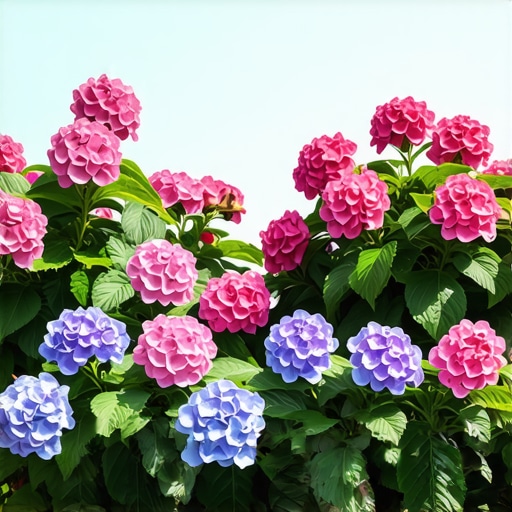
I see this in high-end landscaping all the time. The lawn looks like a golf course, and the hydrangeas look like giant green cabbages. To fix this, you need to transition to a fertilizer with a higher middle number (Phosphorus) and ensure your soil pH is correct. For Macrophylla, the pH doesn’t just change the color; it affects the plant’s ability to uptake specific micronutrients. A pH of 5.5 (acidic) gives you blue; 6.5 to 7.0 (neutral) gives you pink. But if the soil is too alkaline, the plant will suffer from iron chlorosis, turn yellow, and stop blooming entirely.
“Phosphate availability is severely limited in soils with high calcium carbonate content, often requiring targeted subsurface application to ensure floral induction in woody ornamentals.” – Penn State Agricultural Extension
How much water do hydrangeas need for consistent blooming?
Hydrangeas require approximately 1 inch of water per week, delivered deeply to the root zone. Surface sprinkling is useless. You need to saturate the soil to a depth of 8 to 12 inches to encourage the deep root structures that can support the heavy moisture demands of a blooming flower head. During the ‘dog days’ of August, when the flower buds for next year are forming, moisture stress will cause the plant to abort those buds to save itself. Use drip irrigation, not overhead sprays which invite powdery mildew. If the leaves wilt every afternoon, you are losing next year’s flowers today.
Seasonal Hydrangea Care Checklist
- March: Identify dead wood. Scratch the bark; if it’s green underneath, leave it alone. If it’s brown and brittle, prune it back to the first living bud.
- April: Apply a slow-release, balanced fertilizer (10-10-10) or one formulated specifically for acid-loving plants.
- May: Monitor for late frosts. Cover ‘old wood’ bloomers with frost blankets if temperatures dip below 32°F.
- June/July: Maintain consistent soil moisture. Mulch with 2-3 inches of aged arborist wood chips to regulate soil temperature.
- August: This is the critical window for next year’s buds. Do not allow the plant to go into drought stress.
- September: Stop all pruning. Let the plant harden off for winter.
Landscape success isn’t about luck. It is about understanding the biological requirements of the species you’ve installed. If your hydrangeas aren’t blooming, stop looking for a ‘magic spray.’ Check your pruning dates, test your soil pH, and look at your winter protection. The plant wants to bloom; you just have to stop getting in its way. Ground-up biology beats aesthetic guessing every time.