
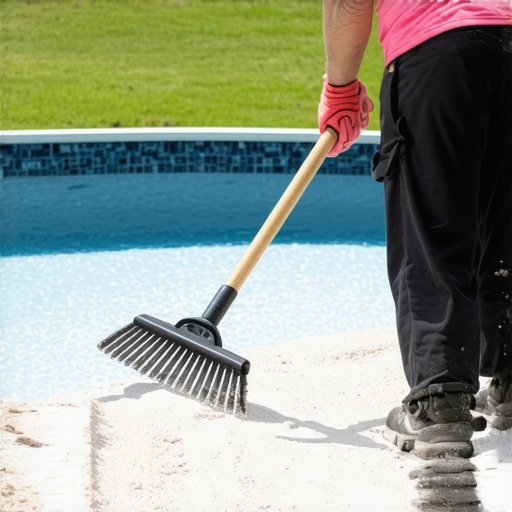
How to Level a 2026 Above-Ground Pool Base with Sand
The Engineering Reality of Above-Ground Pool Foundations
To level an above-ground pool base with sand, you must first remove all organic turf, excavate the native subgrade to a uniform depth, and establish a high-density structural perimeter using pressure-treated wood or concrete pavers. Masonry sand acts as a protective buffer for the liner, not as the primary structural support; the underlying soil must be compacted to a 95% Proctor density to prevent catastrophic settling under the weight of thousands of gallons of water.
I recently got called out to tear up a $30,000 patio that was sinking because the previous contractor didn’t understand the basics of hydrostatic pressure and soil compaction. They thought they could just dump four inches of sand over uncompacted topsoil and call it a day. Within six months, the entire structure had shifted three inches toward the neighbor’s retaining wall. The pool was leaning, the liner was stressed to the point of tearing, and the surrounding hardscaping was ruined. This is what happens when you treat soil like a static surface rather than a living, shifting engineering material. If you don’t fix the soil grading first, every pound of sand you put in the ground is just expensive dust that will eventually wash away.
“A pool foundation doesn’t fail because of the liner; it fails because of the water-saturated soil and poor compaction beneath the base layer.” – Hardscape Engineering Axiom
The Physics of Water Weight on Soil
An average 24-foot round pool holds approximately 13,500 gallons of water. At roughly 8.34 pounds per gallon, you are looking at over 112,000 pounds of weight concentrated on a single patch of your yard. If your leveling job is off by even one inch across the diameter, the pressure on the ‘low’ side of the pool wall increases exponentially. This is why we don’t just ‘fill’ low spots with sand. Sand is a non-cohesive material; it has high compressive strength when confined but zero shear strength. If the native soil underneath isn’t perfectly level and compacted, the sand will simply migrate to the lowest point, causing the liner to wrinkle and the pool frame to buckle.
| Material Type | Best Use Case | Compaction Rating | Drainage Capability |
|---|---|---|---|
| Masonry Sand | Liner protection buffer | Low (Non-structural) | High |
| Concrete Sand | Base for heavy pavers | Medium | Moderate |
| Crushed Limestone (21A) | Structural sub-base | Extreme (Mechanical) | Low |
| Stone Dust | Leveling small voids | High | Minimal |
How much modified gravel do I need for a patio or pool base?
For a standard above-ground pool base, you should calculate your needs based on a 4-inch structural sub-base and a 2-inch sand finish layer. To find the volume, multiply the total square footage of the pool area (plus a 1-foot buffer) by the depth in feet. For example, a 24-foot pool has a 452-square-foot footprint; at a 4-inch depth, you will need approximately 5.5 cubic yards of material. Never guestimate this. Use a laser level. Don’t rely on a 4-foot bubble level for a 20-foot span. The margin of error is too wide. [IMAGE_PLACEHOLDER]
Phase 1: Excavation and Subgrade Preparation
Start by marking your circle one foot wider than the pool’s actual diameter. Use a sod cutter to remove every blade of grass and all root mats. Grass decays. Decay creates voids. Voids create sinkholes. Once you are down to the raw subsoil—usually clay or till in most regions—you must use a plate compactor. A hand tamper won’t cut it for a 112,000-pound load. You need mechanical vibration to force the air out of the soil.
- Remove all organic matter (grass, roots, twigs).
- Check for underground utility lines (Call 811 before you dig).
- Use a transit or laser level to identify the lowest point of the site.
- Always dig down the high side to meet the low side; never build up the low side with loose dirt.
“Uniform compaction of the subgrade is the single most critical factor in preventing differential settlement in residential hardscape applications.” – ICPI Tech Spec No. 2
Phase 2: Setting the Perimeter and Screeding Sand
Once the ground is level and hard as concrete, place 12×12 inch concrete pavers under every vertical support post of the pool frame. These pavers must be recessed so they are flush with the compacted soil. Now comes the sand. Use masonry sand because it is washed and screened; it won’t contain pebbles that could puncture a 2026-spec vinyl liner. Lay down 1-inch diameter PVC pipes across the area to act as screed rails. Dump the sand between the pipes and use a straight 2×4 board to ‘saw’ the sand flat across the rails. This ensures a perfectly uniform 1-inch thickness.
Can I just use sand without excavating?
No. This is the most common mistake DIYers make. If you dump sand over grass, the grass will die and rot, causing the sand to shift. Furthermore, sand has no ‘angle of repose’ when wet; it will wash out from under the pool rails during a heavy rainstorm if it isn’t contained within an excavated pit or a solid border. It will fail. Every time. It’s not a matter of if, but when.
Maintenance and The Settling Period
After the pool is filled, the sand will compress slightly. This is normal. However, you must monitor the perimeter for ‘washouts.’ If you see sand bleeding out from under the bottom rail, you have a drainage issue. You need to install a decorative stone border (like river rock) around the outside of the pool to break the fall of rainwater coming off the top rail. This prevents the ‘trenching’ effect that undermines the sand base. Stop listening to the big-box store guys who tell you a bag of weed-and-feed and some loose sand is a pool foundation. It’s engineering. Treat it like that.
{“@context”:”https://schema.org”,”@type”:”HowTo”,”name”:”How to Level a 2026 Above-Ground Pool Base with Sand”,”step”:[{“@type”:”HowToStep”,”text”:”Excavate the site to the lowest point by removing all sod and organic material.”},{“@type”:”HowToStep”,”text”:”Compact the native subgrade using a mechanical plate compactor until it reaches 95% density.”},{“@type”:”HowToStep”,”text”:”Install concrete pavers flush with the ground at every vertical support location.”},{“@type”:”HowToStep”,”text”:”Spread 1-2 inches of masonry sand using screed pipes to ensure a perfectly level surface.”}],”totalTime”:”P1D”}
![Build a $250 Gravel Shed Base [2026 No-Slab Fix]](https://lawnmajesty.com/wp-content/uploads/2026/05/Build-a-250-Gravel-Shed-Base-2026-No-Slab-Fix.jpeg)
![Building a 2026 Modern Wood Fence [Budget DIY]](https://lawnmajesty.com/wp-content/uploads/2026/09/Building-a-2026-Modern-Wood-Fence-Budget-DIY.jpeg)