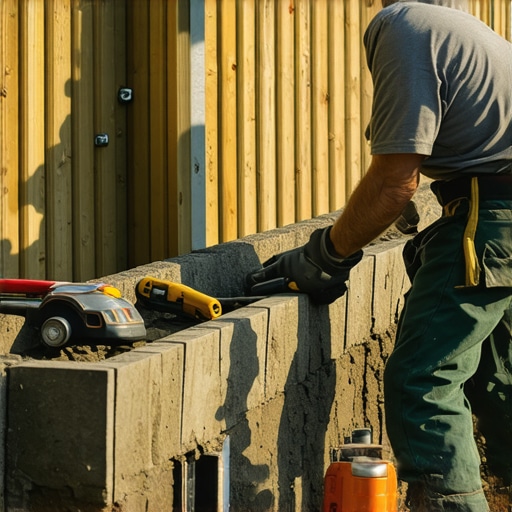
Fix Your 2026 Sinking Retaining Wall for $150
Identifying the Symptoms of Structural Wall Failure
A sinking or leaning retaining wall is caused by hydrostatic pressure, inadequate base compaction, or poor soil grading that allows water to saturate the foundation. To stop the failure, you must divert water away from the wall’s heel using French drains or swales, costing approximately $150 in raw materials like PVC and aggregate. Neglect leads to total collapse.
I have spent twenty years staring at failed masonry and modular block systems. Usually, I am the guy who gets paid $25,000 to bring in the excavator and haul away the wreckage of a DIY disaster. You see it first in the joints. A hairline crack in the mortar or a 1/4 inch gap between dry-stack blocks isn’t just cosmetic. It is the wall screaming that the earth behind it is heavier than the stone can hold. When soil becomes saturated, it gains weight and loses its internal friction. This creates a lateral load that pushes against the back of your wall. If you see ‘weeping’—muddy water leaking through the face of the stone—the system is already failing. It will fall. Don’t wait for a rainy Tuesday to find out when.
The Forensic Autopsy: Why $30,000 Patios Sink
I recently got called out to tear up a $30,000 patio that was sinking because the previous contractor used ‘clean’ sand as a base instead of a properly graded 21A or 411 crushed limestone. They ignored the 95 percent Proctor density requirement. Within two years, the hydrostatic pressure from a misdirected downspout turned the sub-base into a slurry. The entire 800 square foot installation settled four inches toward the foundation of the house. This wasn’t a material failure; it was an engineering failure. The contractor didn’t understand that water is the primary enemy of every hardscape project. They saved $200 on a drainage pipe and cost the homeowner thirty grand.
“A retaining wall doesn’t fail because of the stone; it fails because of the water trapped behind it.” – Hardscape Engineering Axiom
In the world of professional landscaping, we look at the ‘angle of repose.’ This is the steepest angle at which a sloping surface formed of loose material is stable. When you build a wall, you are artificially altering that angle. If your soil is heavy clay, common in the Midwest and South, it holds water like a sponge. That water weight increases the pressure on your wall by 62.4 pounds per cubic foot. If your wall is 4 feet tall and 20 feet long, you are looking at tons of force pushing outward. Without a 12 inch chimney of 57 stone (clean crushed gravel) behind the blocks, that pressure has nowhere to go but through your wall.
Can a Sinking Retaining Wall Actually Be Fixed for $150?
Fixing a sinking retaining wall for $150 is possible if the failure is in its early stages and caused by localized water saturation. By spending $150 on SDR-35 perforated pipe, non-woven geotextile fabric, and 3/4 inch clean stone, you can redirect the water causing the soil to settle. This stops the sinking process before structural collapse occurs.
| Material | Quantity | Estimated Cost | Purpose |
|---|---|---|---|
| SDR-35 Perforated Pipe | 20 Linear Feet | $45.00 | Main water transport |
| 3/4 Inch Clean Crushed Stone | 1.5 Tons | $65.00 | Drainage backfill |
| Non-Woven Geotextile | 1 Roll (Small) | $30.00 | Preventing soil migration |
| Pop-up Emitter | 1 Unit | $10.00 | Safe water exit point |
The goal here isn’t to jack the wall back up. Once a wall has settled, ‘lifting’ it is rarely successful without a total teardown. However, you can stop the bleeding. The $150 budget goes entirely into water management. You are going to dig a trench exactly 12 inches behind the wall. This trench must be deeper than the current base of the wall. You will line this with your geotextile fabric. Do not use the cheap ‘weed barrier’ from a big-box store. It will clog in six months. Use a professional-grade non-woven fabric that allows water through but stops silt. If silt gets into your gravel, your drainage system is dead. It will rot the structural integrity of the wall from the inside out.
How much modified gravel do I need for a patio base?
For a standard residential patio, you need a minimum of 6 inches of compacted 21A modified gravel. To calculate the tonnage, multiply the square footage by the depth in feet, then multiply by 0.05 to get the approximate tons needed. For a 100 square foot area at 6 inches deep, you need 2.5 tons. Do not skimp on this. Use a plate compactor every 2 inches of ‘lift.’ If you throw 6 inches of gravel in a hole and run a tamper over the top, the bottom 4 inches will stay loose. It will settle. Your pavers will dip. You will be angry.
How do you stop a retaining wall from leaning?
To stop a wall from leaning, you must remove the ‘surcharge load’ or the water pressure behind it. This involves excavating the soil behind the wall and replacing it with ‘clean stone’ that doesn’t hold water. You also need to ensure the wall has ‘batter,’ which is a slight backward lean into the slope. A wall that is perfectly vertical is already halfway to falling over. Professional blocks are often manufactured with a lip or a setback to ensure a 1-inch batter for every 1-foot of height. If your wall is leaning out, the only permanent fix is to remove the pressure or install soil anchors (deadmen), though anchors are difficult to do for $150.
The Step-by-Step Drainage Remediation (The $150 Protocol)
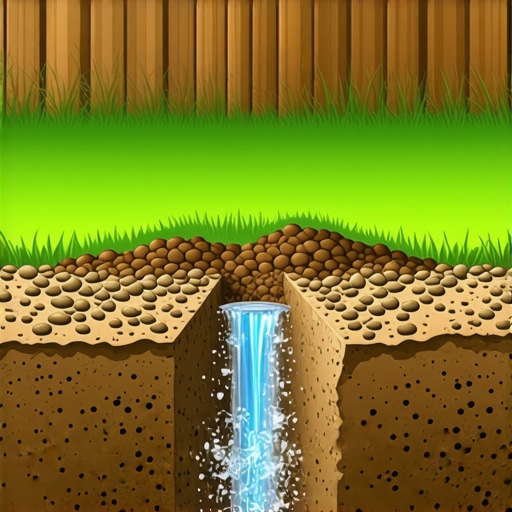
First, identify the low point. Water follows gravity. If your wall is sinking in the middle, that is where the water is pooling. You need to dig a ‘trench drain’ behind the wall. This is labor-intensive, but the materials are cheap. You are going to install a perforated pipe wrapped in a ‘sock’ of geotextile. The holes in the pipe must face down. This sounds counterintuitive to many DIYers. However, water rises into the pipe from the bottom; if the holes face up, the pipe just fills with silt and fails. Put the holes at the 4 o’clock and 8 o’clock positions.
“Saturation of the retained soil mass reduces the shear strength of the soil and increases the lateral earth pressure exerted on the wall.” – Penn State Agricultural Extension, Engineering Division
Second, manage your surface water. Look at your gutters. Are they dumping water within 10 feet of the wall? If so, you are killing your masonry. For $20, you can buy a solid PVC extension to move that water 20 feet away. This is the single most effective way to save a wall. Third, check the ‘toe’ of the wall. The toe is the bottom front. If soil has eroded away from the base, the wall will ‘kick out.’ For the cost of a few bags of heavy clay soil or some decorative rip-rap stone, you can reinforce the toe. Pack it tight. Use a hand tamper. A wall is only as strong as the dirt it sits on. Don’t let the foundation get mushy.
- Inspect the wall during a heavy rainstorm to see exactly where water exits.
- Ensure all downspouts are piped at least 10 feet away from the wall’s backfill zone.
- Clear any debris or weeds from existing weep holes using a stiff wire.
- Check for ‘sinkholes’ appearing in the lawn behind the wall—this indicates soil piping.
- Add a layer of decorative stone or mulch with a slope of 1 inch per foot away from the wall top.
- Never use ‘dirt’ as backfill; always use clean, angular crushed stone.
- If the wall has moved more than 2 inches out of plumb, consult a structural engineer.
- Ensure your French drain has a ‘daylight’ exit point or a dry well.
- Avoid planting large trees with aggressive root systems within 5 feet of the wall.
- Seal the top cap of the wall with a professional masonry adhesive to prevent water entry.
Remember, soil pH and biology matter too. If you have dead grass behind your wall, the soil is more likely to erode. Healthy turf with deep roots helps stabilize the top layer of soil, reducing the amount of water that permeates into the backfill. However, do not over-water the lawn near the wall. Turf grass needs exactly 1 inch of water per week. If you are running your irrigation for 30 minutes every morning, you are effectively a slow-motion flood for your retaining wall. Stop it. Force those roots to chase water deep into the ground. It makes the lawn tougher and the wall safer. Engineering and biology work together. If you ignore one, the other will fail you.
The 10-Point Wall Health Audit
Perform this audit every spring. Look for ‘efflorescence’—that white, salty powder on the stones. It is a sign of water moving through the material. Check for ‘shingling’ where blocks are sliding over each other. Use a 4-foot level to check the plumb. If the bubble is off-center, mark the spot and check again in three months. If the movement is active, your $150 window is closing. Fast. Hardscaping is not ‘set it and forget it.’ It is a battle against gravity and fluid dynamics. You either win by being smarter than the water, or you lose by being lazier than the rain. Buy the pipe. Dig the trench. Save the wall.