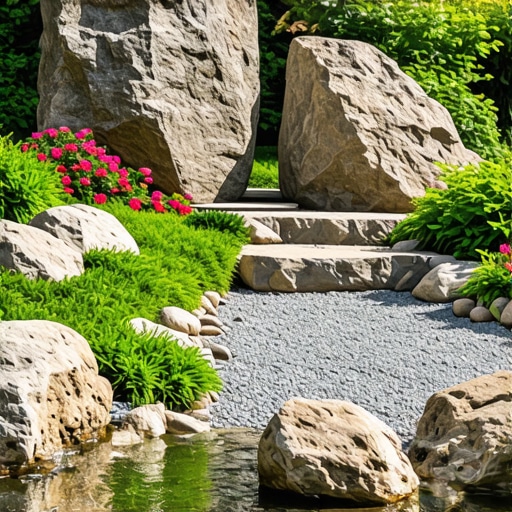
Building a 2026 Dry Creek Bed for Rainwater Runoff
Why Build a Dry Creek Bed for Rainwater Runoff?
A dry creek bed is a precision-engineered drainage swale designed to direct stormwater runoff away from structures using a graded channel lined with non-woven geotextile fabric and graded river rock. This system mitigates soil erosion and manages hydrostatic pressure during intense 2026 rainfall patterns. It is not a decoration; it is a hydraulic tool.
I recently got called out to tear up a $30,000 patio that was sinking because the previous contractor thought a dry creek bed was just a pile of pretty rocks on top of the mud. Within two seasons, the fines from the soil had migrated up into the stone, clogging the drainage, and the water backed up right under the patio footer. The whole thing was a $30,000 lesson in why engineering matters. If you don’t manage the sub-grade, the water will manage it for you. It will move your dirt, it will lift your pavers, and it will flood your basement. Water always wins. My job is to make sure it wins on my terms.
“A retaining wall doesn’t fail because of the stone; it fails because of the water trapped behind it.” – Hardscape Engineering Axiom
The Physics of Surface Water Flow
Before you move a single shovelful of dirt, you must understand the hydrology of your site. Most residential lots fail because they ignore the 1-2% minimum slope required for positive drainage. In a 2026 climate landscape, we are seeing higher-intensity, shorter-duration rain events. This means your creek bed must handle a higher cubic-feet-per-second (CFS) flow than what was standard ten years ago. We calculate the drainage basin size—every square foot of roof, driveway, and compacted lawn that sheds water—to determine the required depth and width of the channel.
How deep should a dry creek bed be for 2026 runoff?
For most residential applications, a dry creek bed should be excavated to a depth of 12 to 18 inches to allow for base material and rip-rap. This depth ensures the water remains below the surface grade, preventing lateral soil saturation and protecting nearby landscape foundations. Don’t go shallow. Shallow beds overflow.
| Material Component | Specification | Purpose |
|---|---|---|
| Geotextile Fabric | 4-oz Non-Woven | Separation and Filtration |
| Base Stone | #57 Crushed Granite | Structural Stability |
| Core Stones | 2-4 inch River Jack | Water Dissipation |
| Anchor Boulders | 12-18 inch Fieldstone | Bank Stabilization |
The Step-by-Step Engineering Process
The process begins with a layout that mimics natural topography. Nature doesn’t move in straight lines, and neither should your runoff. We use marking paint to trace a meandering path. We excavate a parabolic trench—not a V-shape. A V-shape concentrates energy at the bottom and undermines the banks. A parabola spreads the weight of the water. Excavate deep. Remove the root balls of any invasive species. Compact the sub-grade to at least 95% Standard Proctor density if you’re near a structure. Don’t skip the tamper.
Next comes the fabric. Use non-woven needle-punched geotextile. Do not use that cheap plastic woven stuff from a big-box store. It will slide, it won’t filter, and it will eventually surface like a ghost. Lay the fabric with at least 12 inches of overlap at the seams. Pin it down with 6-inch steel staples. This is your filter. It keeps the dirt out of your rocks. If dirt gets in, weeds grow. It’s that simple.
“Effective drainage design must prioritize the separation of native sub-soils from hydraulic structural layers to prevent clogging and frost heave.” – Penn State Agricultural Extension
What is the best stone for a high-flow dry creek bed?
The best stone for a high-flow dry creek bed is a mix of smooth river rocks for the bed and angular rip-rap or boulders for the banks. Use 3-inch to 8-inch stones for the center to break up water velocity, and 12-inch+ boulders at the curves where centrifugal force hits the hardest. Smooth stones look better, but angular stones lock together. Use both.
Critical Maintenance and 2026 Realities
Maintenance isn’t optional. Every autumn, you must clear debris. Leaves rot and turn into compost. Compost becomes soil. Soil becomes a bed for weeds. Use a leaf blower on a low setting. Check the ‘outfall’ point—where the water leaves the creek. If that area isn’t armored with larger stone, you’ll just create a new erosion problem for your neighbor. Don’t be that guy. Keep your outfall clear. Check for ‘piping’—where water finds a way under your fabric. If you see a hole, plug it immediately with bentonite clay or more stone.
- Check slope with a laser level before laying stone.
- Ensure the creek bed terminates at a legal discharge point.
- Avoid ‘mulch volcanoes’ near the edges of the bed.
- Use native plants like sedges or switchgrass to anchor the banks.
![Why Your 2026 Retaining Wall is Leaning [3 Fixes]](https://lawnmajesty.com/wp-content/uploads/2026/06/Why-Your-2026-Retaining-Wall-is-Leaning-3-Fixes.jpeg)