![Stop Raking Your 2026 Leaves [Nutrient Hack]](https://lawnmajesty.com/wp-content/uploads/2026/07/Stop-Raking-Your-2026-Leaves-Nutrient-Hack.jpeg)
Stop Raking Your 2026 Leaves [Nutrient Hack]
The Forensic Autopsy of a Sterile Soil Profile
Soil nutrient depletion and microbial collapse occur when homeowners strip every ounce of organic matter from their turf during the fall cycle, leading to a reliance on synthetic fertilizers that eventually burn the rhizosphere and kill off beneficial earthworms.
I recently got called out to a job where a homeowner had spent a decade meticulously vacuuming every leaf off his two-acre property. He was proud of his ‘clean’ lawn. But when I took a soil probe and drove it into his turf, the results were pathetic. The soil was a gray, compacted slab of lifeless clay with a bulk density of nearly 1.6 g/cm3. There was no pore space, no humus, and his cation exchange capacity (CEC) was in the basement. He had essentially turned his backyard into a biological desert. He couldn’t understand why his grass was yellowing despite throwing $800 of nitrogen at it every spring. The answer was simple: his soil was dead because he had been throwing the fuel in the trash for ten years. It was a chemical nightmare. Every time he applied a quick-release urea, he was just salting the earth because there was no organic carbon left to buffer the reaction.
“Returning leaf litter to the soil profile is not merely a disposal method; it is a critical input of organic carbon that supports the microbial biomass necessary for nitrogen cycling in cool-season turfgrasses.” – Penn State Extension Agronomy Manual
How much nitrogen is in fallen leaves?
Fallen leaves contain approximately 0.5 to 1.0 percent nitrogen, along with essential phosphorus, potassium, and micronutrients that trees have pulled from deep within the subsoil. When you mulch these leaves back into the turf, you are essentially recycling a free fertilizer application that would otherwise cost $50 to $100 in bagged product per acre. This is a closed-loop system. Most deciduous leaves have a carbon-to-nitrogen (C:N) ratio between 40:1 and 80:1. While that sounds high, the soil microbiology in a healthy lawn is more than capable of breaking this down if the particle size is reduced. If you leave the leaves whole, they mat down and create a hydrophobic barrier. They will rot. But if you pulverize them with a mulching mower, you increase the surface area for fungal decomposition.
[image placeholder]
The Anatomy of a Decaying Leaf: C:N Ratios and Microbial Flux
The decomposition rate of organic matter in your 2026 lawn depends on the carbon-to-nitrogen ratio of the leaf species, the soil temperature, and the moisture content of the thatch layer which dictates how fast saprotrophic fungi can colonize the material. If the ratio is too high, the soil microbes will actually steal nitrogen from the grass to break down the carbon. This is why timing matters. You want to mulch when the grass is still active. Soil pH also plays a massive role; acidic soils will slow down bacterial decomposition, leaving your leaves to sit as an undigested mat. Soil doesn’t lie. If you don’t provide the carbon, the biology shuts down.
| Leaf Type | C:N Ratio (Approx) | Decomposition Speed | Nutrient Profile |
|---|---|---|---|
| Sugar Maple | 35:1 | Fast | High Calcium/K |
| Red Oak | 50:1 | Slow (Tannins) | Acidic/High Carbon |
| White Pine | 70:1 | Very Slow | High Lignin |
| Fruit Trees | 25:1 | Rapid | High Sugars/N |
“A retaining wall doesn’t fail because of the stone; it fails because of the water trapped behind it, much like a lawn fails not from the grass type, but from the structural collapse of the soil beneath it.” – Hardscape Engineering Axiom
How many leaves can I mulch without killing my grass?
You can safely mulch up to six inches of dry leaves into your turf provided you use a high-lift mulching blade and make multiple passes to ensure the particle size is smaller than a dime. Once the leaves are processed, they should settle into the canopy of the turf, disappearing from sight within 48 hours. If you still see a ‘carpet’ of brown, you haven’t mulched enough. You need to see the green blades poking through. This allows oxygen exchange to continue while the micro-arthropods start the heavy lifting at the soil surface. Don’t skip this. If you leave a solid mat, you are inviting snow mold and root rot.
The Mulching Protocol: Technical Execution
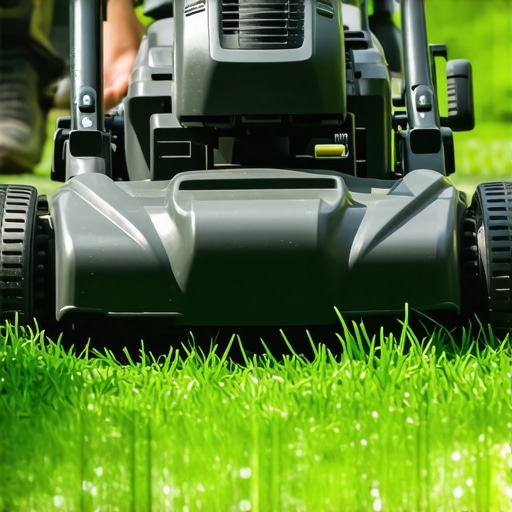
Effective leaf recycling requires a mulching mower with a closed deck or a mulching plug installed to ensure the material stays under the deck long enough to be shredded by the centrifugal force of the blades. Set your mower deck height to at least 3.5 inches. Low-mowing or ‘scalping’ during the leaf drop is a recipe for disaster. You need the grass height to act as a trap for the leaf bits. I tell my crew: if the mower isn’t humming with the weight of the debris, you aren’t doing it right. The blade tip speed must be maintained at a high RPM to ensure a clean shear. Dull blades will just tear the leaf veins, leading to browning and pathogen entry. Check your sharpening angle. It should be 30 degrees. Anything less is a butter knife.
- Step 1: Inspect the lawn for heavy debris or sticks that could damage the mandrels.
- Step 2: Set the mower height to 3.75 inches for the first pass.
- Step 3: Mow in a circular pattern, throwing discharge toward the center to re-cut the material.
- Step 4: Check soil moisture; never mulch soaking wet leaves as they will clump into anaerobic balls.
- Step 5: Apply a soil conditioner or humic acid post-mulch to accelerate the breakdown.
By the time 2026 rolls around, if you have followed this nutrient hack, your soil will have a dark, crumbly A-horizon rich in organic carbon. You will notice that your irrigation requirements drop by 20% because organic matter holds ten times its weight in water. This isn’t just about saving time; it’s about building a resilient landscape. Stop being a slave to the rake. Start acting like a landscaper who understands biochemistry.
How long does it take for mulched leaves to turn into dirt?
Under optimal conditions with active soil biology, mulched leaf particles will be fully incorporated into the topsoil within 3 to 5 months, providing a slow-release nitrogen source just as the spring green-up begins. If your soil is dead or heavily compacted, this process could take longer. This is why core aeration is the perfect partner for leaf mulching. By opening up 2.5-inch deep cores, you provide a direct path for the shredded leaves to fall into the root zone, bypassing the thatch layer entirely. It’s a nutrient injection for the 21st-century lawn. Do it right, or don’t do it at all. The hydrostatic pressure of water in un-mulched leaves can even damage hardscape edges if left to rot against paver stones, causing polymeric sand failure. Keep the leaves in the grass, not on the patio.