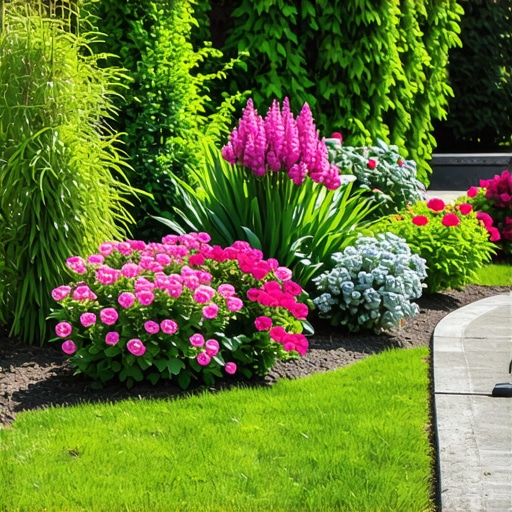
5 2026 Best Perennials for Part Shade Areas
5 2026 Best Perennials for Part Shade Areas: Engineering High-Performance Shade Gardens
Success in professional landscaping is not about buying the prettiest flower at the garden center; it is about managing biological systems and hydraulic pressure. When we talk about partial shade—typically defined as 4 to 6 hours of direct solar radiation—we are dealing with a delicate energy balance. Most residential landscapes fail because they treat shade as a deficit rather than a specific environmental condition requiring precise soil pH management and drainage engineering.
The Fundamental Engineering of Shade Horticulture
Part shade perennials thrive in environments where photosynthetic rates are moderated by filtered light or morning sun, requiring soil microbiology that supports moisture retention without causing root anaerobic conditions. Choosing the right cultivars for 2026 involves analyzing USDA hardiness zones, cation exchange capacity, and the bulk density of your planting medium.
I always drill into my new crew members: if you don’t fix the soil grading first, every plant you put in the ground is just expensive compost. I’ve seen rookies slap $5,000 worth of nursery stock into heavy clay that hadn’t been aerated or graded. Three months later, those plants were rotting in a perched water table. You have to respect the physics of the site. If the water doesn’t move through the soil at a rate of at least one inch per hour, your perennials are doomed regardless of how much you paid for them. We focus on the soil structure—the aggregate of sand, silt, and clay—long before we look at the aesthetics of the foliage.
“Soil compaction is the single most common cause of plant failure in the urban landscape, preventing necessary gas exchange and root penetration.” – University of Florida IFAS Extension
1. Helleborus orientalis (Lenten Rose) – The 2026 Foundation Plant
Helleborus orientalis is a critical evergreen perennial for part shade that offers early-season nectar for pollinators and stabilizes soil microbial networks during winter dormancy. This plant is a workhorse for hardscaping borders where alkaline soil leaching from concrete pavers might kill more sensitive species.
We specify Hellebores because they are chemically resistant to deer browsing and highly drought-tolerant once established. The trick is the planting depth. If you bury the crown, it will rot. Period. We install them with the root flare exactly 0.5 inches above the surrounding grade to account for mulch settling. For 2026, we are seeing high performance from double-flowered hybrids that maintain their structural integrity even in high-humidity zones. They require a soil pH between 6.5 and 7.5; if you’re in an acidic pine forest, you better be ready to apply pelletized lime.
2. Heuchera (Coral Bells) – Managing Foliage Density and Soil Heave
Heuchera cultivars provide a biological matrix of color in shade garden design, functioning as a high-density groundcover that prevents soil erosion and suppresses weed germination through canopy shading. These plants are susceptible to frost heaving if the soil structure lacks sufficient organic matter.
In my 20 years, I’ve seen more Heuchera killed by poor drainage than by any pest. They have a shallow fibrous root system. If your soil is 40% clay or higher, you must incorporate expanded shale or coarse sand to increase the macropore space. We use them for landscape lighting focal points because their metallic leaf textures reflect low-voltage LED spreads beautifully. Don’t buy the cheap flats from big-box stores; those are forced in greenhouses and have zero cold-hardiness. Get nursery-hardened stock that has already faced a freeze cycle.
3. Astilbe chinensis – Engineering Moisture Retention
Astilbe chinensis is the go-to species for moisture-wicking areas near French drains or retaining wall footings where water accumulates but doesn’t stagnate. Unlike other perennials, Astilbe requires high nitrogen levels and consistent hydration to maintain its plume-like inflorescence.
If you let the root ball dry out once, the leaf margins will scorch, and the plant will enter a stress-induced dormancy that ruins the season’s aesthetic. We install these with a dedicated drip irrigation line delivering 0.75 gallons of water per hour during peak summer heat. We also mulch with aged hemlock or pine bark to a depth of 3 inches—never more, or you’ll suffocate the root zone. It’s about maintaining a constant state of field capacity in the soil.
“A perennial’s ability to thrive in partial shade depends entirely on its photosynthetic efficiency and the available soil moisture profile.” – Cornell Horticultural Extension
How much soil amendment do I need for a shade bed?
To prepare a 100-square-foot shade garden, you typically need 1 cubic yard of organic compost to achieve a 3-inch layer, which must be mechanically tilled or broad-forked to a depth of 8 inches. This ensures a soil organic matter (SOM) increase of approximately 5%, which is optimal for nutrient cycling.
4. Hakonechloa macra (Japanese Forest Grass)
Hakonechloa macra is a structural ornamental grass that excels in landscape architecture by providing movement and texture in low-light environments where traditional turf grasses fail. It is a slow-growing rhizomatous plant that requires high potassium levels for cell wall strength.
This isn’t a plant you just throw in the dirt. It needs a high cation exchange capacity (CEC). We often blend calcined clay into the backfill to ensure the roots have access to minerals without the soil becoming a brick. It’s perfect for cascading over natural stone walls. In the 2026 design palette, we are using the ‘Aureola’ variety to brighten dark corners. Just remember: it hates wet feet in the winter. If your site has a 2% grade or less, you need to build a raised berm.
5. Polygonatum (Solomon’s Seal)
Polygonatum provides the verticality needed in landscape design, reaching heights of 36 inches to create a layered effect behind lower-profile hostas or ferns. Its arching stems are a lesson in geotropism and structural botany.
We use Solomon’s Seal for its rhizome architecture. It spreads slowly but surely, creating a colony that stabilizes the soil. It’s tough as nails. I’ve seen it survive under a canopy of Black Walnut trees—which produce juglone, a toxin that kills most other plants. If you want a plant that survives neglect, this is it. But if you want it to look professional, you need to feed it a balanced 10-10-10 slow-release fertilizer in early April.
What is the best fertilizer for part shade perennials?
The best fertilizer for shade perennials is a slow-release organic granular with a 3-1-2 NPK ratio, supplemented with humic acid to improve nutrient uptake. Avoid high-nitrogen fertilizers that cause leggy, weak growth susceptible to fungal pathogens like powdery mildew.
| Plant Species | Optimal pH Range | Water Requirement | Mature Height (Inches) |
|---|---|---|---|
| Helleborus | 6.5 – 7.5 | Low-Moderate | 12-18 |
| Heuchera | 6.0 – 7.0 | Moderate | 8-12 |
| Astilbe | 5.5 – 6.5 | High | 24-36 |
| Hakonechloa | 6.0 – 7.0 | Moderate | 12-18 |
| Polygonatum | 5.0 – 7.0 | Moderate | 24-48 |
The Professional Installation Checklist
- Site Analysis: Measure solar duration using a sun calculator over a 12-hour period.
- Soil Testing: Send samples to a lab for pH and nutrient analysis; don’t guess.
- Grading: Ensure a minimum 2% slope away from structures to prevent pooling.
- Root Prep: Tease out circling roots from container-grown stock to prevent root girdling.
- Hydration: Water immediately after installation to eliminate air pockets in the soil.
The first year of a shade garden is the most critical. You are not just growing plants; you are establishing a mycorrhizal network. This is why we avoid synthetic fungicides unless absolutely necessary—they kill the beneficial fungi that help roots absorb phosphorus. In year one, expect slow growth above ground. The plant is putting all its energy into the root system. By year three, the canopy will close, and you’ll have a self-sustaining biological system. It’s not magic; it’s just good engineering.