Build a $300 2026 Stone Fire Pit Area for Small Backyard Decks
The $300 Fire Pit Reality Check
Building a $300 stone fire pit area near a small backyard deck requires strict adherence to ASTM safety standards and thermal barrier engineering to prevent structural fires or deck warping. I recently got called out to tear up a $30,000 patio that was sinking because the previous contractor skipped the 4-inch compacted sub-base and just threw pavers on top of screened dirt. It was a muddy mess within two seasons. When you are working on a budget of three hundred dollars, you cannot afford to waste money on materials that will fail due to poor ground preparation. You are not just stacking rocks; you are creating a drainage system and a heat-management zone that protects your largest investment: your home. 80 percent of your success happens underground. If you ignore the soil mechanics, your fire pit will become a collection of crooked stones and weeds within twelve months. We are going to look at how to build a professional-grade fire pit area that sits safely adjacent to your deck without violating local fire codes or compromising the structural integrity of your yard.
Designing for Thermal Clearance and Safety
Establishing a safe clearance zone between a combustible deck and a stone fire pit involves calculating the radiant heat radius to prevent the ignition of wood or composite materials. Most local municipal codes require a minimum of 10 feet from any structure. If you have a small deck, this means your pit must be placed strategically to account for wind patterns and spark travel. A common mistake is thinking that stone is an absolute insulator. It is not. Stone absorbs heat and radiates it. If a stone pit is too close to a deck, the constant heat-cool cycles can cause the wood to dry out prematurely, a process called pyrolysis, which lowers the ignition temperature of the wood over time. You need a dedicated heat-affected zone (HAZ) that uses non-combustible materials like 3/4-inch modified gravel or pea stone. This area acts as a buffer.
“A fire pit area should be treated as an industrial thermal zone, where the primary goal is the management of radiant heat and the mitigation of ember-induced ignition.” – Hardscape Engineering Axiom
Excavation and Base Layer Dynamics
Proper soil excavation and sub-base compaction are the most critical steps in hardscaping a fire pit area to prevent hydrostatic pressure from shifting your stones. You must dig down at least 6 to 8 inches. The first 4 inches should be filled with a compacted base of CR6 or 21A modified gravel. This isn’t just for leveling; it provides a capillary break that prevents water from wicking up into your stones and causing frost heave during the winter. If you live in an area with heavy clay soil, like the red clay found in many southern regions, you must use a non-woven geotextile fabric between the soil and the gravel. Without this fabric, the heavy clay will eventually swallow your gravel base, leading to a sunken, uneven pit. Use a plate compactor. A hand tamper is for amateurs. If the tamper does not literally bounce off the ground, your base is not tight enough. It must be a solid, monolithic plate that can support the weight of the stone without shifting a millimeter. It will rot if you trap water. Don’t skip this.
Material Procurement on a 2026 Budget
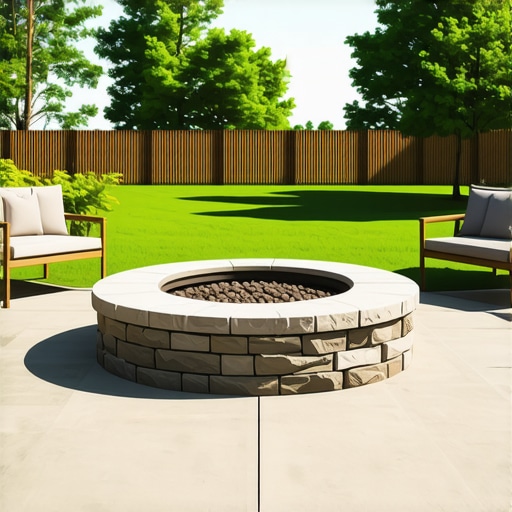
Selecting cost-effective hardscape materials for a $300 fire pit requires sourcing concrete wall blocks and industrial-grade steel rings rather than expensive natural fieldstone. Natural stone is beautiful but irregular, making it difficult for a DIYer to get a tight, heat-efficient seal. For a $300 target, you are looking at standard trapezoidal retaining wall blocks. They are pre-cut to form a perfect circle. You also need a steel fire ring insert. Do not build a fire pit without a steel liner. The liner protects the concrete blocks from direct flame contact. Concrete blocks are not fire-rated; they contain moisture. If you subject them to 800-degree temperatures without a liner, the moisture inside the concrete can turn to steam, causing the block to crack or even explode.
| Material | Quantity | Estimated Cost (2026) |
|---|---|---|
| Trapezoidal Wall Blocks | 36-40 Units | $140 |
| Steel Fire Pit Liner | 1 Unit | $85 |
| 3/4-inch Modified Gravel | 0.5 Cubic Yard | $40 |
| Polymeric Sand | 1 Bag | $25 |
| Landscape Fabric | 15 sq ft | $10 |
How much modified gravel do I need for a fire pit base?
To calculate the gravel volume for a fire pit base, multiply the square footage of the excavation area by the depth in feet (0.33 for 4 inches) and divide by 27 to get cubic yards. For a standard 5-foot diameter circle, you are looking at approximately 20 square feet. 20 times 0.33 is 6.6 cubic feet. Since there are 27 cubic feet in a yard, you need about a quarter of a yard. Always buy 20 percent more than you think to account for compaction. Gravel shrinks when you hit it with a compactor.
Can I put a stone fire pit directly on a wood deck?
You should never place a stone fire pit directly on a wood or composite deck because the dead load weight can exceed the deck’s structural capacity and the conductive heat will ignite the sub-structure. Even with a heat shield, the risk of a stray ember falling into the gaps between deck boards is too high. Instead, build your fire pit area at ground level, adjacent to the deck, using a transition step. This keeps the fire away from the house and ensures your deck remains a safe, fire-free zone. Safety is non-negotiable in hardscaping.
The Ground-Up Installation Process
The installation of a stone fire pit involves a multi-layer compaction sequence to ensure long-term stability and proper drainage.
- Layout: Use a center stake and a string line to mark a circle 12 inches wider than your intended pit.
- Excavation: Dig to a depth of 8 inches, ensuring the floor of the pit is sloped 1/8 inch per foot away from your deck or house.
- Fabric: Lay down your non-woven geotextile. This is your insurance policy against mud.
- Base: Add gravel in 2-inch lifts. Compact each lift until it is rock hard.
- Setting: Place your first course of blocks. Use a 4-foot level to check every direction. If the first course is crooked, the whole pit will look like a disaster.
- Stacking: Stagger the joints of the blocks. Do not line them up vertically. This creates structural strength.
- Liner: Drop in the steel ring. It should sit flush on the top or slightly above the inner lip.
“Failure to provide a level, compacted base is the primary cause of structural failure in small-scale residential hardscapes.” – Penn State Agricultural Extension
The Long-Term Maintenance Schedule
Maintaining a fire pit area requires polymeric sand replenishment and ash management to prevent drainage clogs and stone degradation. Every spring, check the joints between your stones. If the sand has washed out, broom in new polymeric sand and mist it with water. This sand hardens like mortar and prevents ants and weeds from taking over your project. Also, never leave a pile of wet ash in your pit. Ash is acidic and, when mixed with rainwater, creates a caustic paste that can eat away at the steel liner and the concrete blocks. Clean it out after every third or fourth burn. This $300 investment can last 20 years if you respect the materials. Cheap out on the base, and you’ll be doing this again in 2027. Do it right the first time.