
![Build a $300 Boulder Fire Pit Circle [2026]](https://lawnmajesty.com/wp-content/uploads/2026/06/Build-a-300-Boulder-Fire-Pit-Circle-2026.jpeg)
Build a $300 Boulder Fire Pit Circle [2026]
Build a $300 Boulder Fire Pit Circle [2026]
I recently got called out to tear up a $30,000 patio that was sinking because the previous contractor thought he could skip the compaction phase on a slope. It was a mess. Water had infiltrated the sub-base, turning the stone dust into a slurry that pushed the pavers out of alignment. That job taught me that whether you are spending thirty grand or three hundred bucks, the physics of the earth do not change. If you do not respect the drainage and the base, the ground will reclaim your work. Building a boulder fire pit is about managing heat and hydrostatic pressure. It is not a weekend craft project; it is a small-scale civil engineering task. Most DIY guides tell you to throw some rocks in a circle. They are wrong. If you use the wrong stones, they explode. If you ignore the frost line, they shift. We are going to build this for under $300 by sourcing raw materials and doing the labor correctly.
Site Analysis and Utility Clearance for Fire Pit Safety
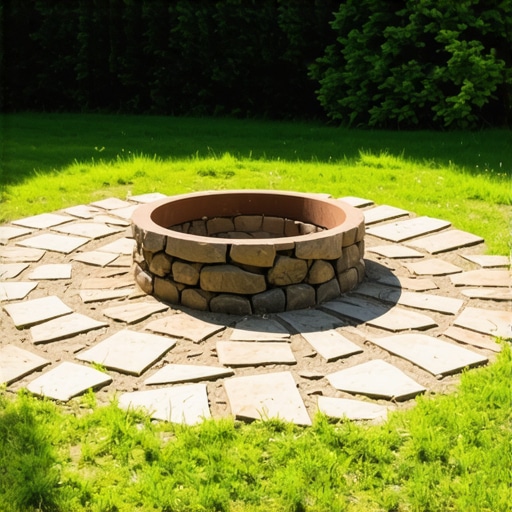
To ensure a safe boulder fire pit installation, you must identify a location at least 10 to 20 feet from any structures, overhanging trees, or property lines while verifying underground utility lines via 811. Failure to check for gas or electric lines before excavation is professional negligence. I have seen guys nick a secondary power line for a backyard shed because they thought they were only digging six inches. Don’t be that guy. Use a marking wand to spray a 6-foot diameter circle. This gives you a 3-foot interior pit and a 1.5-foot stone shoulder. Check the grade. If you have more than a 2-inch drop across that 6-foot span, you need to cut into the high side to level the footprint. You are not just building on the grass; you are removing the organic layer entirely. Grass rots. Roots shrink. Both lead to settling.
The $300 Budget Breakdown: Sourcing Natural Fieldstone
Building a budget fire pit requires moving away from retail landscaping centers and toward local quarries or farm-sourced fieldstone to keep material costs under $300 for 2026. Retailers markup palletized stone by 300%. Go to a local aggregate yard. Ask for ‘bulk fieldstone’ or ‘oversized cobbles.’ You need roughly 0.75 to 1 ton of stone. In most regions, bulk fieldstone runs $60 to $120 per ton if you haul it yourself. The rest of your budget goes to the base material.
| Material | Quantity | Estimated Cost |
|---|---|---|
| Bulk Fieldstone (6-12 inch) | 1 Ton | $90.00 |
| Crushed #57 Limestone/Granite | 0.5 Cubic Yard | $45.00 |
| Fire-Rated Lava Rock (Internal) | 3 Bags | $60.00 |
| Geotextile Fabric (Non-woven) | 6′ x 6′ Scrap | $15.00 |
| Delivery/Fuel/Misc Tool Rental | N/A | $90.00 |
Total: $300. This assumes you own a shovel and a heavy-duty rake. If you buy ‘decorative fire pit kits’ from a big-box store, you are paying for the convenience of uniform shapes, but you lose the structural weight of real boulders.
Excavation and Base Preparation: The 4-Inch Rule
The excavation depth for a permanent fire pit must reach 4 to 6 inches below the surface to allow for a compacted aggregate base that facilitates drainage and prevents the stones from sinking. Most people skip the fabric. Do not. Without a non-woven geotextile layer between the dirt and your gravel, the stones will eventually migrate into the soil. It is called ‘fines migration.’ Once the soil mixes with your base, you lose the drainage gaps.
“A retaining wall doesn’t fail because of the stone; it fails because of the water trapped behind it.” – Hardscape Engineering Axiom
This applies to fire pits too. If water sits at the base of your boulders during a freeze-thaw cycle, the ice will expand and kick your stones out of alignment. Dig the circle. Line it with fabric. Pour 4 inches of #57 stone. Level it. Tamp it until your shoulders hurt. The base should be so hard that you can’t see your footprint when you walk on it.
How much modified gravel do I need for a fire pit base?
For a standard 6-foot diameter area, you will need approximately 0.5 cubic yards of crushed stone to reach a 4-inch compacted depth. Use a calculator: (Area x Depth). If you use rounded pea gravel, the base will never stabilize. You need angular, crushed stone that locks together under pressure. This creates a structural ‘raft’ for your boulders to sit on.
Boulder Selection and Structural Stacking
Selecting igneous rocks like granite or basalt is critical because porous sedimentary rocks like limestone or sandstone contain trapped moisture that can turn to steam and explode when heated. I have seen limestone crack like a gunshot. It is dangerous. When you arrive at the stone yard, look for ‘dense’ stones. Pick boulders that have at least one flat ‘face.’ You want the weight of the stone to travel straight down into the base. If the stone is round like a bowling ball, it will roll out of the circle the first time someone kicks it. Lay the largest stones first. These are your ‘foundation stones.’ Push them tight against each other. There should be no gaps larger than two inches. If there is a gap, ‘chink’ it with smaller stones. Use a 4-pound sledgehammer to drive the chinking stones in. It must be solid.
Can you use river rock for a fire pit?
You should never use river rocks for the internal lining of a fire pit because the high moisture content trapped in the smooth stone pores expands rapidly under heat, causing the rock to shatter or explode. If you want the river rock look, keep them on the outside of the circle where the temperature does not exceed 150 degrees Fahrenheit. For the interior, stick to volcanic rock or fire-rated glass.
Finishing with Fire-Safe Aggregates
The center of the fire pit should be filled with 2 inches of lava rock or fire-safe stones to protect the base and allow oxygen flow to the bottom of the wood stack. This is about combustion efficiency. If you build the fire directly on the dirt, the fire will struggle for air and produce excessive smoke. The gravel base allows air to move through the gaps.
- Clear all combustible debris within a 10-foot radius.
- Install a steel fire ring if you want to extend the life of the boulders.
- Fill the bottom with 2-3 inches of lava rock for drainage.
- Check local fire department ordinances for ‘open burn’ regulations.
- Use a level to ensure the top rim is consistent.
“Proper drainage in small-scale hardscapes is often the difference between a ten-year feature and a two-season failure.” – Penn State Agricultural Extension
This quote highlights why the #57 stone is more important than the boulders themselves.
Maintenance and Thermal Management
Maintaining a boulder fire pit requires annual ash removal because wet ash creates a highly alkaline lye-like paste that can chemically weather the surface of certain natural stones over time. It will eat your stone. After a rain, the ash turns into muck that clogs your drainage layer. Shovel it out. If you notice a boulder has shifted, it means your base has settled. Lift the stone, add more crushed aggregate, and reset it. Don’t wait. A single loose stone compromises the circle’s tension. High-end landscaping is not a ‘set it and forget it’ endeavor. It is a relationship with the elements. You are fighting gravity and thermal expansion every day. Respect the materials, and this $300 build will look like a $3,000 professional installation for the next decade.
![Repairing 2026 Deck Boards with Wood Hardener [Pro Tip]](https://lawnmajesty.com/wp-content/uploads/2026/07/Repairing-2026-Deck-Boards-with-Wood-Hardener-Pro-Tip.jpeg)
![Why Your 2026 Deck is Turning Black [3 Fixes]](https://lawnmajesty.com/wp-content/uploads/2026/06/Why-Your-2026-Deck-is-Turning-Black-3-Fixes.jpeg)
![Build a $300 2026 Stone Fire Pit Area [Fast]](https://lawnmajesty.com/wp-content/uploads/2026/07/Build-a-300-2026-Stone-Fire-Pit-Area-Fast.jpeg)