Stop 2026 Lawn Thinning: 3 Soil Aeration Hacks
Stop 2026 Lawn Thinning: 3 Soil Aeration Hacks
Your lawn is gasping for air because the soil bulk density has exceeded 1.6 g/cm3, effectively turning your yard into a slab of concrete that rejects water and nitrogen. To stop lawn thinning by 2026, you must implement mechanical core aeration, top-dressing with 80/20 sand-compost blends, and liquid humate applications to restore the rhizosphere’s gas exchange and macropore structure.
The Autopsy of a Dying Turf System
I always drill into my new crew members: if you don’t fix the soil grading and compaction first, every plant you put in the ground is just expensive compost. Last season, I walked onto a property where the homeowner had spent four figures on high-end fescue seed, only to watch it wither by July. They blamed the seed. They blamed the heat. I took a penetrometer to the soil and couldn’t even get past two inches. The roots were pancaked against a layer of hardpan clay. We weren’t looking at a ‘brown lawn’; we were looking at a structural engineering failure. The soil was so compacted that the root systems had zero oxygen, leading to anaerobic conditions that invited Pythium blight. If you don’t solve the compaction, you are just throwing money into a graveyard.
“Soil compaction is the most overlooked factor in urban lawn decline, as it reduces the pore space necessary for oxygen and water movement, leading to shallow root systems and increased susceptibility to drought.” – Penn State Center for Turfgrass Science
How deep should aeration cores be?
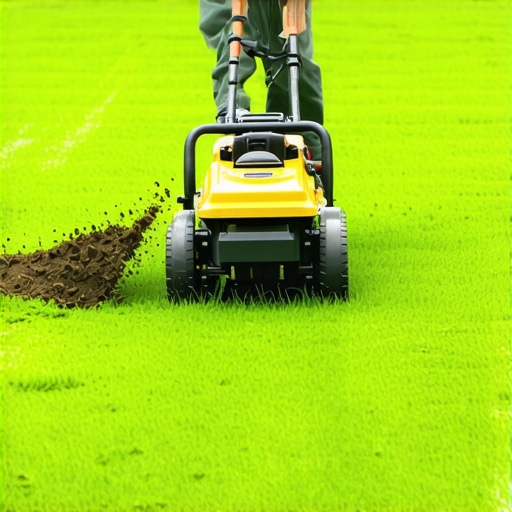
For effective compaction relief, aeration cores must reach a minimum depth of 2.5 to 3 inches to penetrate the thatch layer and enter the subsoil horizon. Shallow holes created by spike aerators actually increase compaction by pushing soil sideways rather than removing it. Pulling a clean plug is the only way to facilitate true gas exchange.
Hack 1: The Liquid-Mechanical Hybrid Protocol
Mechanical core aeration is the industry standard, but it’s only half the battle in heavy clay soils. The ‘hack’ is the timing of a high-concentrate liquid humic acid application immediately following the mechanical pull. When you pull those plugs, you’ve created thousands of direct vertical pathways to the root zone. Dropping liquid humates and sea kelp into those open holes bypasses the surface tension of the soil. This chemical-physical combo accelerates the breakdown of the ‘organic mat’ or thatch. Don’t just pull plugs; treat the holes. It will rot if you don’t manage the biology. This process forces the roots to chase the nutrients deeper into the profile, creating a drought-resistant mat that can survive a 100-degree August.
Hack 2: The 80/20 Sand-Compost Top-Dressing
Most ‘mow-and-blow’ guys will tell you to just leave the plugs on the lawn to break down. That’s lazy. If you want to permanently change your soil structure, you need to fill those aeration holes with a specific medium. We use an 80% washed masonry sand and 20% organic leaf compost mix. The sand provides permanent structural macropores that cannot be re-compacted easily, while the compost reintroduces the microbial life needed to process nitrogen. You aren’t just ‘feeding’ the lawn; you are performing a soil transplant. This is the difference between a lawn that looks okay for a week and a turf system that thrives for a decade.
| Method | Impact on Bulk Density | Duration of Benefit | Cost-to-Value Ratio |
|---|---|---|---|
| Spike Aeration | Increases (Negative) | 2 Weeks | Poor |
| Core Aeration (Single Pass) | Moderate Reduction | 6 Months | Good |
| Core Aeration + Top Dressing | High Reduction | 3-5 Years | Elite |
| Liquid Aeration Only | Surface Level Only | 1 Month | Moderate |
When is the best time to aerate a lawn for 2026?
The optimal window for cool-season grasses is during the early fall (September to October), while warm-season grasses like Bermuda or Zoysia should be aerated in late spring (May to June) when they are in their peak growth phase. Aerating during dormancy is a death sentence for the turf crown. Timing is everything.
Hack 3: The Vertical Slicing & Over-Seeding Synergy
If your lawn is thinning, you have a ’tiller’ problem. Turf grass needs to crown and spread. Use a power rake or verticutter to slice the stolons and rhizomes of the grass before you aerate. This sounds counter-intuitive—you’re wounding the plant—but this ‘trauma’ triggers a massive hormonal growth response. When followed by aeration and a high-phosphorus starter fertilizer (something like a 10-18-10 NPK), the lawn will aggressively fill in the bare spots. Do not use big-box store weed-and-feed; the pre-emergents in those bags will kill your new seed before it even germinates.
“Hydrostatic pressure from trapped water is the primary cause of retaining wall failure, much like how trapped CO2 in compacted soil is the primary cause of turf root senescence.” – ICPI Hardscape Engineering Standard
The 2026 Prevention Checklist
- Test soil pH: Aim for 6.5 to 7.0 for optimal nutrient uptake.
- Check core depth: Use a ruler; if it’s not 3 inches, you’re wasting gas.
- Audit irrigation: Ensure 1 inch of water per week delivered in two deep sessions.
- Sharpen blades: Ragged cuts lead to moisture loss and fungal entry.
- Monitor thatch: If it’s over 0.5 inches, you need a heavy mechanical dethatching.
Stop listening to the guy at the hardware store. Your soil is a living, breathing organism that requires structural integrity to function. If you treat your yard like a chemical dump, it will fail you. If you treat it like a biological engine, it will perform. Focus on the pore space. The grass will follow. Stick to the measurements. pH levels matter. Bulk density matters. Don’t skip the sand. Do it right the first time.