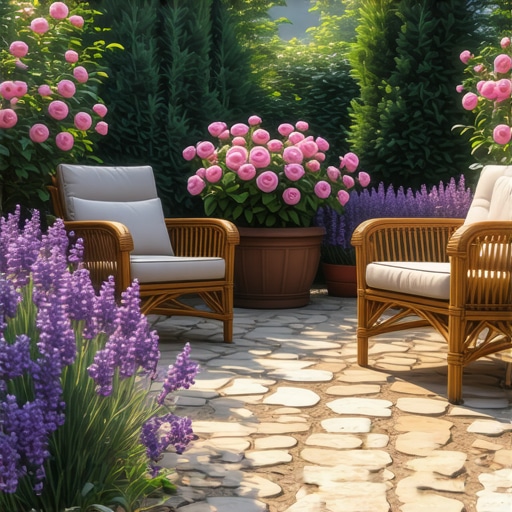
How to Design a Fragrant Garden Near Your Patio Seating
Designing the Ultimate Fragrant Patio Garden
To design a fragrant garden near your patio seating, you must strategically place high-VOC emitters and nocturnal bloomers based on prevailing wind patterns and thermal radiation from hardscape materials. Success requires balancing soil pH levels and subsurface drainage to prevent stagnant water from destroying root systems.
The Apprentice Lesson: Why Grading Precedes Aesthetics
I always drill into my new crew members: if you don’t fix the soil grading first, every plant you put in the ground is just expensive compost. I have seen too many rookies spend five figures on specimen-grade shrubs only to have them drown because the hardscape crew didn’t set the pitch of the patio correctly. If your patio is flat, water pools. If it pools, the soil stays saturated. Saturated soil lacks oxygen. Without oxygen, the roots of your fragrant plants will suffocate and rot. Don’t skip the transit level. Measure the grade. Ensure a minimum 2 percent slope away from the foundation and the seating area.
“Soil structure and the presence of macropores are essential for gas exchange in the root zone, particularly for woody ornamentals that produce volatile oils.” – Agricultural Extension Agronomy Manual
The Engineering of Scent: Wind and Heat
Fragrance is not a static cloud. It is a series of Volatile Organic Compounds (VOCs) that are released by the plant and carried by air currents. When designing your landscaping, you must identify the prevailing wind direction during your primary hours of patio use. If the wind typically blows from the west, your most aromatic species belong on the western edge of the hardscape. Garden design is about managing the microclimate. The pavers themselves act as a heat sink. This thermal mass absorbs energy during the day and radiates it back at night. This radiation can accelerate the transpiration rates of plants, often causing them to release scent more intensely in the evening. This is physics, not magic.
[IMAGE_PLACEHOLDER]
Material Selection and Thermal Retention
Different hardscaping materials interact with plants differently. Darker stones like slate or certain granites absorb more UV radiation. This creates a hot microclimate. If you plant moisture-loving fragrant plants like Gardenia near dark stone, they will scorch. Use the table below to understand how your choice of materials affects your garden design.
| Material Type | Heat Absorption Index | Recommended Plant Proximity | Drainage Requirement |
|---|---|---|---|
| Concrete Pavers (Light) | Medium | 12 to 18 inches | High (Polymeric Sand) |
| Natural Flagstone (Dark) | High | 24 to 36 inches | Critical (Subsurface Pipe) |
| Travertine (White) | Low | 6 to 12 inches | Moderate |
| Decomposed Granite | Low | 0 inches (Can touch) | High (Natural Perc) |
How much modified gravel do I need for a patio base?
A standard residential patio requires a compacted base of 4 to 6 inches of 2A modified gravel (CR6). For every 100 square feet at a 6-inch depth, you will need approximately 2.5 to 3 tons of gravel. Do not guess. Rent a plate compactor. Run it in 2-inch lifts. If the base isn’t solid, your garden edge will shift, and your plants will be crushed by moving stone. It will fail. Use a non-woven geotextile fabric between the subgrade and the gravel to prevent the layers from mixing.
The Horticultural Foundation: Soil Chemistry
Most fragrant plants, specifically those in the Rosaceae or Lamiaceae families, require a specific soil environment. You must test your lawn care and garden soil for pH levels. Most aromatic shrubs prefer a pH between 6.0 and 7.0. If your soil is too alkaline, the plant cannot uptake iron, leading to chlorosis. The scent production will drop. Use elemental sulfur to lower pH or lime to raise it. Do this six months before planting. Chemical changes in soil take time. They are not instant.
“A retaining wall doesn’t fail because of the stone; it fails because of the water trapped behind it, which increases hydrostatic pressure and destabilizes the plant beds.” – Hardscape Engineering Axiom
Pre-Planting Inspection Checklist
- Verify 811 utility markings are complete and clear.
- Perform a 12-inch deep percolation test for drainage speed.
- Test soil pH and Cation Exchange Capacity (CEC).
- Check root flares on nursery stock for girdling roots.
- Inspect hardscape edge restraints for structural integrity.
How do I keep my patio garden smelling good all year?
To maintain scent throughout the seasons, you must employ a layered planting strategy. Use Sarcococca hookeriana (Sweet Box) for late winter, Hyacinthus for spring, Lavandula for summer, and Osmanthus fragrans for autumn. This ensures a constant VOC release. Avoid over-fertilizing with high-nitrogen products. Excessive nitrogen produces fast, weak growth with low oil content. Use a slow-release organic fertilizer with a balanced NPK ratio. Deep, infrequent watering is mandatory. Force the roots to chase the water down 12 inches into the profile. This builds resilience against the heat reflected by your patio stones.
![Build a $200 Tiered Garden for 2026 Slopes [DIY]](https://lawnmajesty.com/wp-content/uploads/2026/06/Build-a-200-Tiered-Garden-for-2026-Slopes-DIY.jpeg)