Why Your Birdbath Is Growing Algae and How to Stop It
The Forensic Autopsy of a Toxic Garden Basin
To stop birdbath algae, you must disrupt the eutrophication process by limiting direct solar radiation and removing dissolved organic carbon such as bird droppings and leaf litter. Frequent water changes or the addition of a submersible pump for aeration prevents the stagnation that opportunistic cyanobacteria and green algae require to colonize the surface. Stop treating your birdbath as a static ornament and start treating it as a dynamic biological system.
I always drill into my new crew members: if you don’t fix the soil grading first, every plant you put in the ground is just expensive compost. This technical wisdom applies directly to water features. I recently walked onto a job site where the client was furious that their $800 hand-carved limestone birdbath looked like a vat of radioactive soup. They had it sitting in the middle of a baking Kentucky bluegrass lawn, receiving zero shade and catching every ounce of overspray from their high-nitrogen lawn fertilizer. They were essentially feeding the algae a gourmet meal every time the sprinklers ran. It will rot if you don’t understand the physics of water. Most homeowners think a birdbath is a set-it-and-forget-it deal. It is not. It is a shallow, high-surface-area vessel that functions as a heat sink. When water temperatures exceed 75 degrees Fahrenheit, the metabolic rate of algae hits a vertical climb. You are not just growing gunk; you are hosting a microscopic explosion of life that robs the water of oxygen and creates a bio-hazard for the very birds you are trying to attract.
“A birdbath is not a closed ecosystem; it is a high-turnover biological filter that requires constant mechanical or chemical resetting to prevent the accumulation of nitrogenous waste.” – Horticultural Water Management Standards
How does sunlight affect algae growth in birdbaths?
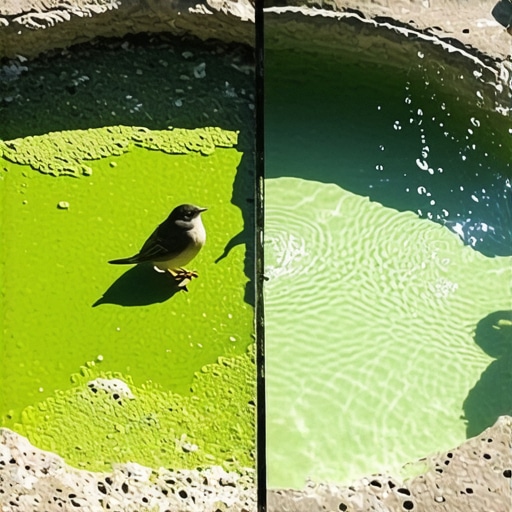
Direct sunlight provides the photochemical energy necessary for algae to perform photosynthesis, turning dissolved carbon dioxide and nutrients into filamentous green mats. By placing a birdbath in a shaded micro-climate, you significantly reduce the PAR (Photosynthetically Active Radiation) available to the algae, effectively starving the bloom at its energy source. Algae are opportunistic. They don’t need much. A few spores carried on the wind or a bird’s wing, a little bit of phosphorus from some drifting lawn dust, and six hours of sun. That is the recipe for a disaster. When I see a basin with that thick, velvet-like coating, I know the homeowner has ignored the biofilm adhesion. This isn’t just a surface stain. It is a complex matrix of bacteria and sugars that glue the algae to the stone. You can’t just splash water on it and call it a day. You have to break the bond. [IMAGE_PLACEHOLDER_1]
Professional Material Comparison for Algae Resistance
| Material Type | Porosity Level | Algae Adhesion Risk | Maintenance Requirement |
|---|---|---|---|
| Cast Concrete | Very High | Severe | Weekly Scrubbing |
| Glazed Ceramic | Zero | Low | Rinse and Wipe |
| Resin / Plastic | Moderate | Medium | Bi-Weekly Cleaning |
| Natural Granite | Low | Medium | Pressure Wash Monthly |
How much modified gravel do I need for a birdbath base?
For a standard birdbath, you need a 4-inch deep base of compacted 21A or 3/4-inch modified gravel to prevent the basin from tilting due to soil heave or hydrostatic pressure. A level basin ensures uniform water depth, which prevents shallow hot spots that accelerate algal thermogenesis and evaporation. If the basin is unlevel, one side stays shallow. Shallow water heats up faster. Hot water holds less oxygen. Low oxygen favors anaerobic bacteria. It is a chain reaction. I see it every day. A hack contractor will just plop a basin on the dirt. Two months later, it is leaning, half the water has spilled out, and the remaining two inches of liquid is a breeding ground for West Nile mosquitoes. Use a hand tamper. The tamper should literally bounce off the compacted base before you even think about setting that stone.
The Chemical Reality of Water Maintenance
Don’t use bleach. I see this advice on
![Build a $200 Solar Pond Fountain [2026 DIY Project]](https://lawnmajesty.com/wp-content/uploads/2026/05/Build-a-200-Solar-Pond-Fountain-2026-DIY-Project.jpeg)
![Build a $250 2026 Backyard Waterfall [Step-by-Step]](https://lawnmajesty.com/wp-content/uploads/2026/07/Build-a-250-2026-Backyard-Waterfall-Step-by-Step.jpeg)