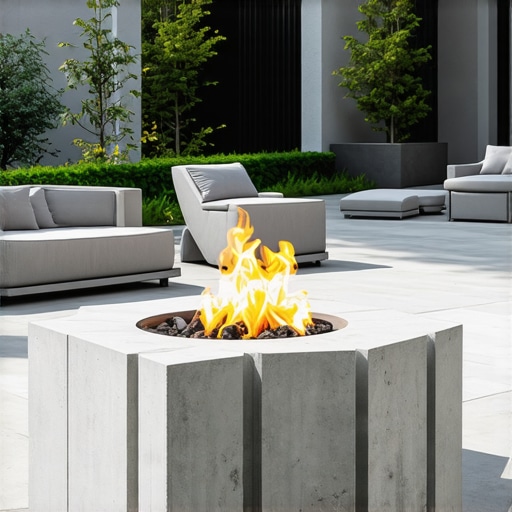
Build a $150 Modern Fire Pit with 2026 Concrete Blocks
Why Site Engineering Trumps Aesthetics in Fire Pit Construction
Building a modern fire pit with 2026 concrete blocks requires a 6-inch compacted gravel base and high-heat mortar to ensure longevity. Success in hardscaping depends on hydrostatic pressure relief and 98% soil compaction to prevent the structure from shifting or cracking during intense thermal load cycles.
I recently got called out to tear up a $30,000 patio that was sinking because the previous contractor ignored the fundamental laws of physics. They had laid high-end pavers over a 2-inch layer of uncompacted sand. Within one winter, the freeze-thaw cycle turned that expensive stone into a wavy mess of mud and grit. It was a forensic autopsy of incompetence. The same logic applies to a $150 fire pit. If you don’t excavate deep enough to bypass the organic topsoil, your blocks will tilt, the joints will separate, and the entire structure will become a liability within eighteen months. Do not trust the surface. Dig deeper. Soil grading is the only thing standing between a permanent installation and a pile of expensive rubble.
How much modified gravel do I need for a fire pit base?
For a standard 4×4-foot fire pit area, you need approximately 0.5 cubic yards of 3/4-inch modified gravel to create a stable 6-inch deep foundation. This volume accounts for compaction rates where the material loses roughly 20% of its height once hit with a manual or power tamper. Use a plate compactor if available. Manual tamping is exhausting but necessary.
“Compaction is the single most important factor in the performance of any segmental pavement or wall system.” – ICPI Tech Spec 2
The Critical Materials Breakdown for a $150 Budget
Building on a budget does not mean buying substandard materials. It means choosing industrial-grade concrete masonry units (CMU) over decorative retail stones. A standard 8x8x16-inch CMU currently costs under $3.00 at most yards. You need twenty of these to form a clean, minimalist square fire pit. The remaining budget goes toward the refractory lining and the sub-base. Do not skip the fire bricks. Standard concrete is porous. When water trapped inside those pores turns to steam, the block can explode. This is called spalling. It is dangerous. It is preventable.
| Material Item | Quantity | Estimated Cost | Function |
|---|---|---|---|
| 8x8x16 Standard CMU | 20 Blocks | $55.00 | External Structure |
| 3/4″ Modified Gravel | 10 Bags | $45.00 | Compacted Sub-base |
| Split Fire Bricks | 15 Bricks | $35.00 | Internal Heat Shield |
| High-Temp Mortar | 1 Bucket | $15.00 | Refractory Binding |
The engineering of the base is where 80% of your labor occurs. You must reach the Proctor density required to support the dead weight of the blocks without settling. 1200 PSI concrete blocks are heavy. Gravity is relentless. If the soil is heavy clay, you must increase the gravel depth to 8 inches to facilitate capillary action and drainage. Wet soil expands. Dry soil shrinks. This movement destroys rigid structures.
Will concrete blocks explode in a fire pit?
Standard concrete blocks can crack or spall violently if exposed to direct flame because they contain calcium silicate hydrates that release chemically bound water when heated above 600 degrees Fahrenheit. To prevent this, always line the interior with ASTM C27-grade fire bricks. This creates a thermal barrier that protects the structural CMU from the core heat of the fire.
“Standard concrete masonry units are not designed for direct flame contact; thermal expansion can cause spalling without a refractory lining.” – NCMA TEK Manual
Step-by-Step Installation: The Forensic Approach
Start by marking a 5×5-foot perimeter. This gives you 6 inches of over-dig on all sides. Excavate 8 inches down. Remove every root. Roots rot. Rotting creates voids. Voids cause sinking. Once the pit is clear, add 2 inches of gravel. Level it. Tamp it until the tamper bounces. Repeat this in 2-inch lifts. A single 6-inch dump will never compact correctly. The middle will stay soft. It will fail.
- Mark the footprint with marking paint.
- Excavate to a depth of 8-10 inches.
- Install a non-woven geotextile fabric to separate soil from gravel.
- Add gravel in 2-inch lifts and compact.
- Set the first course of CMU using a 4-foot level.
- Apply polymeric sand or heat-resistant adhesive between layers.
- Line the interior with fire bricks set in refractory mortar.
Precision is mandatory. If the first block is off by 1/8 of an inch, the top course will be off by an inch. Use a dead-blow hammer to seat the blocks into the gravel. Check the level on every single block. Not every other block. Every block. Once the structure is up, fill the bottom of the pit with 2 inches of lava rock. This protects the base and provides air gaps for better combustion. Oxygen is the fuel. Without ventilation, your fire will smolder and smoke. Leave a 1/2-inch gap in the mortar on two opposite sides of the bottom course. This acts as a weep hole and an air intake. It is basic civil engineering.
The Long-Term Maintenance Cycle
During the first year, expect the structure to settle by a fraction of an inch. This is normal. If you compacted the base to 98% density, the settling will be uniform. If you took shortcuts, one corner will dip. Check the weep holes every spring. Spiders and debris clog them. A clogged fire pit holds water. Water leads to efflorescence—that white, salty staining on the side of concrete. It is ugly. It indicates moisture saturation. Keep it dry. Cover the pit when not in use. This isn’t about aesthetics; it is about preventing freeze-thaw degradation of the concrete matrix. Concrete is a sponge. Manage the water, and the pit lasts thirty years. Ignore the water, and it lasts three. The choice is yours. Level it. Tamp it. Burn it safely.