Build a 2026 Herb Garden in a $50 Vertical Planter
The Planning Phase of High-Density Vertical Horticulture
Vertical herb gardening in 2026 focuses on maximizing biomass per square inch by utilizing hydro-logical gradients and specialized growing media within a $50 hardware budget. Success depends on capillary action and nutrient bioavailability rather than aesthetic placement. Most homeowners fail because they treat a vertical tower like a flat garden bed. It is not. It is a closed-loop hydraulic system. I always drill into my new crew members: if you don’t fix the soil grading or the media composition first, every plant you put in the ground is just expensive compost. You cannot slap dirt from your backyard into a plastic tower and expect it to perform. The bulk density is too high. The oxygen diffusion rate is too low. You are essentially suffocating the roots in a plastic coffin. In my 20 years of hardscaping and planting, I have seen thousands of dollars of nursery stock die because the installer ignored the physics of the perched water table. Every container, regardless of size, has a zone at the bottom where the soil stays saturated. In a vertical stack, this effect is multiplied. You must engineer the drainage from the top tier to the bottom to ensure the bottom tier doesn’t become a stagnant bog while the top tier bakes in the sun.
The Substrate Science: Why Media Choice Dictates Yield
Selecting the correct growing media for a vertical planter requires balancing capillary lift and macroporosity to ensure 100% root zone oxygenation. For a $50 budget, you must avoid pre-mixed boutique soils and instead blend for cation exchange capacity and bulk density using raw components. Most ‘potting soils’ are 90% cheap forest products that decompose and compact within 60 days. This compaction destroys the air-filled porosity required for herbs like Rosmarinus officinalis or Lavandula. You need a mix that maintains a stable pH of 6.0 to 6.8 and provides enough structural integrity to support the vertical load of the tiers above it. I recommend a 40% coconut coir, 30% perlite, and 30% composted rice hulls or pumice. This combination ensures that even when the planter is fully saturated, there is at least 15% air space. Don’t add gravel to the bottom of the tiers. This is a common DIY myth that actually increases the height of the perched water table, reducing the usable root space. Instead, use a mesh screen to prevent media loss while allowing free drainage.
“A containerized plant is entirely dependent on the physical properties of its substrate; once the air-filled porosity drops below 10%, root respiration ceases and anaerobic pathogens take hold.” – Agronomy Manual for Greenhouse Management
How much potting mix do I need for a 5-tier vertical planter?
A standard 5-tier vertical planter usually requires 1.5 to 2.0 cubic feet of high-porosity growing media to fill all pockets without excessive compaction. Calculating volume is critical to stay under the $50 budget, as buying individual 8-quart bags is 400% more expensive than buying bulk components. Measure the internal diameter of each tier. Most $30 to $50 planters sold on the market have a volume of approximately 4 gallons per tier. If you have 5 tiers, that is 20 gallons. One cubic foot is roughly 7.5 gallons. Therefore, you need approximately 2.7 cubic feet. If you over-stuff the tiers, you decrease the oxygen diffusion. If you under-fill, the media will settle and expose the root flares. It is a precise measurement. I tell my guys to fill to within 0.5 inches of the rim. No more. No less.
| Component | Ratio | Function | Cost (Approx) |
|---|---|---|---|
| Coconut Coir | 40% | Water Retention / Capillary Action | $15.00 |
| Perlite (Coarse) | 40% | Aeration / Drainage / Bulk Density | $12.00 |
| Worm Castings | 20% | Nutrient Density / Microbes | $10.00 |
| Planter Unit | N/A | Structural Housing | $13.00 |
The Mechanical Installation: Stabilizing the Vertical Stack
Installing a $50 vertical planter requires a level foundation and mechanical stabilization to prevent hydrostatic shifting or wind-driven collapse. In 2026, many of these budget units are made of high-density polypropylene, which is lightweight and prone to tipping once the herb canopy reaches maturity. You must start with a level base. If you are placing this on a patio, use a spirit level to check the grade. If it is on soil, you must excavate 3 inches, backfill with 3/4-inch modified gravel, and tamp it until the tamper literally bounces off the surface. This prevents the stack from leaning as the weight increases from water. A fully saturated 5-tier tower can weigh over 100 pounds. If that weight is unevenly distributed, the plastic joints will shear. I often see ‘mow-and-blow’ guys just throw these on the grass. Within two weeks, the unit is leaning at a 15-degree angle, and the water is only reaching half the root systems. Don’t be that guy. Fix the base first. Use a center 1/2-inch PVC pipe or a piece of rebar driven into the ground to act as a spine for the tiers. This adds a level of structural safety that budget planters lack out of the box.
- Excavate the base area to a depth of 3 inches to remove organic matter.
- Install a geotextile fabric to prevent soil migration into your base gravel.
- Add 2 inches of leveled, compacted 21A or 57 stone.
- Insert a central stabilization rod (Rebar or PVC) to guide the tier stack.
- Check level after every second tier is added to ensure vertical alignment.
“Soil compaction and leveling are the two most ignored factors in residential hardscaping, leading to 90% of structural failures within the first year.” – Hardscape Engineering Axiom
What are the best herbs for a vertical garden?
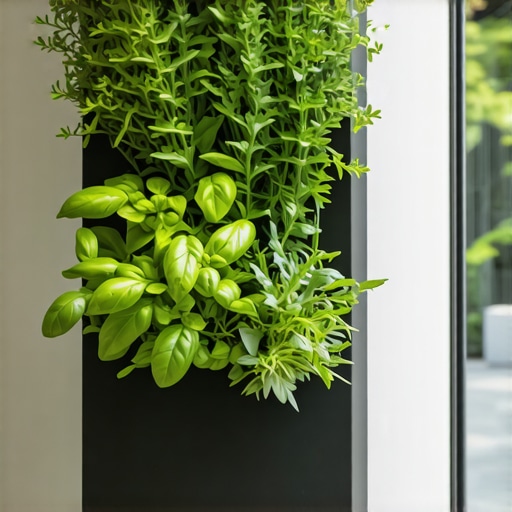
The best herbs for vertical systems include trailing varieties like creeping thyme and upright species like basil or chives, positioned according to their moisture requirements. Because water moves downward through the stack, you must place drought-tolerant Mediterranean herbs like Rosemary and Sage at the top. They can handle the faster drying times and the intense UV exposure. Place the moisture-loving herbs like Mint, Parsley, and Cilantro in the bottom tiers where the water accumulates. This is called ‘hydro-zoning.’ If you put Mint at the top, it will wilt by noon. If you put Rosemary at the bottom, it will develop Phytophthora root rot within a week. You are building an ecosystem, not just a decoration. Think about the photosynthetic photon flux density (PPFD). The top tier gets 100% of available light; the bottom tiers might be shaded by the foliage above. Plan accordingly.
Maintenance and the 2026 Nutrient Protocol
Long-term success in vertical herb gardening requires a precision fertilization schedule and flush cycles to prevent salt accumulation from tap water. In small containers, the nitrogen cycle is highly volatile. You do not have the buffering capacity of a 500-square-foot garden bed. I recommend using a water-soluble, organic-based fertilizer with a 5-1-1 NPK ratio every 14 days. Do not use cheap granular synthetic fertilizers; they contain high concentrations of salts that will scorch the roots in a confined space. Every fourth watering, you should ‘flush’ the system by watering until 20% of the volume exits the bottom of the planter. This removes excess sodium and carbonates that build up in the media. Watch for the ‘settling’ period. In the first three months, your media will settle by about 10%. Top it off with more compost and perlite. Don’t just add more mulch. Mulch volcanoes at the base of your herbs will trap moisture against the stem and rot the plant. Keep the root flares exposed. It is a simple rule, but skip it and you will be buying new plants by July. This isn’t magic; it’s biology. Treat it with the respect it deserves and you will have more herbs than you can use.
![5 Vertical Garden Layouts for Small 2026 Patios [DIY]](https://lawnmajesty.com/wp-content/uploads/2026/05/5-Vertical-Garden-Layouts-for-Small-2026-Patios-DIY.jpeg)