Build a $250 2026 River Rock Garden Path
The Engineering Fundamentals of a Low-Cost River Rock Path
To build a 2026-ready river rock garden path on a $250 budget, you must prioritize subgrade compaction, non-woven geotextile separation, and hydrostatic drainage over purely aesthetic considerations. This approach ensures the path remains stable against freeze-thaw cycles and heavy foot traffic without the need for expensive structural concrete or pavers.
I recently got called out to tear up a $30,000 patio that was sinking because the previous contractor thought they could skip the sub-base and just throw down some ‘pretty’ stone over topsoil. Within two seasons, the clay underneath saturated, the hydrostatic pressure pushed the fines up into the decorative layer, and the whole thing became a muddy, expensive mess. I spent three days excavating their failure before we could even start the remediation. It was a textbook case of ignoring the soil physics. Don’t be that guy. Even on a small $250 budget for a garden path, if you don’t fix the soil grading and base first, you are just throwing money into a hole. You need to understand that the soil is a living, shifting engine. If you don’t account for how water moves through it, the earth will eventually reclaim your path.
Phase 1: Soil Physics and Site Preparation
The success of any hardscaping project depends on the CBR (California Bearing Ratio) of the underlying soil and ensuring a positive slope away from structures to prevent water ponding. You must excavate at least 4 to 6 inches deep to remove organic matter that will eventually rot and cause settling.
“A retaining wall doesn’t fail because of the stone; it fails because of the water trapped behind it.” – Hardscape Engineering Axiom
How much modified gravel do I need for a patio base?
To calculate the required 2RC or modified gravel, multiply the square footage of your path by the desired depth (usually 2-3 inches for a walkway) and divide by 324 to get the total cubic yards needed. For a $250 project, buying in bulk from a local quarry is the only way to keep costs down compared to buying bags at a big-box store.
| Material | Estimated Cost (Bulk) | Function | Critical Specification |
|---|---|---|---|
| #57 Crushed Limestone | $45 – $60 / ton | Base Layer | 98% Compaction |
| River Rock (1-3″) | $80 – $110 / ton | Top Decorative Layer | Rounded Surface |
| Non-Woven Geotextile | $0.40 / sq ft | Separation Layer | 4.0 oz / sq yard |
| Steel Edging | $2.50 / linear ft | Lateral Constraint | 14 Gauge Min. |
Phase 2: The Foundation and Drainage Layer
A stable path foundation requires a layer of compacted aggregate that provides structural integrity while allowing vertical drainage into the subsoil. Skip the cheap plastic ‘weed barrier’ from the garden center; it will tear under the weight of the rocks and allow mud to seep through within 18 months.
- Call 811 to mark underground utilities before any shovel hits the dirt.
- Excavate the path to a uniform depth of 5 inches.
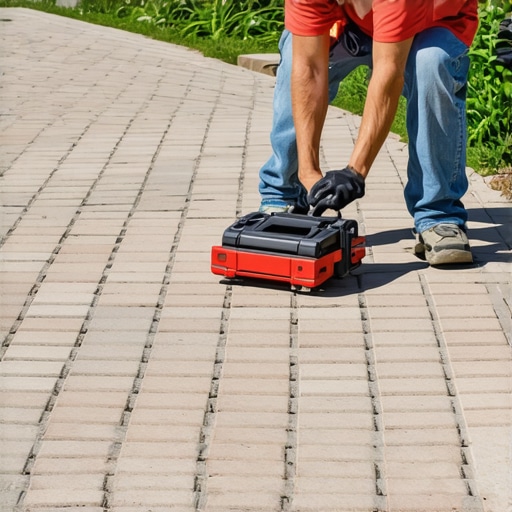
- Compact the subgrade using a manual tamper or a rented plate compactor.
- Install a heavy-duty non-woven geotextile fabric to separate the soil from your rocks.
- Grade the path with a 1% to 2% slope to shed water laterally.
Precision matters here. Use a line level. Don’t eyeball it. If you have a flat spot, water will sit. If water sits, ice will form in the winter. If ice forms, your path will heave. It is a simple chain of events that leads to failure. I see it every single spring. People think they can skip the grading because it’s ‘just a path.’ It isn’t. It’s a drainage system that you happen to walk on.
Phase 3: Material Selection and Lateral Constraint
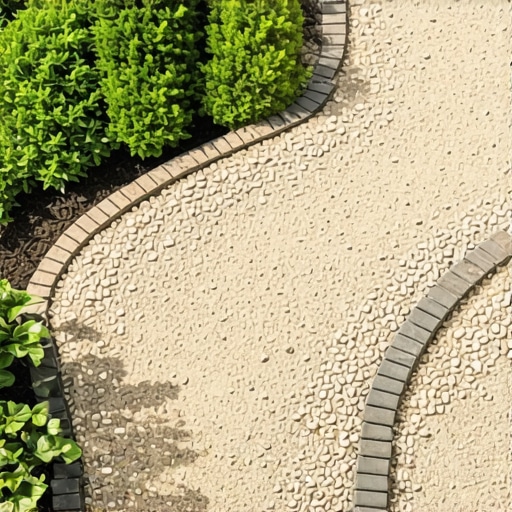
Selecting river rock with a diameter of 1 to 3 inches provides the best balance of footing stability and permeability while remaining cost-effective for a 2026 budget. You must use a lateral constraint, such as steel or heavy-duty composite edging, to prevent the stones from migrating into the lawn or garden beds over time.
“Soil compaction is the most critical and most neglected part of any landscape installation; without it, the structural integrity of the project is compromised from day one.” – Penn State Department of Plant Science
What is the best way to prevent weeds in a rock garden?
The most effective weed prevention strategy involves using a high-quality geotextile combined with a thick (3-inch) layer of stone to block sunlight, supplemented by a pre-emergent herbicide applied twice annually to kill wind-blown seeds. Do not rely on fabric alone; weeds grow in the sediment that settles between the rocks, not just from the soil below.
Phase 4: Installation and Long-Term Maintenance
Final installation of the river rock involves spreading the stone evenly over the compacted base and ensuring the edging is set slightly above the final stone height to contain the material. Avoid overfilling the path; the stones should sit roughly half an inch below the top of the edging to prevent ‘spill-over’ during heavy rains.
Maintain the path. Blow out leaves. If organic debris breaks down between the stones, it creates a seedbed for weeds. It will rot. Once a year, hit the path with a high-pressure hose to wash any accumulated silt down through the stones and into the drainage layer. This keeps the path clean and ensures the porosity remains high. Landscaping is not a one-and-done event; it is a management cycle. If you ignore it for three years, you will be digging it up again in five. Treat the $250 investment with the same respect you would a $25,000 driveway. The physics doesn’t care about the price tag.