Build a $300 2026 Stone Fire Pit Surround [DIY]
The Engineering Reality of a $300 Fire Pit Surround
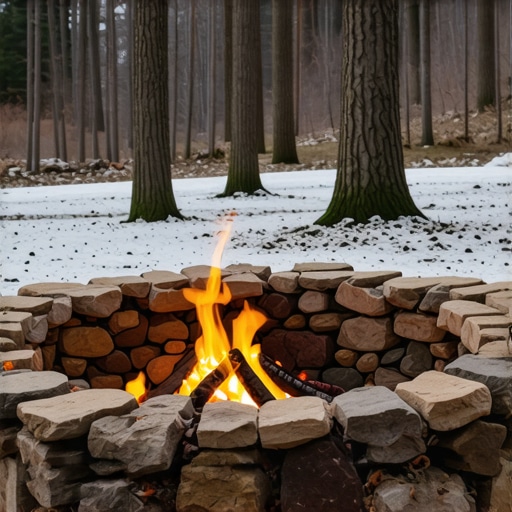
Building a stone fire pit surround for under $300 in 2026 requires a shift from aesthetic dreaming to rigorous civil engineering on a micro-scale. A durable $300 fire pit surround depends on a 4-inch compacted base of ¾-inch modified crushed stone, a non-woven geotextile fabric layer, and a top-dressing of angular aggregate to ensure structural stability and efficient drainage. Most DIY failures occur because the homeowner prioritizes the visible stone over the subgrade preparation. Without a properly compacted base, the first freeze-thaw cycle will heave your pavers, turning a weekend project into a liability. I have spent 20 years fixing the mistakes of ‘mow-and-blow’ crews who think a layer of sand is a foundation. It is not. It is a recipe for a sinking mess. I recently got called out to tear up a $30,000 patio that was sinking because the previous contractor used limestone screenings—which hold water—instead of a clean, modified gravel base that allows for drainage. The hydrostatic pressure simply pushed the stones out of alignment. Do not make that mistake with your fire pit. You are not just laying stones; you are managing soil mechanics and water flow.
Why Site Preparation Dictates Fire Pit Longevity
Site preparation for a stone fire pit surround involves excavating to a depth of 6-8 inches, removing organic matter, and installing a compacted 4-inch base of ¾-inch modified crushed stone to prevent frost heave and structural settling. Soil is a living, shifting entity. If you leave grass or organic topsoil beneath your surround, it will decompose, create voids, and lead to catastrophic settling. You must reach the sub-base, typically a dense clay or mineral soil, and compact it until it is rock hard. This is where the real work happens. Use a manual tamper or, better yet, rent a power plate compactor. You want to achieve 95% Standard Proctor Density. If the tamper doesn’t bounce off the ground, you aren’t done yet.
“A retaining wall doesn’t fail because of the stone; it fails because of the water trapped behind it.” – Hardscape Engineering Axiom
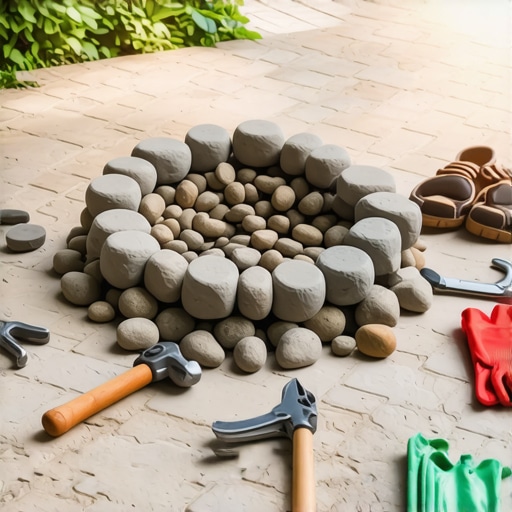
This principle applies to your fire pit surround as well. If water cannot move through the base and away from the pit, the expansion of freezing water will destroy your work. [image_placeholder_1]
How much modified gravel do I need for a patio base?
To calculate the amount of modified gravel needed, multiply the square footage of your surround by the desired depth in feet (e.g., 0.33 feet for 4 inches), then divide by 27 to get cubic yards. Most local quarries sell by the ton, so multiply your cubic yardage by 1.5 to ensure you have enough for compaction. Precision matters. Ordering too little means you’ll skip the final lift; ordering too much means you’re hauling away heavy debris. For a standard 10-foot diameter surround, you are looking at roughly 1.5 to 2 tons of base material. Do not substitute this with ‘all-purpose’ sand from a big-box store. Sand is a leveling medium, not a structural base. You need angular stones that lock together under pressure.
Material Breakdown: Maximizing a $300 Budget
Achieving a high-end look on a $300 budget in 2026 requires sourcing materials from local quarries rather than retail landscaping centers. Retailers mark up stone by 300% or more. By purchasing 2A modified stone for the base and bulk Mexican beach pebbles or crushed granite for the surface, you can keep material costs under $220, leaving $80 for rentals or edging. Avoid the ‘kits’ sold at home improvement stores. They are often made of inferior pre-cast concrete that spalls after three fires. Look for natural stone leftovers or ‘boneyard’ specials at local stone yards.
| Material | Estimated Cost | Benefit | Engineering Role |
|---|---|---|---|
| 3/4″ Modified Stone | $60 – $80 | Compaction | Load-bearing foundation |
| Non-woven Geotextile | $30 – $40 | Separation | Prevents soil migration |
| Angular Crushed Granite | $100 – $120 | Stability | Top-dress/Surface friction |
| Steel Edging (4 lengths) | $60 – $70 | Containment | Lateral pressure resistance |
While the internet tells you to water every day during the build, you actually only need to ‘moisturize’ the gravel base during compaction. Over-saturation creates a slurry that will never stabilize. You want just enough moisture to lubricate the particles so they slide into a tight matrix.
What is the best stone for a fire pit surround?
The best stone for a fire pit surround is an angular, crushed volcanic rock or granite because these materials provide high surface friction, preventing the stones from shifting underfoot. Avoid rounded river rocks; they act like ball bearings and create an unstable walking surface. Furthermore, river rocks can contain trapped moisture that expands when heated by the fire, causing the stones to crack or explode. Always opt for igneous rocks that have been mechanically crushed. This creates ‘interlocking’ capability which is vital for a dry-laid surround.
“Proper drainage is the single most important factor in the longevity of any hardscape installation, regardless of climate or soil type.” – ICPI Tech Spec 2
The Step-by-Step Installation Protocol
The installation process for a $300 fire pit surround requires a specific sequence of excavation, fabric placement, base compaction, and stone setting. Follow this checklist to ensure a professional-grade result:
- Mark a 10-foot diameter circle using a center stake and string line.
- Excavate to a depth of 7 inches, ensuring a 1% slope away from the fire pit for drainage.
- Lay non-woven geotextile fabric over the bare soil to prevent the gravel from sinking into the clay.
- Install your base in 2-inch ‘lifts,’ compacting each layer thoroughly before adding the next.
- Set your fire pit ring first, then build the surround outward to ensure perfect concentricity.
- Install steel edging around the perimeter to prevent lateral migration of the surface stones.
- Fill the top 2 inches with your decorative stone, leveling it with a garden rake.
Don’t skip the fabric. Without it, your expensive stone will eventually vanish into the subsoil. It is a physical impossibility for stones to stay level on raw dirt over time. Capillary action will pull the fines up and swallow the aggregate. Stop the cycle before it starts. [image_placeholder_2]
Managing Heat and Soil Microbiology
A fire pit surround isn’t just about the stones; it affects the local soil microbiology and root systems of nearby trees. Intense heat from a fire pit can sterilize the soil up to 12 inches deep, killing beneficial mycorrhizal fungi and potentially scorching the ‘root flare’ of adjacent hardwoods. If you are building near a tree, you must consider the drip-line. Never build a fire pit directly over a major lateral root. The heat can cause cambium damage, leading to the slow death of the tree over 3-5 years. In my crew, we call this ‘stealth killing.’ The homeowner thinks the tree died of old age, but it was actually the DIY fire pit that cooked the roots. Maintain at least a 15-foot clearance from any significant canopy. This is about fire safety, but it’s also about horticultural preservation. Your landscape is an ecosystem. Don’t sacrifice a 50-year-old oak for a weekend fire pit project. The surround acts as a thermal buffer, but it doesn’t eliminate the downward heat transfer. Use a heat shield or a layer of fire bricks inside the pit to reflect energy upward and protect the structural integrity of your surround base.
The “Settling In” Period
Expect your surround to settle slightly in the first 6 months. This is normal. After the first major rain event, check for low spots and top-dress with additional decorative stone to maintain a level surface. If you used modified stone for the base, it will continue to cure and harden as it goes through wet-dry cycles. Avoid using chemical weed killers on the surround. Instead, use a high-strength vinegar solution or a propane torch. Chemicals can leach through the porous stone and contaminate the sub-base, eventually reaching the root zones of your lawn. This is how you maintain a professional-grade landscape. You think like a chemist and act like an engineer. Landscaping is a game of inches and pH levels. If you follow this technical path, your $300 surround will look better and last longer than the $5,000 ‘designer’ versions built on sand. Build it once. Build it right.”,