Build a $400 2026 Stone Fire Pit for Patios
The Foundation of Every Stone Fire Pit Project
A $400 stone fire pit requires a 6 inch compacted base of 3/4 inch modified crushed stone and a heat resistant steel ring to prevent structural failure. Success in 2026 relies on proper soil excavation and managing hydrostatic pressure through a leveled, non shifting sub base.
I recently got called out to tear up a $30,000 patio that was sinking because the previous contractor failed to account for the capillary action of the native clay soil. The homeowner wanted a fire pit added, but the entire foundation was a mess of shifting pavers and trapped moisture. If you don’t handle the subsurface engineering, your fire pit will eventually lean, crack, or settle into a dangerous mess. I told my crew that day: we aren’t just laying stone; we are managing water and gravity. That is the difference between a contractor and a guy with a truck. Most DIY kits fail because they ignore the soil. You cannot just drop stones on grass. The grass dies, the organic matter rots, and your fire pit sinks. It is basic biology and physics. You need to reach the subsoil. You need to understand the compaction rate of the earth beneath your feet.
“A retaining wall doesn’t fail because of the stone; it fails because of the water trapped behind it.” – Hardscape Engineering Axiom
The Science of Soil and Site Preparation
Before you buy a single block, you must analyze your dirt. Most residential yards consist of a thin layer of topsoil over a denser B-horizon of clay or silt. You must excavate at least 8 to 12 inches deep. This removes the organic material that will compress over time. If you live in a region with heavy freeze-thaw cycles, this depth is non-negotiable. I have seen 400 pound fire pits heave 2 inches out of the ground because the owner skipped the gravel base. Use a flat-head shovel to create a clean, vertical edge. This prevents the surrounding turf from encroaching on the structural base. Don’t skip this. A messy hole leads to a messy build.
How much modified gravel do I need for a fire pit?
Calculating your base material requires multiplying the area of the pit by the desired depth (usually 6 inches) and adding a 20 percent compaction factor. For a standard 48 inch diameter pit, you will typically need about 0.5 to 0.75 tons of 2A modified stone to ensure a stable, non-shifting foundation. This stone contains both 3/4 inch aggregate and fine dust. When you hit this with a hand tamper, it locks together. It becomes a solid plate. It allows for drainage while providing the PSI strength needed to hold the weight of the masonry. If you use round pea gravel, it will never lock. It will act like ball bearings. Your fire pit will slide. Use the right stone.
| Material Item | Quantity / Spec | Estimated Cost (2026) |
|---|---|---|
| Wall Blocks (Concrete) | 36-42 Units | $180 – $220 |
| 3/4 Inch Modified Stone | 0.5 Tons | $40 – $60 |
| Heat-Resistant Steel Insert | 30 Inch Diameter | $70 – $90 |
| Landscape Adhesive (High Temp) | 3 Tubes | $25 – $35 |
| Leveling Sand | 3 Bags | $15 – $20 |
The Thermal Reality of Masonry
Concrete blocks are not fireproof. This is a fact that most big-box stores won’t tell you. Standard concrete contains moisture. When that moisture hits 500 degrees Fahrenheit, it turns to steam. If that steam cannot escape, the block will undergo thermal spalling. It can even explode. This is why a steel insert or firebrick lining is mandatory for a $400 build. The steel ring acts as a thermal shield. It creates an air gap between the flame and the stone. This gap is vital. It allows for convective cooling. It preserves the integrity of the adhesive you used to bond the stones together. Use a heavy-gauge 10-12 gauge steel. Thin 20-gauge rings will warp after three fires. Spend the extra $20 on the thicker metal.
What is the best stone for a DIY fire pit?
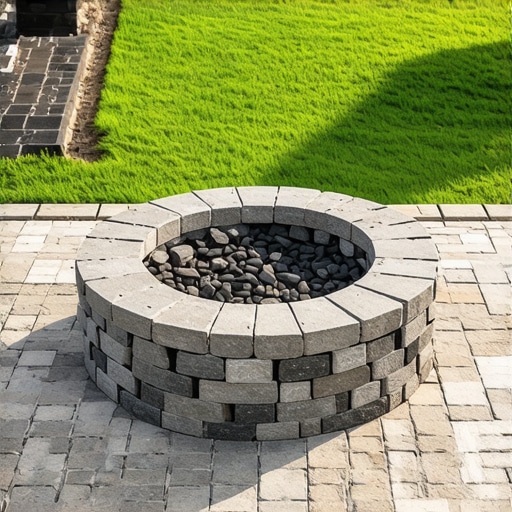
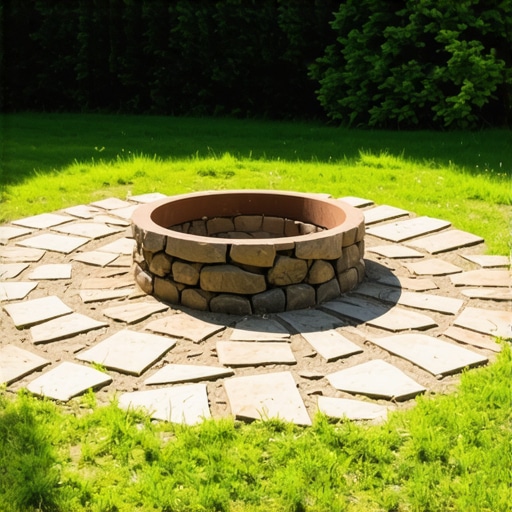
The best stone for a DIY fire pit is a kiln-fired concrete wall block or natural granite due to their high density and resistance to thermal shock. Avoid soft limestones or river rocks, which often contain high moisture levels that can lead to explosive fracturing when exposed to direct flame contact. Natural fieldstone looks great but is difficult to level without professional mortar skills. For a $400 budget, the tumbled concrete block is the king of the industry. It provides the look of natural stone with the engineering precision of a manufactured product. It makes the leveling process much easier for a homeowner.
- Call 811 before you dig to mark underground gas and electric lines.
- Excavate a circle 12 inches wider than the fire pit diameter.
- Compact the subgrade soil until it is rock hard.
- Add 6 inches of modified stone in 2-inch lifts, compacting each layer.
- Set the first course of blocks perfectly level in all directions.
- Stagger the joints of the second and third courses for structural bond.
- Install the steel ring and check for a snug fit.
- Apply high-temperature masonry adhesive to the top course only.
“Proper drainage is the silent partner of every successful hardscape installation; without it, the soil’s load-bearing capacity is compromised by saturation.” – ICPI Technical Manual
The Engineering of Airflow and Combustion
A fire needs oxygen. If you build a solid stone cylinder, you create a vacuum that results in a smoky, struggling flame. I always tell my clients to leave two small gaps in the bottom course of stone. These are your intake vents. Position them opposite each other to catch the prevailing wind. This creates a Venturi effect. It pulls fresh air into the base of the fire, pushing the smoke upward and outward. It makes the fire hotter and cleaner. This is how you avoid the dreaded “smoke in the face” all night. Also, fill the center of the pit with 2 inches of lava rock or small gravel. This keeps the logs off the dirt and allows for better drainage after rain. Standing water in a fire pit is a breeding ground for mosquitoes. It also ruins the flavor of any food you might cook over the coals.
Long Term Maintenance and Safety
Once the pit is built, the work isn’t done. You need to check the stone joints every spring. The freeze-thaw cycle in many climates will try to push these stones apart. If a block is loose, scrape off the old adhesive and apply a fresh bead. Keep the ash level low. Ash is acidic. When it gets wet, it forms a paste that can eat away at the steel ring and the bottom of your blocks. Clean it out once a month. As for safety, keep the pit 10 to 15 feet away from any structures or overhanging trees. Do not place it on a wooden deck. It sounds like common sense, but I have seen the charred remains of decks because someone thought a few pavers were enough protection. It isn’t. The radiant heat will eventually ignite the wood. Stick to the ground. Stick to the stone.