Stop 2026 Tree Root Damage with Proper Soil Care
The Forensic Autopsy of a Dying Root System
To stop tree root damage in 2026, you must address soil compaction and nutrient stratification by maintaining a bulk density below 1.5 g/cm3 and ensuring the root flare is exposed. Managing hydrostatic pressure and utilizing physical root barriers effectively prevents the structural failure of adjacent hardscaping while preserving the specimen’s biological integrity.
I always drill into my new crew members: if you don’t fix the soil grading first, every plant you put in the ground is just expensive compost. I’ve seen it a thousand times. A homeowner spends five figures on a mature White Oak, only to have the crew bury the root flare under six inches of heavy clay fill. Within three years, the tree is strangled by girdling roots and the nearby paver walkway is buckled like a cheap card table. You can’t fight physics, and you certainly can’t fight biology. When soil is compacted, roots don’t grow down; they grow out and up, searching for the oxygen and water that the crushed soil pores can no longer provide. This isn’t just about ‘gardening.’ This is civil engineering with a biological component.
“A retaining wall doesn’t fail because of the stone; it fails because of the water trapped behind it.” – Hardscape Engineering Axiom
Why Tree Roots Destroy Hardscaping: The Search for Oxygen
Tree roots migrate toward hardscape installations because the void space in gravel bases often provides the only aerobic environment in a compacted urban site. This opportunistic growth leads to the lifting of pavers and the cracking of concrete as the root’s radial expansion exerts immense pressure on the subgrade.
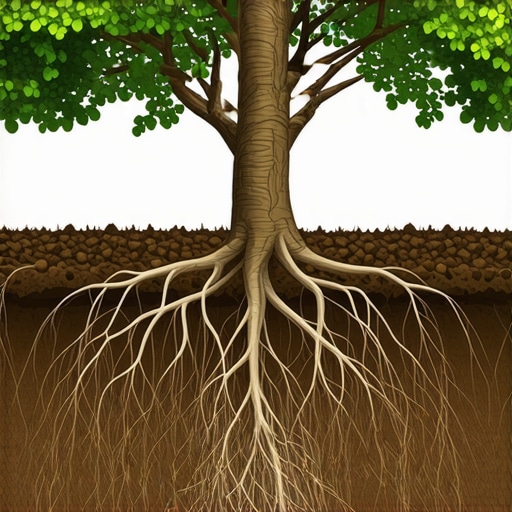
In a healthy ecosystem, soil consists of 50% solid material and 50% pore space. That pore space is divided between water and air. When we build patios or driveways, we often over-compact the surrounding landscape. The tree roots, desperate for gaseous exchange, follow the oxygen gradient directly under your pavers. Once they find the 21A or #57 stone base of your patio, they flourish. As the root diameter increases by mere millimeters each year, it generates enough force to heave thousand-pound slabs. It is a slow-motion car crash. [image_placeholder_1]
How do I stop tree roots from lifting my patio?
Stopping root heave requires a multi-tiered approach: install a physical root barrier at least 24 inches deep, use a reinforced gravel base, and ensure the soil adjacent to the hardscape is aerated. Deep root fertilization forces growth downward into the lower soil horizons rather than horizontally under the patio surface.
The Chemical Reality: Soil pH and Cation Exchange
The chemical composition of your soil, specifically its pH and Cation Exchange Capacity (CEC), determines how aggressively a tree’s root system will search for nutrients in 2026. Soils with poor nutrient mobility force the tree to expand its root footprint rapidly, increasing the risk of structural damage to nearby landscaping.
If your soil pH is off-kilter, nutrients like phosphorus and iron become ‘locked’ and unavailable to the tree. In alkaline soils, roots often become desperate and invasive. We measure CEC to understand how well the soil holds onto essential cations like Calcium, Magnesium, and Potassium. A low CEC soil—common in sandy regions—means nutrients leach out faster than a sieve. To fix this, we don’t just dump 10-10-10 fertilizer on top. That’s a hack’s move. We incorporate organic matter to build the soil’s ‘battery’ (CEC) and use sulfur or lime to bring the pH into the 6.0 to 7.0 range for most hardwoods. Stop guessing and start testing.
| Soil Condition | Root Behavior | Hardscape Risk Level | 2026 Mitigation Strategy |
|---|---|---|---|
| High Compaction | Surface Crawling | Extreme | Mechanical Aeration / Air-Spade |
| Low CEC (Sandy) | Extensive Search | High | Organic Matter / Biochar Inoculation |
| Improper Grading | Root Girdling | Moderate | Regrading / Root Flare Exposure |
| Hydrostatic Load | Base Infiltration | Extreme | French Drains / Perforated Pipe |
“Root growth is significantly reduced when soil bulk density exceeds 1.6 g/cm3, as the mechanical resistance of the soil becomes greater than the turgor pressure of the root cells.” – Texas A&M Agrilife Extension
The 2026 Soil Health Audit: A Professional Checklist
Do not wait for the sidewalk to crack before you take action. Use this checklist to evaluate your site’s risk factors.
- Expose the Root Flare: If the tree looks like a telephone pole sticking out of the ground, it’s too deep. Excavate until you see the structural transition from trunk to root.
- Bulk Density Test: Use a penetrometer. If you can’t push it into the ground with ease, your tree is suffocating.
- Mycorrhizal Check: Healthy soil should smell earthy, indicating fungal activity. If it smells like rotten eggs, it’s anaerobic.
- Drainage Slope: Ensure a minimum 2% slope away from tree trunks and hardscape foundations to prevent root rot.
What is the best soil for healthy tree roots?
The ideal soil for tree health is a well-structured loam consisting of roughly 40% sand, 40% silt, and 20% clay, with at least 5% organic matter. This balance ensures adequate drainage while maintaining the water-holding capacity necessary to support the tree during summer heat without forcing aggressive root searching.
Engineering the Root Zone: Hardscaping and Biology
Properly engineered hardscaping incorporates ‘root paths’ or structural soils that allow for both pavement stability and healthy root expansion without conflict. Using CU-Structural Soil or Silva Cells provides the necessary load-bearing capacity for vehicles while maintaining 30% porosity for root growth.
When we design a modern landscape, we look at the ‘Zone of Rapid Taper.’ This is the area within 3 to 10 feet of the trunk where the roots are thickest. If you must put a walkway here, you don’t use poured concrete. You use a flexible paver system with a ‘bridging’ base. This allows the ground to move slightly without the entire structure failing. Furthermore, the use of Biobarrier—a geo-textile infused with trifluralin—can chemically deflect roots away from sensitive areas without killing the tree. It’s about surgical precision, not blunt force. Don’t be the contractor who just cuts the roots and hopes for the best. That tree will blow over in the next windstorm, and you’ll be the one liable.