
3 Reasons Your Yard Always Stays Soggy After Rain
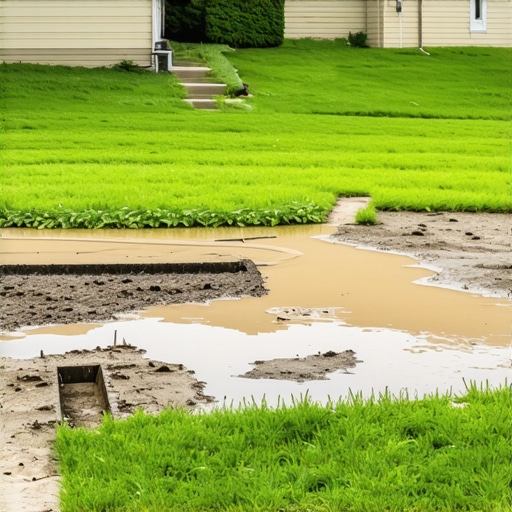
Walk out onto your lawn twenty-four hours after a storm. If you hear a distinctive squish or see water pooling around your ankles, your property is failing a fundamental engineering test. This isn’t just an aesthetic nuisance; it is a slow-motion architectural disaster. Standing water indicates a total breakdown in hydraulic conductivity, leading to anaerobic soil conditions that suffocate root systems and compromise the structural integrity of your hardscapes. As someone who has spent two decades excavating failed projects, I can tell you that water always wins. If you don’t give it a path, it will carve its own through your foundation.
The Hardscape Autopsy: A $30,000 Lesson in Drainage
I recently got called out to tear up a $30,000 patio that was sinking because the previous contractor ignored the basic laws of hydrostatic pressure. The homeowner showed me a beautiful set of pavers that, after only two seasons, looked like a topographical map of the Himalayas. Upon excavation, the culprit was clear: they had used a standard sand base over heavy clay without a single foot of perforated pipe or a geotextile barrier. The base had become a bathtub. The water had nowhere to go, so it saturated the bedding layer, turned the subgrade into slurry, and the entire structure simply collapsed under its own weight. We had to haul away tons of ‘soup’ before we could even start the remediation. This is what happens when you hire a mow-and-blow crew to do a civil engineer’s job. Don’t be that homeowner.
1. Soil Compaction and High Clay Content (The Pore Space Problem)
A soggy yard is often caused by high bulk density in the soil, where heavy clay or mechanical compaction eliminates macro-pores. This prevents gravity from pulling water through the profile, resulting in perched water tables that drown turf roots and cause anaerobic conditions. Most residential lots are ‘vandalized’ by heavy machinery during construction, leaving a layer of soil as hard as concrete just four inches below the sod. Look at it under a microscope: you need 50% solid material and 50% pore space (half water, half air). When you lose that air, you lose the lawn.
“Soil compaction occurs when soil particles are pressed together, reducing pore space between them. Heavily compacted soils contain few large pores and have a reduced rate of both water infiltration and drainage from the root zone.” – Penn State Extension Agronomy Manual
If you have high clay content, you are dealing with plate-like particles that stack and bond together. This creates a literal seal. You can dump all the fertilizer you want, but if the soil is compacted, those chemicals just sit on the surface, eventually washing into the storm drains. To fix this, you need more than a simple aerator. You need deep core aeration followed by a top-dressing of organic compost or calcined clay to physically change the soil structure. It takes years to fix a clay profile. It takes one afternoon to ruin it with a heavy truck.
How do I know if my soil is compacted?
Perform a ‘Screwdriver Test.’ If you cannot easily push a standard flathead screwdriver six inches into the soil when it is moist, your bulk density is too high. You are essentially trying to grow grass on a parking lot. Another method is the percolation test. Dig a hole 12 inches deep, fill it with water, and time how long it takes to drain. If it takes more than four hours, your infiltration rate is failing.
2. Grading and Hydrostatic Pressure (The Surface Logic)
Improper surface grading or a lack of positive slope (less than 2%) forces water to pool rather than flow toward a discharge point. Without a clear exit, water exerts hydrostatic pressure against foundations and hardscapes, leading to structural failure and persistent saturation in low-lying areas. Water follows the path of least resistance. If your yard has a ‘bowl’ shape, you are the neighborhood’s catch basin. It is a simple matter of physics and surveying.
“Adequate drainage is the single most important factor in the performance of any hardscape. Without a way for water to escape the sub-base, the entire structure is subject to frost heave and settlement.” – Hardscape Engineering Axiom (ICPI)
The solution isn’t always adding more dirt. In fact, most DIYers make it worse by piling topsoil against the foundation, which leads to rot and termite issues. You need a 1-inch drop for every 4 feet of horizontal distance away from the house. If your lot doesn’t allow for that, you need to move from passive drainage to active drainage. This means installing a French drain or a dry well. We’re talking 4-inch NDS pipe, wrapped in a 140N non-woven geotextile, buried in a trench of #57 clean stone. Don’t use those cheap corrugated pipes from the big box store. They crush. They clog. They fail. Use Schedule 40 PVC if you want it to last fifty years.
| Solution Type | Best For | Longevity | Installation Difficulty |
|---|---|---|---|
| French Drain | Sub-surface water/High water table | 25+ Years | High (Requires Excavation) |
| Catch Basins | Surface pooling/Downspout runoff | 20 Years | Medium |
| Dry Creek Bed | Heavy runoff/Erosion control | Lifetime | Medium (Aesthetic focus) |
| Core Aeration | Surface compaction | 1-2 Years | Low |
3. Subsurface Barriers and The ‘Sponge Effect’
Invisible barriers like buried debris, “souping” gravel bases, or a high groundwater table can trap moisture near the surface. When impermeable layers exist just below the root zone, even light rain creates a saturation point that takes days to dissipate without mechanical intervention. Sometimes the problem isn’t the soil you can see; it’s the junk the builder buried twenty years ago. I’ve pulled old plywood, concrete chunks, and even rusted car parts out of ‘soggy’ yards. These items create a physical barrier that stops the downward migration of water.
Furthermore, many modern yards suffer from ‘mulch volcanoes’ and over-mulching. While organic matter is good, a four-inch thick layer of shredded hardwood becomes a hydrophobic mat or a giant sponge that holds moisture against the crown of your plants. This leads to root rot and fungal pathogens. It’s a fine balance. You want moisture in the soil, not a swamp on top of it. If your garden design doesn’t account for the volume of water coming off your roof, your garden is just a very expensive filter for your gutters.
How much modified gravel do I need for a patio base?
For a standard pedestrian patio, you need a minimum of 4 to 6 inches of compacted 21A or 3/4-inch modified gravel. If the soil is heavy clay, you must increase this to 8 or 10 inches and use a woven stabilization fabric. Every lift of 2 inches must be compacted with a plate tamper until it reaches 95% Standard Proctor Density. If the tamper doesn’t bounce off the stone, it isn’t ready. Skipping this step is why your patio will be soggy and uneven within three years.
- Step 1: Locate all underground utilities (Call 811).
- Step 2: Identify the low point of the property with a transit level.
- Step 3: Conduct a ribbon test to determine clay vs. silt vs. sand ratio.
- Step 4: Check downspout discharge; never let them empty within 10 feet of the foundation.
- Step 5: Inspect for ‘Hardpan’ layers—compacted soil that prevents vertical drainage.
The Forensic Remediation Plan
If you’re tired of the muck, stop buying bags of seed and start buying a shovel. First, address the source. Is the water coming from your neighbor’s property? Is it coming from your roof? If it’s roof water, pipe it away. If it’s groundwater, you need a French drain. The remediation process starts with a topographical survey. You have to know the elevations. Once you have the elevations, you can cut your swales or dig your trenches. When installing a drain, the slope of the pipe is non-negotiable. You need an 1/8-inch drop per foot. Gravity doesn’t take days off. Don’t fight it.
After the mechanical drainage is installed, address the biology. Use a high-quality turf-type tall fescue or a native grass with deep root structures. Deep roots create natural macropores. Avoid high-nitrogen fertilizers during the wet season, as they force top-growth at the expense of root development, making the plant more susceptible to the very rot that a soggy yard promotes. Maintenance isn’t just mowing; it’s managing the hydraulic cycle of your land. Keep your gutters clean. Keep your drains clear. Watch the water. It tells you everything you need to know about the health of your landscape.

![How to Install 2026 Drip Irrigation [Fast]](https://lawnmajesty.com/wp-content/uploads/2026/09/How-to-Install-2026-Drip-Irrigation-Fast.jpeg)