The Best Way to Remove Moss from Shaded Brick Walkways
The Green Scourge: Why Moss Claims Your Shaded Walkway
The best way to remove moss from shaded brick walkways involves a dual-stage approach of mechanical agitation and low-pH chemical treatment, specifically using 30-percent acetic acid or potassium salts of fatty acids. To prevent recurrence, you must correct the sub-surface drainage and replace degraded joint sand with polymeric sand that creates a hardened barrier against bryophyte spores.
I recently got called out to tear up a $30,000 patio that was sinking because the previous contractor ignored the basic laws of physics. The client complained that no matter how much bleach they dumped on the bricks, the moss came back thicker every month. When I pulled the first three courses of pavers, I didn’t find the required six inches of compacted 3/4-inch modified gravel. Instead, I found two inches of stone dust sitting on top of raw, anaerobic clay. The entire patio was essentially a shallow bathtub. The moss wasn’t the problem; it was the messenger. It was telling us that the ground was perpetually saturated because the water had nowhere to go. If you see moss, you have a moisture management failure. Period.
The Biology of the Invader
Mosses are bryophytes. They don’t have true roots; they have rhizoids. These microscopic anchors don’t pull nutrients from the soil; they simply hang on for dear life while the plant absorbs moisture directly through its leaves. In a shaded environment, the lack of UV radiation means the brick never fully dries. Brick is essentially a hard sponge. It has a high capillary suction rate. When you have shade, moisture, and the slightly acidic environment created by decaying leaves, you have a moss factory. Don’t be fooled by the soft texture. These plants secrete organic acids that slowly dissolve the calcium carbonate in your mortar and the minerals in your brick, leading to long-term structural spalling.
“A retaining wall or paved surface doesn’t fail because of the stone; it fails because of the water trapped behind or beneath it. Proper hydrostatic relief is the only permanent solution for masonry longevity.” – Hardscape Engineering Axiom
How do I keep moss from coming back?
To keep moss from returning, you must eliminate the three pillars of moss growth: persistent moisture, organic food sources (leaf litter), and acidic pH levels. Increasing sunlight penetration by thinning the tree canopy and installing French drains to divert runoff are the most effective long-term strategies for maintaining a dry, moss-resistant hardscape.
The Removal Process: Step-by-Step Forensic Remediation
Stop reaching for the high-pressure power washer immediately. I see homeowners every weekend blasting their bricks with 4,000 PSI. All you’re doing is opening up the pores of the brick, making it even more hospitable for the next generation of moss. You’re also blowing out the joint sand that provides the friction lock for your pavers. It’s a shortcut to a wobbly, broken walkway. It will rot if you don’t fix the joints properly.
Phase 1: Mechanical Debridement
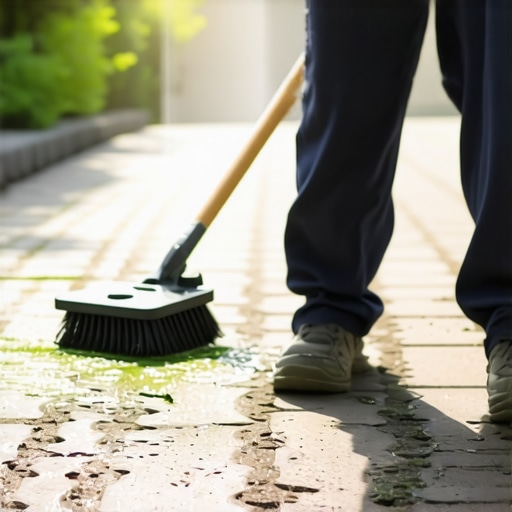
Use a stiff-bristled nylon brush. Avoid wire brushes on clay pavers as they can leave metal traces that rust and stain. Scrape the heavy mats of moss during the heat of the day when they are at their driest. This is manual labor, but it’s necessary. You want to remove the biomass before you apply any chemistry. If you just spray a 2-inch thick mat of moss, the chemical only kills the top 1/8th of an inch, and the bottom keeps right on thriving.
Phase 2: The Chemical Strike
Forget the big-box store “green cleaners” that are 99% water. You need an agent that alters the pH or desiccates the plant at a cellular level. I prefer a 20% to 30% acetic acid (industrial vinegar) solution. Warning: This stuff is not grocery store vinegar. It will burn your skin and lungs. Wear a respirator and gloves. Spray it directly onto the remaining moss residue. The acid collapses the cell walls of the bryophytes almost instantly.
| Treatment Method | Efficacy Rate | Environmental Impact | Longevity |
|---|---|---|---|
| Pressure Washing (>3000 PSI) | High (Temporary) | Low | 2-4 Weeks |
| Bleach (Sodium Hypochlorite) | Medium | High (Kills Soil Microbes) | 1-2 Months |
| Industrial Vinegar (30% Acetic) | High | Low (Biodegradable) | 3-6 Months |
| Zinc Sulfate Strips | High | Moderate | 1-2 Years |
Engineering the Permanent Fix
Once the brick is clean and dry—and I mean bone dry—you have to address the joints. Most old walkways were built with “paver sand” which is just crushed rock. It’s a perfect nursery for moss. I tell my crew: if you don’t fix the soil grading and the jointing, you’re just decorating a disaster. We use high-performance polymeric sand. This is a mix of graded sand and binders that, when wetted, turn into a flexible, mortar-like substance. It seals the joint, preventing spores from finding a home in the gaps. It’s the difference between a professional job and a DIY weekend mistake.
“In saturated soils, the lack of oxygen leads to the reduction of iron and manganese, creating the gray, gleyed appearance common in poorly drained landscapes where moss thrives.” – Penn State Agricultural Extension
Will vinegar damage my bricks?
Vinegar with high acetic acid content is generally safe for fired clay bricks, but it can etch concrete-based pavers or natural limestone. Always test a small, inconspicuous area and ensure you neutralize the area with a water rinse after the moss has turned brown to protect the structural integrity of the masonry joints.
The Maintenance Checklist
Maintaining a moss-free walkway is an ongoing engineering task, not a one-time event. Follow this protocol to ensure your hardscape remains clear:
- Monthly Sweeping: Remove organic fines and leaf litter that provide the “soil” for moss.
- Canopy Thinning: Prune overhanging limbs to allow at least 4 hours of direct or dappled sunlight.
- Gutter Inspection: Ensure downspouts aren’t dumping directly onto the walkway.
- Annual pH Check: Moss loves acidic environments; a light dusting of horticultural lime can discourage growth.
- Joint Integrity: Inspect polymeric sand for cracks and top off as needed to prevent water pooling.
If you live in a region with heavy clay soil like we have in the Mid-Atlantic, drainage is your primary enemy. You can’t fight the earth, but you can out-engineer it. Fix the grade so it falls away from the house at a minimum of 1/4 inch per foot. Use a plate compactor. Don’t skip this. A stable, dry base is the only thing that will keep your bricks from becoming a slippery, green liability. Done right, your walkway should last 50 years. Done wrong, and you’ll be calling me back in two seasons to dig it all up again.
“