
The Hidden Danger of Over-Mulching Your Trees
The Silent Tree Killer: Why Over-Mulching and Mulch Volcanoes Are Destroying Your Landscape
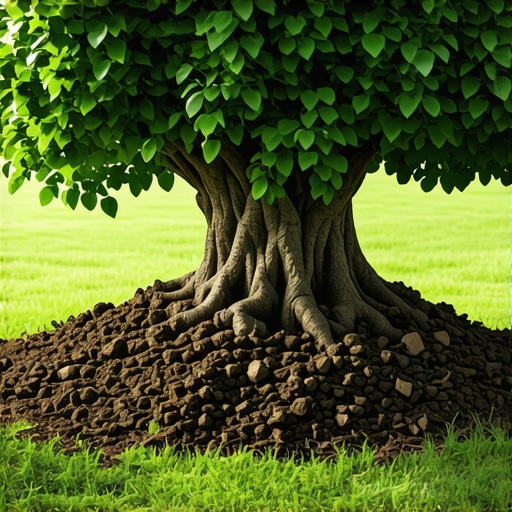
I always drill into my new crew members: if you don’t fix the soil grading first, every plant you put in the ground is just expensive compost. Last week, I had to dress down a new hire, Tyler, who thought he was being ‘thorough’ by piling triple-shredded hardwood mulch eight inches high against the base of a mature Red Maple. He created a mulch volcano. To the untrained eye, it looks clean and manicured. To a veteran horticulturist, it looks like a slow-motion execution. I made him grab a hand rake and expose the root flare immediately. If you bury the flare, you are essentially suffocating the tree’s most vital respiratory and structural junction. Trees are not poles; they are complex biological systems that require gas exchange at the base to survive. [IMAGE_PLACEHOLDER]
The Anatomy of a Mulch Volcano
A mulch volcano is a destructive landscaping error where mulch is piled high against a tree trunk, covering the root flare and trapping moisture. This practice leads to bark decay, root girdling, and anaerobic soil conditions that prevent oxygen from reaching the root system, eventually killing the specimen. It is the hallmark of a lazy contractor.
“Mulch applied too deeply or against the trunk can lead to excess moisture retention against the bark, causing tissue decay and providing an entry point for pathogens.” – Penn State Extension
How much mulch should be around a tree?
The standard industry practice is the 2-2-2 rule. Apply a layer exactly 2 inches deep, starting 2 inches away from the trunk flare, and extending at least 2 feet outward in a ring. This protects the root zone without suffocating the bark or inviting rodents to nest against the trunk. Anything more than 3 inches deep begins to inhibit the movement of oxygen into the soil, which is critical for root respiration. In heavy clay soils, even 2 inches can be too much if the mulch is a fine, matted material like shredded cedar.
The Biological Cost of Root Girdling
Root girdling occurs when a tree’s secondary roots grow into the loose, moist environment of a mulch volcano and eventually encircle the main trunk. As these roots thicken, they compress the phloem and xylem, cutting off the flow of nutrients and water between the canopy and the root system. This strangulation process is often invisible until the tree begins to show signs of canopy dieback or lean. I have seen 40-year-old Oaks fall over in moderate winds because their root systems were compromised by 20 years of improper mulching. The bark under that mulch stays soft and wet. This moisture invites fungal pathogens like Phytophthora and Armillaria to feast on the cambium layer. Once the cambium is gone, the tree is a goner.
| Mulch Type | Decomposition Rate | Gas Exchange Level | Best Landscape Use |
|---|---|---|---|
| Triple-Shredded Hardwood | Fast | Low (when matted) | Active Garden Beds |
| Pine Bark Nuggets | Slow | High | Large Tree Rings |
| Cedar Mulch | Very Slow | Moderate | Pathways/Slope Stabilization |
| Wood Chips (Arborist) | Medium | High | Naturalized Areas |
Structural Failure: From Root Rot to Tip Dieback
Root rot and vascular strangulation are the primary results of over-mulching, leading to chlorosis, premature leaf drop, and structural instability. When the lenticels on the bark are covered by wet mulch, they cannot exchange gases, causing the underlying tissue to die and rot. This creates a feedback loop of decay. The tree tries to compensate by sending out adventitious roots into the mulch layer. These roots are weak and susceptible to drought because they are not in the actual soil. When the mulch dries out during a hot July, those roots die, and the tree loses a significant portion of its ability to take up water. You might think you are helping the tree retain moisture, but you are actually making it more vulnerable to dry spells.
Can you save a tree that has been over-mulched?
Yes, but it requires surgical precision. First, you must manually remove the excess mulch until the root flare is visible. If girdling roots have already formed and begun to bite into the bark, you may need an arborist to perform a root pruning or use an air-spade to clear the soil without damaging the delicate vascular tissue. Don’t just hack at them with a shovel. You need to know which roots are structural and which are strangling. It is a delicate balance. If you’ve caught it early, simply pulling the mulch back and allowing the bark to dry out and harden can be enough to stop the decay.
The Critical Tree Health Audit Checklist
- Expose the Flare: Ensure the trunk widens at the soil line. If it looks like a telephone pole going into the ground, it is too deep.
- Check Mulch Depth: Insert a finger into the mulch. If it is deeper than 3 inches, you are in the danger zone.
- Identify Girdling: Look for roots circling the trunk at or just below the surface.
- Smell the Soil: If the mulch smells like vinegar or rotten eggs, it has gone anaerobic and is killing your soil microbiology.
- Monitor Canopy: Look for yellowing leaves or dieback at the very tips of the branches.
“The root flare is the most critical junction of a tree’s anatomy; burying it is a slow-motion execution.” – ISA Arborist Manual
Stop following the ‘mow-and-blow’ crowds. They want to use as much mulch as possible because they charge by the yard. It is a scam that kills your investment. Proper landscaping is about biology, not just aesthetics. Keep your mulch rings wide and your flares high. Your trees will thank you by living another hundred years. Skip the big-box store dyed mulches that are often made from ground-up pallets and instead look for high-quality, aged organic matter that actually feeds the soil without suffocating the life out of your yard.


![Stop 2026 Leaf Wilt on Roses [Soil Fix]](https://lawnmajesty.com/wp-content/uploads/2026/07/Stop-2026-Leaf-Wilt-on-Roses-Soil-Fix.jpeg)