
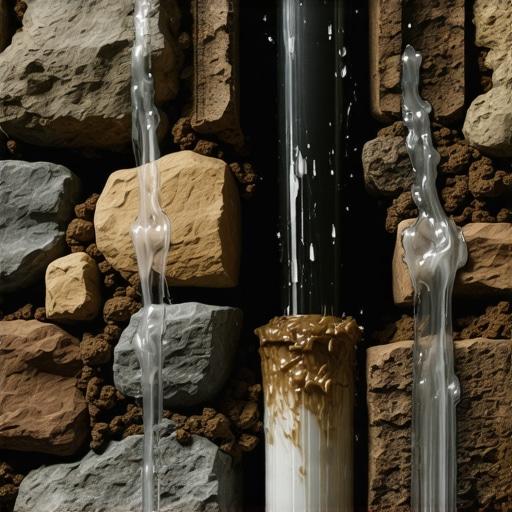
Why Your Retaining Wall Drainage Is Failing
Why Your Retaining Wall Drainage Is Failing: A Hardscape Forensic Report
The failure of a retaining wall is rarely a sudden event; it is a slow, grinding surrender to the laws of physics. You see it in the hairline fractures across the face of a stone veneer or the subtle, sickening lean of a timber wall toward the driveway. When I walk onto a site to diagnose a failing structure, I do not look at the blocks first. I look at the ground. I look for the ‘weeping’—that tell-tale trail of mineral deposits and mud leaking through the joints. It is the signature of a wall that is drowning from the inside out. If your wall is bowing, it is not because the material is weak. It is because you are trying to hold back the weight of the world without giving the water a place to go.
The Hardscape Autopsy: A $30,000 Lesson in Gravity
I recently got called out to tear up a $30,000 patio and retaining wall system that was sinking and tilting because the previous contractor thought he could cheat the drainage layer. The homeowner had paid for premium travertine and custom-cut capstones, but the man behind the shovel had used ‘dirt’ as backfill instead of clean stone. Within two seasons, the hydrostatic pressure had reached a breaking point. The wall had pushed four inches out of plumb, and the expensive pavers were undulating like a wave. We had to excavate every single block, haul away tons of saturated, clay-heavy muck, and start from the virgin subgrade. It was a total loss for the homeowner, all because someone wanted to save $800 on a load of 57 stone and a roll of geotextile fabric. Don’t be that person.
The Physics of Failure: Hydrostatic Pressure and Soil Saturation
Retaining wall drainage fails when the accumulation of water behind the wall increases hydrostatic pressure to a level that exceeds the structural capacity of the wall and its reinforcement. Without proper perforated pipes, clean aggregate backfill, and weep holes, water saturates the soil, doubling its weight and creating a hydraulic jack effect that pushes the wall forward.
“A retaining wall doesn’t fail because of the stone; it fails because of the water trapped behind it.” – Hardscape Engineering Axiom
Water is heavy. One cubic foot of saturated soil can weigh upwards of 120 pounds. When you have a six-foot-tall wall holding back a slope, you are dealing with thousands of pounds of lateral force. In a properly engineered wall, the drainage zone acts as a pressure relief valve. If that zone is clogged with fines or was never installed, the water has nowhere to go but out through the wall itself. This pressure will eventually overcome the friction of the block or the shear strength of the mortar. It is a mathematical certainty.
The Fatal Flaw: Why Your Backfill is Actually a Dam
The most common cause of drainage failure is the use of non-porous backfill materials, such as native clay or unwashed stone, which trap water against the back of the wall. To prevent this, professional installers use 3/4-inch clean angular stone (often called #57 stone) wrapped in a non-woven geotextile fabric to ensure water moves freely to the base drain. Most DIYers and low-bid contractors make the mistake of using ‘modified’ gravel or crusher run. These materials contain ‘fines’—tiny dust particles that, when wet, pack together into a nearly waterproof cement. This creates a dam. You need void space. The gaps between clean stones are where the water travels. Without those gaps, you have a solid mass that holds water like a sponge. Furthermore, if you don’t use a non-woven fabric to separate the soil from the stone, the silt from the yard will migrate into your gravel over time, clogging the system. This is called siltation, and it is the silent killer of hardscapes.
How much modified gravel do I need for a patio base?
For a standard patio, you need a minimum of 4 to 6 inches of compacted modified gravel (2A or CR6), but for the drainage column behind a wall, you should never use modified gravel. Instead, calculate a 12-inch wide column of clean #57 stone for the entire height of the wall. This ensures the hydrostatic pressure never builds up. To find the volume, multiply the wall length by the height by the 1-foot width, then divide by 27 to get the cubic yardage.
What is the best pipe for a retaining wall drain?
Avoid thin, corrugated black plastic ‘sock’ pipe if you want a wall to last 30 years. It crushes too easily under the weight of the stone and backfill. Use SDR-35 perforated PVC. It is rigid, has a higher crush rating, and the smooth interior walls prevent sediment buildup. Ensure the holes are facing down toward the trench bottom so the water table rises into the pipe and is carried away.
Surface Water vs. Subsurface Water Management
Managing wall drainage requires a dual-track strategy: redirecting surface runoff away from the wall’s top edge and evacuating subsurface groundwater through a dedicated pipe system. Failure to address surface grading often leads to ‘overtopping,’ where heavy rain pours over the wall, eroding the base and creating ‘scour’ that undermines the foundation.
| Material Component | Function in Drainage | Risk of Substitution |
|---|---|---|
| SDR-35 PVC Pipe | Subsurface evacuation | Corrugated pipe collapses under load. |
| #57 Clean Stone | Pressure relief / Void space | Modified gravel traps water (damming). |
| Non-Woven Geotextile | Silt filtration | Woven fabric or no fabric leads to clogging. |
| Buried Downspout | Surface water diversion | Surface runoff causes soil erosion and scour. |
The Critical Checklist: Engineering a Dry Wall
- Excavate a proper toe: The drain pipe must sit behind the first course of block, slightly below the finished grade.
- Daylight the pipe: Your drain must exit to a lower point in the yard or a dry well. A pipe that goes nowhere is just a buried bucket.
- Use Chimney Drainage: The clean stone must extend from the base pipe all the way to within 6 inches of the top of the wall.
- Cap with Impermeable Soil: The final 6 inches of backfill should be clay or topsoil to prevent surface water from entering the drainage column directly.
- Check your batter: Lean the wall back into the slope at a rate of 1 inch for every 1 foot of height to counteract future settling.
“Soil saturated with water behaves more like a liquid than a solid, exerting lateral pressure that can exceed the design limits of standard gravity walls.” – Penn State Agricultural Extension
The Local Reality: Clay, Frost, and Failure
In regions with heavy red clay or high silt content, the margin for error is zero. Clay expands when wet and shrinks when dry, a cycle that physically ‘walks’ a wall out of its trench. If you live in a freeze-thaw climate, the stakes are even higher. Saturated soil behind a wall will freeze, expand, and exert ‘frost heave’ pressure. This is why we bury the base of the wall (the ‘toe’) below the frost line in many engineering specs. If your drainage is failing, the ice will crack your blocks like eggshells. Don’t skip the drainage. It’s not an ‘extra.’ It is the only thing keeping your investment from becoming a pile of rubble. It will rot if you let the water win. Fix the grade. Use the right stone. Sleep better when the storm hits.
![Stop Hillside Soil Washout for $200 [2026 DIY Fix]](https://lawnmajesty.com/wp-content/uploads/2026/05/Stop-Hillside-Soil-Washout-for-200-2026-DIY-Fix.jpeg)
![Fix Standing Water: Why Your Yard Needs a Swale [DIY]](https://lawnmajesty.com/wp-content/uploads/2026/06/Fix-Standing-Water-Why-Your-Yard-Needs-a-Swale-DIY.jpeg)