
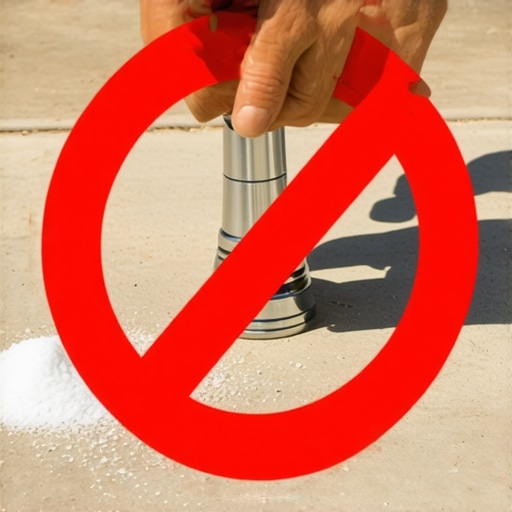
Stop Using Salt on Your Concrete Driveway
Why Traditional Rock Salt Destroys Your Concrete Surface
Rock salt (sodium chloride) destroys concrete by increasing the frequency of freeze-thaw cycles and creating sub-surface osmotic pressure. This chemical reaction leads to scaling, spalling, and structural fatigue. It is a corrosive agent that attacks the cement paste holding the aggregate together. Most homeowners assume salt melts ice and disappears. It does not. It migrates into the pores of the slab. It waits for the temperature to drop. Then it expands. It is a slow-motion explosion under your tires.
I recently got called out to tear up a $30,000 patio and driveway transition that was sinking and crumbling because the previous contractor failed to explain the chemistry of winter maintenance to the homeowner. The surface was pitting so badly you could see the rebar shadows underneath. This wasn’t a weight-load issue. It was a chemical autopsy. The homeowner had been dumping bags of cheap halite on the surface for three winters. That salt worked its way down into the sub-base, altered the soil density, and the entire 4-inch slab began to heave and crack. Once the structural integrity of the top two millimeters is gone, the driveway is on a countdown to total failure. You cannot patch this. You can only replace it. It is a waste of good engineering.
“A retaining wall doesn’t fail because of the stone; it fails because of the water trapped behind it, and the same principle applies to concrete slabs saturated with brine.” – Hardscape Engineering Axiom
The Microscopic Reality of Concrete Damage
Concrete is not a solid, impenetrable block. Under a microscope, it is a network of capillaries and pores. When you apply sodium chloride, it lowers the freezing point of water. This sounds helpful until you realize it increases the saturation of the concrete. This brine solution is drawn into the pores by capillary action. When the temperature eventually drops low enough to freeze that brine, the resulting ice crystals expand by approximately 9% in volume. This creates internal hydraulic pressure that exceeds the tensile strength of the concrete. The result is spalling—where the top layer of the concrete literally pops off in flakes. It is preventable. It is avoidable. Don’t be lazy with your de-icing.
How Salt Poisoning Affects Your Landscaping and Soil
Salt runoff from driveways creates a toxic environment for turf and ornamental plants by causing osmotic drought and destroying soil structure. When the salt washes off the concrete, it enters the root zones of your garden beds. High sodium levels in the soil prevent plants from absorbing water, even if the ground is soaking wet. The salt literally sucks the moisture out of the roots. This is called physiological drought. You will see the edges of your lawn turn brown in April, and you will blame the winter. It wasn’t the winter. It was your spreader.
| De-Icer Type | Minimum Temp (°F) | Concrete Impact | Plant Toxicity |
|---|---|---|---|
| Sodium Chloride (Rock Salt) | 15°F | Extreme (Spalling) | High |
| Calcium Chloride | -25°F | Moderate (Heat Release) | Medium |
| Magnesium Chloride | -5°F | Low | Low |
| Calcium Magnesium Acetate (CMA) | 20°F | Minimal | Very Low |
Is there a driveway salt that won’t hurt concrete?
Technically, no chemical de-icer is 100% safe for concrete, but Calcium Magnesium Acetate (CMA) is the least harmful alternative for high-end hardscapes. CMA works by preventing snow particles from sticking together or to the surface, rather than creating a caustic brine. It is biodegradable and does not migrate into the concrete pores as aggressively as chloride-based salts. If you have a stamped or colored driveway, CMA is your only viable chemical option. Otherwise, you are just throwing money into a hole. Sand is better. It provides traction without the chemical war. Use it.
The Engineering Checklist: Winter Protection for Hardscapes
- Seal your concrete every 2-3 years with a high-quality silane-siloxane penetrating sealer.
- Remove snow manually before it has a chance to compact and turn into ice.
- Use sand or grit for traction instead of chemical melting agents.
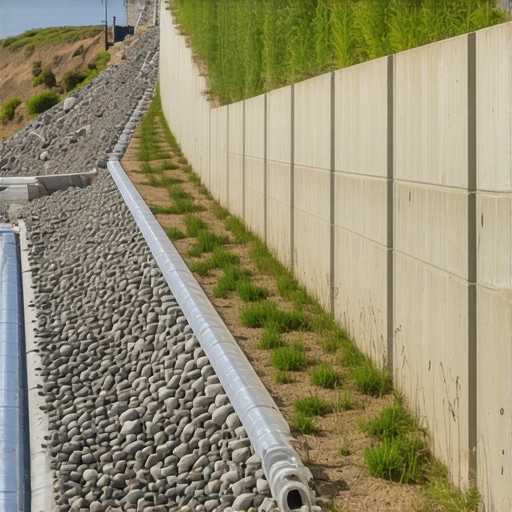
- Ensure your driveway grading directs runoff into a French drain rather than into your garden beds.
- Redirect downspouts away from concrete surfaces to prevent ice damming.
How do I fix salt-damaged concrete?
You cannot reverse the chemical damage of salt, but you can halt further degradation by pressure washing the slab in the spring to flush out residual chlorides. Once the concrete has dried for 48 hours, apply a densifier to help close the pores. For aesthetic repair, a polymer-modified cementitious overlay can be applied, but only if the underlying structural slab is still sound. If the salt has reached the rebar and caused it to oxidize, the expansion of the rusting metal will eventually crack the new overlay from the bottom up. Do the work right the first time. Stop using salt. It will rot your investment.
“Concrete durability is determined by the permeability of the paste and the chemical stability of the aggregate when exposed to ionic solutions.” – Agronomy and Materials Manual
![Build a $150 2026 Cedar Garden Border for Bedding [DIY]](https://lawnmajesty.com/wp-content/uploads/2026/07/Build-a-150-2026-Cedar-Garden-Border-for-Bedding-DIY.jpeg)