3 Secrets to a Perfectly Green Yard Without Using Harsh Chemicals
The Chemical Nightmare: Why Your Lawn Is Dying Despite the Fertilizer
To achieve a green yard without chemicals, you must restore the soil’s biological health by balancing pH levels, fostering microbial activity, and managing root depth through mechanical cultural practices rather than synthetic inputs. Most homeowners fall into a cycle of addiction where they apply high-salt synthetic fertilizers that provide a quick green flush but ultimately sterilize the soil. I remember a call from a homeowner in a panic last August. They had applied a heavy-duty weed-and-feed product during a heatwave, and within 48 hours, their entire front lawn was the color of a discarded cardboard box. It was a classic chemical burn. The synthetic nitrogen salts had literally sucked the moisture out of the grass blades through osmotic pressure, while the herbicides had stressed the already struggling root systems. We didn’t just have dead grass; we had dead soil. The rhizosphere, that critical zone where roots and microbes interact, was a graveyard. This is the result of ‘mow-and-blow’ mentalities that prioritize appearance over engineering. To fix it, we had to stop looking at the grass and start looking at the dirt. Professional landscaping requires understanding that turf is a biological system, not a carpet. If you want a green yard that doesn’t rely on a chemical IV drip, you need to master the three secrets of organic soil management.
Secret 1: Mastering Soil Chemistry and the Microbiome
To fix a chemically dependent lawn, you must identify the Cation Exchange Capacity (CEC) and adjust the soil pH to a range of 6.2 to 7.0, which allows for optimal nutrient uptake without synthetic intervention. When you dump synthetic NPK (Nitrogen, Phosphorus, Potassium) fertilizers on your lawn, you are essentially feeding the plant a diet of fast-food salts. These salts kill beneficial mycorrhizal fungi and predatory nematodes that naturally protect roots. Instead, you should focus on the soil food web. High-quality compost or leaf mold introduces billions of beneficial bacteria that break down organic matter into plant-available nutrients.
“The use of organic amendments improves soil structure, increases water-holding capacity, and provides a slow-release source of nutrients that synthetic salts cannot replicate.” – Penn State Center for Turfgrass Science
We measure success in parts per million (PPM). If your soil is too acidic, nutrients like phosphorus and magnesium become locked in the soil particles and unavailable to the grass, no matter how much you pour on top. Use pelletized lime to raise pH or elemental sulfur to lower it. This is not about aesthetics; it is about the molecular reality of the ground.
Secret 2: The 1/3 Rule and Root Depth Engineering
Optimizing turf health without chemicals requires mowing at a height of 3.5 to 4 inches and never removing more than one-third of the grass blade in a single session to maximize photosynthetic capacity and shade out weed seeds. Deep roots are the only defense against drought. If you scalp your lawn at 2 inches, you are forcing the plant to use all its energy to regrow the blade rather than extending its roots. We want roots that go 6 to 8 inches deep into the soil profile. This is achieved through deep, infrequent watering. Instead of a 15-minute daily spritz that only wets the top half-inch of soil, you need to apply 1 full inch of water once per week. This forces the roots to chase the moisture downward. You can measure this by placing a tuna can in the yard while the sprinklers are running. When it is full, you are done for the week. This creates a resilient plant that can withstand heat without needing chemical boosters.
Comparison of Lawn Management Strategies
| Feature | Synthetic Management | Organic Biological Management |
|---|---|---|
| Nutrient Source | High-salt urea and ammonium | Compost, kelp, and bone meal |
| Soil Health | Sterilizes microbial life | Promotes fungal hyphae and bacteria |
| Water Retention | Low; soil becomes hydrophobic | High; organic matter holds 4x its weight |
| Root Structure | Shallow and weak | Deep and fibrous |
| Environmental Impact | High runoff into local watersheds | Zero runoff; carbon sequestration |
Secret 3: Mechanical Aeration and Top-Dressing
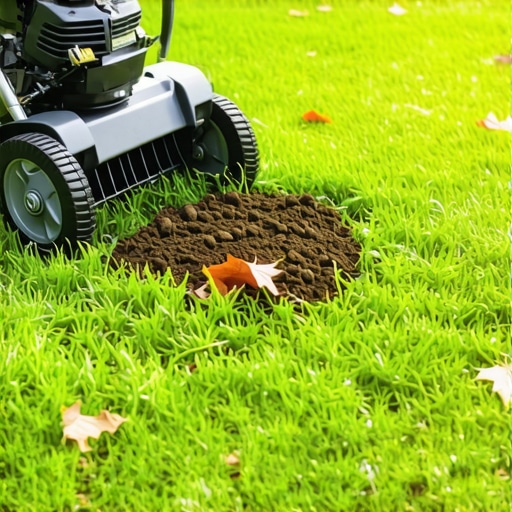
To eliminate the need for chemical aerants, you must perform annual core aeration to relieve soil compaction and top-dress with 1/4 inch of fine-screened organic compost to introduce carbon back into the system. Compaction is the silent killer of urban lawns. In many new developments, the soil is so packed down by heavy machinery that it has the density of concrete. This prevents oxygen from reaching the roots. Without oxygen, roots suffocate and die. We use a reciprocating aerator to pull 3-inch plugs out of the soil. This creates a channel for air, water, and nutrients to reach the root zone. Immediately after aerating, we spread a thin layer of compost. This compost falls into the holes and stays there, permanently changing the soil texture. It is a slow process, but it is the only way to build a lawn that stays green on its own.
“Core aeration is the most effective cultural practice for reducing thatch and improving the physical properties of compacted soils.” – Texas A&M AgriLife Extension
How much organic fertilizer do I need per 1,000 square feet?
Most organic applications require 10 to 15 pounds of high-quality compost or organic granular fertilizer per 1,000 square feet to provide adequate nitrogen without burning the turf. Unlike synthetics, you cannot easily over-apply organic matter. The goal is to build a reservoir of nutrients that the soil microbes release slowly over the entire growing season.
Can I get rid of weeds without using herbicides?
Yes, the most effective way to eliminate weeds is to out-compete them with dense turf and maintain a high mowing height to prevent sunlight from reaching weed seeds at the soil surface. Weeds are opportunistic. They only appear where there is a void in the turf or where the soil is too compacted for grass to grow. Fix the soil, and the weeds will disappear on their own. They are a symptom, not the problem.
- Test your soil pH every two years.
- Sharpen your mower blades after every 10 hours of use.
- Leave grass clippings on the lawn to return 25 percent of the nitrogen to the soil.
- Use corn gluten meal as a natural pre-emergent in early spring.
- Overseed with drought-tolerant fescue or clover blends.
The transition from a chemical-heavy lawn to a biological one takes time. You might see a slight yellowing in the first season as the soil re-adjusts. Do not panic. Do not reach for the blue bottle of liquid fertilizer. Stick to the measurements. Watch the pH. Let the microbes do their job. It will pay off in a lawn that is thicker, tougher, and healthier for your family and the local environment. Any contractor who tells you otherwise is just trying to sell you a subscription to a failing system.