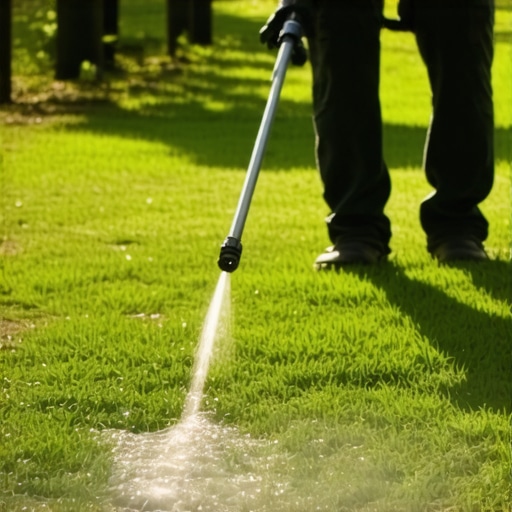
Stop 2026 Fescue Burn: 3 Deep-Soil Watering Rules
The Forensic Autopsy of a Dying Lawn
Walk across a fescue lawn in July and listen. If you hear a distinct crunch, your turf is already in cellular distress. I see this every season: homeowners stare at straw-colored patches, assuming they need more fertilizer, when in reality, they have effectively mummified their root systems. I recently dealt with a chemical nightmare where a client in the suburbs torched three acres of prime Tall Fescue. They applied a high-nitrogen 46-0-0 Urea during a 95-degree heatwave, then ‘sprinkled’ it for ten minutes. Without deep moisture to buffer the chemical salts, the nitrogen pulled every molecule of water out of the grass blades through osmotic pressure. It didn’t just burn; it underwent a total systemic collapse. That $20,000 install became expensive hay in forty-eight hours because they ignored the physics of the rhizosphere.
The Science of Fescue Failure in 2026
To prevent 2026 fescue burn, you must maintain a soil moisture profile that reaches 6 to 8 inches deep, forcing the Tall Fescue (Festuca arundinacea) to develop vertical root architecture rather than shallow, horizontal mats. This requires a shift from daily misting to heavy, infrequent saturation cycles that account for evapotranspiration rates. Fescue is a C3 cool-season grass. Its biological machinery begins to stall when soil temperatures exceed 75 degrees Fahrenheit. Without deep-seated water to cool the crown of the plant, the grass enters a state of dormancy that quickly turns into permanent desiccation.
| Soil Type | Infiltration Rate (Inches/Hour) | Required Run Time (Standard Rotor) |
|---|---|---|
| Sandy Loam | 0.50 – 1.0 | 45 Minutes |
| Silt Loam | 0.30 – 0.5 | 60-90 Minutes |
| Heavy Clay | 0.01 – 0.2 | 20 Minutes (Cycle/Soak) |
“The depth of the root system is directly proportional to the downward movement of the wetting front; if you only water the top inch, you only have an inch of life-support during a drought.” – Agronomy Field Manual, Section 4.2
Rule 1: The One-Inch Saturation Mandate
The one-inch saturation rule dictates that your lawn receives a full inch of water in a single application or two heavy sessions per week to ensure the moisture reaches the sub-soil layers. Most people think they are watering enough when the sidewalk is wet. This is a mistake. You need to measure output, not time. Use tuna cans or rain gauges to verify your irrigation heads are actually delivering a full inch. If you are on heavy clay, you cannot dump an inch at once. You must use a ‘cycle and soak’ method—run the zones for 20 minutes, let it soak for an hour, and repeat until the inch is achieved. This prevents runoff and hydrostatic waste. It forces the water into the macropores of the soil.
How long should I run my sprinklers for fescue?
The duration depends entirely on your nozzle’s precipitation rate. A standard oscillating sprinkler might take four hours to deliver one inch, while a high-efficiency rotary nozzle might take 90 minutes. You must calibrate your system manually. Don’t trust the digital timer’s default settings. They don’t know your soil’s percolation rate.
Rule 2: The Temporal Window and Evaporative Loss
Watering fescue between 4:00 AM and 8:00 AM is critical because it minimizes evaporative loss and ensures the foliage dries quickly, preventing the fungal pathogens like Brown Patch (Rhizoctonia solani) that thrive in evening moisture. If you water at night, the water sits on the leaf blade for 10-12 hours. This creates a petri dish for spores. If you water at noon, you lose 30-50% of the volume to the air before it even touches the dirt. It is a waste of money and a death sentence for the grass. You are effectively steaming the turf. Check your PSI; if the water is atomizing into a mist, it’s drifting away. You want heavy droplets that fall with enough force to penetrate the thatch layer.
“Fungal mycelium growth is optimized when leaf wetness exceeds 10 consecutive hours during periods where nighttime temperatures stay above 65°F.” – Penn State Center for Turfgrass Science
Rule 3: Breaking the Hydrophobic Barrier
To stop fescue burn, you must mechanically address soil compaction and the hydrophobic layer of thatch that prevents water from reaching the root zone. Over time, dead organic matter and compressed clay form a skin on your yard. Water will literally bead up and run off this surface. I tell my crew: if the soil probe doesn’t slide in like butter, the water won’t either. You need to core aerate every fall. This pulls 3-inch plugs out of the earth, creating direct conduits for water, oxygen, and nutrients to reach the primary root mass. Without aeration, you are just watering the street.
Can burned fescue be saved?
If the crown of the plant—the white, fleshy part at the soil line—is still firm, the grass is dormant and can be revived with deep-soil watering. If the crown is tan, shriveled, and pulls out of the ground with no resistance, the vascular system is dead. No amount of water will bring it back. You are looking at a full slit-seeding renovation in the fall. [image_placeholder]
The Pre-Summer Fescue Hardening Checklist
- Calibrate irrigation zones using the catch-can method to ensure uniform 1-inch delivery.
- Sharpen mower blades to prevent jagged tears that leak moisture through the leaf tip.
- Increase mowing height to 4 inches to provide shade for the soil surface.
- Apply a surfactant or wetting agent to areas showing localized dry spots.
- Test soil pH; acidic soil (below 6.0) inhibits root water uptake regardless of how much you irrigate.
The Engineering of a Resilient Root Zone
Hardscaping and garden design often ignore the subterranean engineering required for turf health. If your lawn is adjacent to a concrete driveway or a stone retaining wall, that turf is in a ‘heat sink’ zone. The stone absorbs thermal energy and radiates it back into the soil, baking the fescue roots from the side. In these areas, you must increase watering frequency by 20% to counteract the thermal transfer. It’s not just about the grass; it’s about the thermodynamics of the entire landscape. Stop treating your yard like a painting and start treating it like a living hydraulic system. If the pressure drops or the flow is blocked, the system fails. Period. Check your soil. Buy a probe. Stop guessing. Your fescue’s survival in 2026 depends on the work you do before the first heatwave hits.