
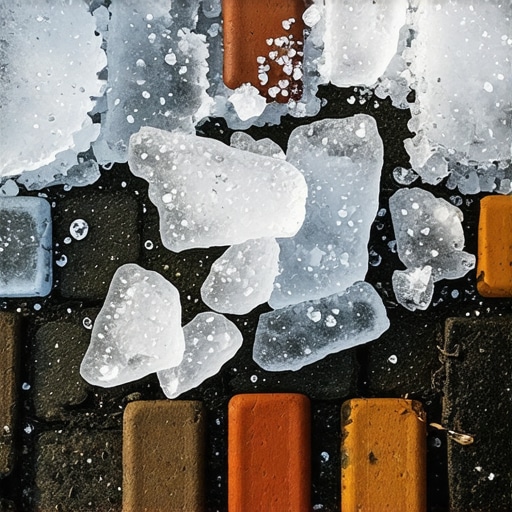
Why You Should Never Use Salt to Melt Ice on Your Pavers
The White Death: Why Your Winter Maintenance is Killing Your Hardscape
Using rock salt on pavers causes irreversible structural damage through accelerated freeze-thaw cycles, subflorescence, and chemical degradation of the cementitious binder. This process forces brine into the microscopic pores of the stone or concrete, where it expands upon freezing and creates internal hydraulic pressure that exceeds the material’s tensile strength.
The Hardscape Autopsy: A $30,000 Mistake
I recently got called out to tear up a $30,000 patio that was sinking and pitting because the previous contractor failed to explain winter care to the homeowner. The surface of the expensive Techo-Bloc slabs looked like it had been hit with a ball-peen hammer. The homeowner had dumped fifty-pound bags of sodium chloride on it every time a flurry hit. By the time I arrived, the pavers were spalling so badly you could sweep up the surface with a broom. The salt hadn’t just sat on top; it had migrated into the base layer, holding moisture and causing the bedding sand to heave. It was a total loss. I had to tell them the truth. The entire install was trash. This wasn’t a product failure. It was a maintenance homicide. We had to excavate three feet down to remove the salt-contaminated soil before we could even think about a re-install. Don’t be that guy.
The Chemical Mechanism of Spalling and Pitting
Spalling occurs when the internal pressure of freezing water, combined with the recrystallization of salt, shears off the top layer of the paver. While concrete pavers are manufactured to high PSI standards, they are not impervious to the laws of physics and chemistry. Specifically, sodium chloride is hygroscopic. It attracts water. When you apply salt, you aren’t just melting ice; you are creating a super-saturated brine that penetrates deep into the concrete matrix.
“A retaining wall doesn’t fail because of the stone; it fails because of the water trapped behind it.” – Hardscape Engineering Axiom
The same logic applies to the surface of your patio. When the temperature drops, that brine freezes. Water expands by approximately 9% when it turns to ice. In a confined pore space, this expansion generates thousands of pounds of pressure per square inch. When you add salt, you increase the number of freeze-thaw cycles the paver undergoes in a single day. Instead of freezing once and staying frozen, the salt causes the ice to melt and re-freeze every time the sun dips behind a cloud. This constant expansion and contraction literally rips the concrete apart from the inside out. This is why you see those small, pock-marked pits on old sidewalks. That is mechanical failure, not wear and tear.
The Silent Killer: Subflorescence and Crystalline Growth
Subflorescence is the internal accumulation of salt crystals within the paver’s pores, which exerts more pressure than the freeze-thaw cycle itself. Most people have heard of efflorescence—the white, powdery salt that breathes out of new concrete. That is harmless. Subflorescence is its lethal cousin. As the water evaporates from the brine inside the paver, the salt stays behind and crystallizes. These crystals grow and exert massive ‘crystal growth pressure’ against the pore walls. This leads to deep-seated structural crumbling that no sealer can fix once it starts.
| De-Icing Agent | Surface Impact | Soil Toxicity | Minimum Effective Temp |
|---|---|---|---|
| Sodium Chloride (Rock Salt) | Severe Spalling | High | 15°F |
| Calcium Chloride | Moderate | Medium | -25°F |
| CMA (Calcium Magnesium Acetate) | Very Low | Low | 20°F |
| Sand (Traction only) | Zero | Zero | N/A |
How much modified gravel do I need for a patio base?
For a standard pedestrian patio, you need a minimum of 6 inches of compacted 21A or 3/4-inch modified gravel, while driveways require 10 to 12 inches. This base must be compacted in 2-inch lifts to ensure a 98% Proctor density. Proper drainage in this base layer is the only way to mitigate the salt migration that causes long-term settling. If your base is thin, salt-laden water will pool underneath, leading to heaving during the deep freeze. I see crews skipping this step every day. They throw down two inches of stone and wonder why the patio looks like a roller coaster in three years. Do it right or don’t do it at all.
Will salt kill my boxwoods and perennials?
Salt runoff causes osmotic stress in plants, effectively sucking the moisture out of the roots and lead to ‘salt burn’ or plant death. When the salt levels in the soil rise, the roots can no longer absorb water, even if the ground is wet. This is why your hedges along the driveway look brown and desiccated in the spring. You are chemically dehydrating your landscape.
The Impact on Soil Microbiology and Turf Health
High sodium levels in the soil destroy soil structure by dispersing clay particles, which leads to compaction and poor aeration. When you shovel salt-laden snow onto your lawn, you are poisoning the nitrogen cycle. The beneficial microbes that grass needs to thrive cannot survive in high-saline environments. You end up with dead zones that won’t grow anything but crabgrass and salt-tolerant weeds. It’s a nightmare for lawn care professionals to remediate. You’ll be looking at gypsum applications and heavy core aeration just to get the pH back to a functional level.
“Excessive sodium ions displace calcium and magnesium, leading to the collapse of soil aggregates and a total loss of permeability.” – Penn State Agricultural Extension
If you care about your garden design, you have to treat the perimeter of your hardscape as a sensitive ecological zone. One heavy winter of salting can ruin a decade of soil building. Your soil is a living organism. Stop bleaching it with chloride.
The Professional’s Winter Protocol: How to Save Your Stone
Stop reaching for the blue bag of rock salt. If you want your pavers to last 50 years, you need to change your methodology. It starts with manual labor and ends with the right materials. [IMAGE_PLACEHOLDER]
- Mechanical Removal First: Clear the snow as soon as it falls. Do not let it sit and compact into ice.
- Use Sand for Traction: Clean, sharp sand provides immediate grip without changing the chemistry of your stone or soil.
- CMA for Critical Areas: If you must use a chemical melter, use Calcium Magnesium Acetate (CMA). It is salt-free and biodegradable.
- Seal Your Pavers: Apply a high-quality, breathable silane/siloxane sealer every 3-5 years to reduce water absorption.
- Check Your Grading: Ensure your patio slopes at least 1/8 inch per foot away from the house to prevent ponding.
It’s simple. Salt is a solvent. Concrete is a porous solid. Those two don’t mix. If you treat your $50,000 outdoor kitchen like a highway overpass, it will fail. Protect the investment. Buy a better shovel and a bag of sand. Your pavers will thank you in twenty years. Don’t be lazy. Dirt doesn’t lie, and neither does a spalled paver.
![Stop Watering Hostas at Night (Do This Instead) [2026]](https://lawnmajesty.com/wp-content/uploads/2026/06/Stop-Watering-Hostas-at-Night-Do-This-Instead-2026.jpeg)

![Stop Killing Your 2026 Boxwoods [Pruning Fix]](https://lawnmajesty.com/wp-content/uploads/2026/09/Stop-Killing-Your-2026-Boxwoods-Pruning-Fix.jpeg)