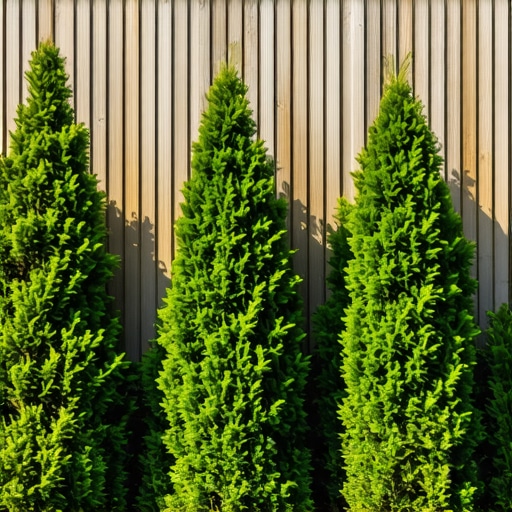
5 Fast-Growing Privacy Shrubs That Don’t Require Constant Pruning
5 Fast-Growing Privacy Shrubs That Don’t Require Constant Pruning
I always drill into my new crew members: if you don’t fix the soil grading first, every plant you put in the ground is just expensive compost. You can buy the highest-grade nursery stock in the state, but if you drop it into a compacted clay hole without proper drainage, it will drown. I’ve spent two decades watching homeowners spend thousands on ‘instant privacy’ only to see the foliage turn bronze and brittle because they ignored the site’s fundamental engineering. We don’t just dig holes; we prepare biological systems. Most people want a wall of green, but they don’t want to spend every Saturday on a ladder with a pair of gas-powered shears. That is where plant physiology and selection become your best tools. Understanding the natural growth habit of a species—its apical dominance and scaffold structure—allows you to install a screen that stops exactly where it should without human intervention.
The Engineering of Living Walls: Why Site Prep Trumps Plant Selection
Successful privacy screening requires a low bulk density soil that allows for rapid gas exchange and root expansion. If your soil compaction exceeds 1.5 g/cm3, root penetration slows, and your ‘fast-growing’ shrub will sit stagnant for years. Proper site prep involves testing the Cation Exchange Capacity (CEC) and adjusting the soil pH to the 6.0 to 7.0 range to ensure nutrient availability.
“A retaining wall doesn’t fail because of the stone; it fails because of the water trapped behind it.” – Hardscape Engineering Axiom
This same principle applies to planting beds. If you don’t ensure a 2% slope away from the root zone, you are creating an anaerobic environment that breeds Phytophthora root rot.
1. Green Giant Thuja (Thuja standishii x plicata)
The Green Giant Thuja is a hybrid powerhouse that reaches mature heights of 30-50 feet with a 12-15 foot spread, maintaining a tight pyramidal form without pruning. It grows at a rate of 3 to 5 feet per year once the root system is established in USDA zones 5-8. This cultivar is highly resistant to bagworms, a common pest that decimates the over-used Leyland Cypress. Because of its strong apical dominance, it naturally maintains a single leader. This means you won’t see the splayed-out, heavy snow damage common in multi-stemmed evergreens. For a dense screen that requires zero shearing, space these exactly 6 feet apart on center. Don’t crowd them. Crowding reduces airflow, which leads to needle drop in the interior canopy.
2. Chindo Viburnum (Viburnum awabuki ‘Chindo’)
Chindo Viburnum is a broadleaf evergreen that provides a dense, waxy foliage barrier ideally suited for USDA zones 7-9. It features a fast growth rate of 1-2 feet per year, reaching a terminal height of 15-20 feet. The leaf cuticle is thick, which significantly reduces transpiration rates during heat waves, making it more drought-tolerant than thinner-leafed competitors. It naturally forms a dense, upright oval. You don’t need to touch it with shears. Just let the terminal buds do their work. It is also highly resistant to the Viburnum Leaf Beetle, a pest that has ruined many other species in the Viburnum genus. It thrives in well-drained loamy soils and can handle partial shade without losing its lower foliage density.
3. Nellie R. Stevens Holly (Ilex x ‘Nellie R. Stevens’)
The Nellie R. Stevens Holly is the gold standard for year-round screening because it is parthenocarpic, meaning it produces bright red berries without needing a male pollinator. It grows 2-3 feet per year, reaching 15-25 feet in height. Its natural growth habit is broadly pyramidal, and the foliage is so dense that it acts as an effective noise buffer for properties near busy roads. Unlike the American Holly, which grows at a snail’s pace, the Nellie R. Stevens hits its stride quickly.
“Plants don’t grow in soil; they grow in the spaces between soil particles.” – USDA Natural Resources Conservation Service
Ensure you are not burying the root flare. If you cover the trunk’s base with soil or a ‘mulch volcano,’ the tree will eventually suffocate. Keep the flare 1 inch above the finished grade.
4. Wax Myrtle (Morella cerifera)
Wax Myrtle is a native powerhouse that excels in sandy or poor soils due to its nitrogen-fixing root nodules. It is a multi-stemmed evergreen that can reach 15-20 feet in height with a similar spread, making it perfect for wide property lines in USDA zones 7-11. Its foliage is aromatic and contains resins that naturally repel many common garden pests. Because it grows in a rounded, billowy form, it looks better when left unpruned than when sheared into a box. If you want a screen that looks like a natural woodland edge rather than a suburban fortress, this is your plant. It can handle salt spray and wet feet, making it the top choice for coastal landscaping or low-lying areas of the yard.
5. Skip Laurel (Prunus laurocerasus ‘Schipkaensis’)
Skip Laurel is the most shade-tolerant privacy shrub in the professional’s arsenal, reaching 10-15 feet in height and 5-7 feet in width. It features long, dark green leaves that have a high chlorophyll density, allowing the plant to thrive in as little as 4 hours of sunlight. Unlike the Cherry Laurel, which can become an invasive mess, the ‘Schip’ variety is more refined and slower to spread laterally. It maintains a dense, vase-shaped habit naturally. To prevent ‘shot hole’ fungus, avoid overhead irrigation; use drip-line emitters to deliver water directly to the soil. This keeps the foliage dry and prevents the spread of bacterial pathogens.
Technical Comparison of Growth and Soil Tolerance
| Shrub Variety | Growth Rate (Annual) | Mature Height | Soil Preference | Sun Requirements |
|---|---|---|---|---|
| Green Giant Thuja | 3-5 Feet | 30-50 Feet | Moist/Well-Drained | Full Sun |
| Chindo Viburnum | 1-2 Feet | 15-20 Feet | Acidic Loam | Full to Part Sun |
| Nellie R. Stevens Holly | 2-3 Feet | 15-25 Feet | Diverse/Well-Drained | Full Sun |
| Wax Myrtle | 3-5 Feet | 15-20 Feet | Sandy/Poor/Wet | Full Sun to Part Shade |
| Skip Laurel | 1-2 Feet | 10-15 Feet | Neutral to Acidic | Part Shade to Shade |
Professional Installation Checklist
- Utility Marking: Always call 811 to mark underground lines before excavation.
- Excavation: Dig the planting trench or hole twice as wide as the root ball but no deeper.
- Root Inspection: Remove all burlap and wire cages. Use a sharp knife to score girdling roots that are circling the root ball.
- Watering: Install a dedicated 12-inch deep drip irrigation system. New shrubs need 1 inch of water per week for the first two growing seasons.
- Mulching: Apply 2-3 inches of triple-ground hardwood mulch, keeping it 4 inches away from the trunk.
How much space should I leave between privacy shrubs?
Spacing depends on the mature width of the cultivar and the desired speed of closure. For Green Giant Thujas, 6 feet on center is the industry standard. For Nellie R. Stevens Hollies, 5-6 feet is ideal. Proper spacing prevents fungal blights by ensuring adequate airflow between the mature canopies.
What is the best time of year to plant a privacy hedge?
Late autumn or early spring is the optimal window for installation. Planting during the dormant season allows for root primordia development without the metabolic stress of high transpiration rates caused by summer heat. Avoid planting when the ground is frozen or during peak July heat.