Why Your Hydrangeas Refuse to Bloom (And How to Fix It)
The Forensic Autopsy of a Flowerless Shrub
Your hydrangeas are likely healthy leaf factories that refuse to produce a single terminal bud, leaving you with nothing but a green mound of disappointment. Hydrangeas fail to bloom primarily due to three systemic failures: improper pruning timing that removes old wood buds, nitrogen-heavy fertilizer runoff from lawn care, or winter-kill of the delicate floral primordia. If the plant is growing vigorously but staying green, the issue is chemical or mechanical, not biological death.
I always drill into my new crew members: if you don’t fix the soil grading and the micro-climate first, every plant you put in the ground is just expensive compost. I’ve walked onto job sites where the homeowner spent five grand on Bigleaf hydrangeas (Hydrangea macrophylla) only to realize they planted them in a wind-tunnel corridor where the winter desiccation kills every bud before April. You can’t fight physics with hope. You have to understand the engineering of the plant. A hydrangea isn’t just a garden ornament; it’s a hydraulic system that relies on specific hormonal triggers to shift from vegetative growth to reproductive flowering.
Why the ‘Old Wood’ Distinction Matters
Most blooming failures happen with the Macrophylla and Quercifolia (Oakleaf) species. These plants are biological historians; they keep the blueprints for next year’s flowers on the wood they grew this year. If you take your shears to them in late fall or early spring, you are literally cutting off the flowers before they exist.
“Pruning of Macrophylla hydrangeas should be limited to the removal of dead wood in the spring or heading back stems immediately after flowering in the summer to avoid removing the next season’s floral primordia.” – Texas A&M AgriLife Extension
The Chemical Sabotage: Nitrogen vs. Phosphorus
Excessive nitrogen application from nearby lawn care treatments forces the hydrangea into a state of perpetual vegetative growth at the expense of flower development. When you treat your turf with high-N fertilizers, that runoff leaches into the drip line of your shrubs. The plant reacts by pumping out massive, dark green leaves because nitrogen fuels chlorophyll and cell elongation, while the phosphorus and potassium needed for bloom induction remain locked or under-represented.
Check your soil. If your pH is out of whack, the plant can’t even uptake the nutrients you’re feeding it.
“A soil test is the only scientific way to determine the nutrient requirements and pH of your garden soil, preventing the over-application of fertilizers that can inhibit blooming.” – Penn State College of Agricultural Sciences
How do I make my hydrangeas blue?
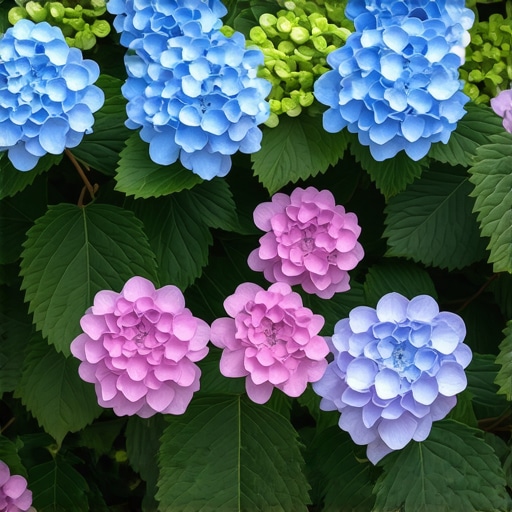
The color of your Macrophylla isn’t about the dye; it’s about the availability of aluminum ions in the soil. In acidic soil (pH 5.0 to 5.5), aluminum is soluble and the flowers turn blue. In alkaline soil, aluminum is locked away, resulting in pink. If you have white hydrangeas (Arborescens), no amount of sulfur will change them. They lack the anthocyanin pigments required for the shift. Stop wasting money on soil acidifiers if you have the wrong cultivar.
The Hydraulic Reality: Moisture Stress and Bud Survival
Hydrangeas are moisture-sensitive engines that require deep, infrequent irrigation to establish a resilient root architecture. Surface-level misting every day is a death sentence for bloom production because it encourages shallow root systems that cannot survive the midday heat of July. When the plant wilts, it enters a survival mode, prioritizing the hydration of the root crown over the maintenance of flower heads. They will drop buds to save the main stem. It’s a biological fail-safe.
[image placeholder]
Hydrangea Species Comparison and Care Requirements
| Species | Bloom Wood | Optimal Light | Common Failure Point |
|---|---|---|---|
| Macrophylla (Bigleaf) | Old Wood | Morning Sun / Afternoon Shade | Late Spring Frost |
| Paniculata (PeeGee) | New Wood | Full Sun | Under-watering |
| Arborescens (Smooth) | New Wood | Part Shade | Floppy stems (Weak lignin) |
| Quercifolia (Oakleaf) | Old Wood | Sun to Part Shade | Poor soil drainage |
The Remediation Protocol: A Step-by-Step Fix
If your hydrangeas didn’t bloom this year, follow this forensic checklist to ensure they hit the mark next season. Do not skip the soil test. It’s the only data that matters.
- Stop pruning now. Do not touch the plant with shears until you see green growth in late May.
- Redirect your lawn fertilizer spreaders. Keep high-nitrogen turf food at least six feet away from the hydrangea’s drip line.
- Apply 3 inches of hardwood mulch. This regulates soil temperature and prevents the freeze-thaw cycles that heave the root ball.
- Check the root flare. If you’ve buried the main stem under a mulch volcano, the bark will rot and the vascular system will fail.
- Irrigate deeply. Use a soaker hose for 45 minutes twice a week rather than a sprinkler for 5 minutes every day.
Why are my hydrangea leaves turning yellow?
Chlorosis, or yellowing leaves with green veins, usually indicates an iron deficiency or a pH that is too high. If the soil is too alkaline, the plant cannot absorb iron, regardless of how much is in the dirt. This is an engineering problem. Fix the pH with elemental sulfur, or you’re just throwing money into the wind. It’s not a mystery; it’s chemistry. Don’t guess. Measure.