
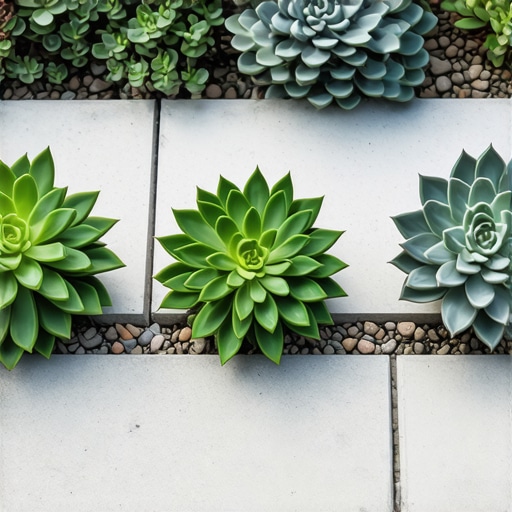
5 Low-Water 2026 Succulents for Modern Walkways
The Engineering Behind the Modern Walkway: Why Sub-Grade Matters
Modern walkway design requires a strictly engineered foundation that prioritizes drainage and structural integrity over aesthetic whimsy. To successfully integrate succulents into a 2026 landscape, you must understand that the soil physics surrounding a concrete or stone paver differ significantly from a standard garden bed due to the heat island effect and lateral water migration. If your sub-grade isn’t compacted to at least 95% standard Proctor density, the shifting pavers will crush the delicate root flares of your botanical investment.
I always drill into my new crew members: if you don’t fix the soil grading first, every plant you put in the ground is just expensive compost. I’ve seen 20-year vets ignore a 2% slope and wonder why their ‘drought-tolerant’ plants are drowning in a bathtub of clay three months later. Succulents don’t die from lack of water; they die from a lack of oxygen in the rhizosphere. We engineer for the 100-year storm, not the average Tuesday.
Soil Physics: Why Your Dirt is Killing Your Succulents
The success of low-water plantings in hardscape corridors depends on macroporosity and cation exchange capacity (CEC). Most residential soil is compacted junk with zero pore space. For succulents, we demand a substrate with at least 40% air-filled pore space to prevent the anaerobic conditions that trigger Phytophthora and other root rots. This requires a specific blend of 70% inorganic material—think expanded shale, pumice, or 1/4-inch clean crushed stone—and 30% high-quality organic matter.
“A retaining wall doesn’t fail because of the stone; it fails because of the water trapped behind it.” – Hardscape Engineering Axiom
How much modified gravel do I need for a patio base?
For a standard pedestrian walkway using 2026 succulent integration, you need a minimum of 4 to 6 inches of compacted 21A or 57 stone topped with a 1-inch bedding layer. This ensures that hydrostatic pressure does not build up beneath your pavers and that the adjacent planting pockets remain free-draining and oxygenated for the succulent root systems.
| Substrate Component | Porosity Level | Water Retention | Best Use Case |
|---|---|---|---|
| Pumice (3/8″) | High | Low | High-drainage succulent pockets |
| Expanded Shale | Medium | Low | Clay soil amendment |
| Coarse Silica Sand | Low | Very Low | Breaking up surface tension |
| Coconut Coir | Medium | High | Organic nutrient delivery |
The Top 5 Resilient Species for 2026 Modern Walkways
The 2026 landscape trend moves away from messy, high-maintenance perennials toward architectural succulents that offer year-round structure and minimal biowaste. We select species based on their ability to handle the reflected heat of hardscaping and their Crassulacean Acid Metabolism (CAM) efficiency.
1. Agave ovatifolia ‘Frosty Blue’ (Whale’s Tongue Agave)
This is a solitary grower that won’t pup and ruin your geometric walkway lines. It is cold-hardy down to Zone 7 and features a massive, powdery-blue rosette. The waxy cuticle, or pruinose coating, reflects UV radiation, keeping the plant’s internal temperature stable during 100-degree heat spikes. Plant it 3 inches above the surrounding grade to ensure the crown never sits in standing water.
2. Aloe striata (Coral Aloe)
Unlike the common aloe vera, Aloe striata lacks the sharp teeth on its margins, making it safe for high-traffic walkways where ankles might brush against it. It thrives on minimal nitrogen and develops deep coral hues when stressed by sunlight. This stress-induced pigmentation is a survival mechanism, not a sign of failure. It requires a soil pH between 6.0 and 7.2 for optimal nutrient uptake.
3. Euphorbia rigida (Silver Spurge)
While technically a succulent-like subshrub, its architecture is indispensable for modern design. Its spiraling glaucous leaves provide a kinetic energy to static stone paths. Be warned: the milky sap contains diterpene esters which are skin irritants. Wear gloves. It will thrive in the leanest, most alkaline soils where other plants perish.
4. Dudleya brittonii (Giant Chalk Dudleya)
For a high-contrast modern look, this species offers the whitest foliage in the botanical world. The ‘chalk’ is actually a thick layer of epicuticular wax. Do not touch the leaves. The oils from your fingers will permanently mar the finish. It is a specialist that requires vertical drainage; we often install these at a 45-degree angle between boulders to mimic their native cliff-side habitats.
5. Manfreda x Agave ‘Sliver Fox’ (Mangave)
A 2026 staple, Mangaves provide the fast growth of Manfreda with the durability of Agave. ‘Silver Fox’ has a distinct arching habit and purple spotting that intensifies under high UV. It handles more water than a pure Agave but still requires a lithic substrate. It is the perfect bridge plant for homeowners transitioning from high-water lawn care to xeriscaping.
“Effective xeriscaping is not the absence of water, but the management of its transit through the soil profile.” – Agronomy Manual for Arid Landscapes
How often should I water succulents in a walkway?
Succulents in a modern walkway require deep, infrequent irrigation. During the establishment phase (the first 90 days), water once per week to a depth of 6 inches. Once established, move to a bi-weekly or monthly schedule depending on local evapotranspiration rates. Never use a sprinkler; use 0.5 GPH drip emitters placed 2 inches from the base of the plant.
The Installation Checklist: No Shortcuts
- Verify utility markings via 811 before any excavation of the walkway path.
- Excavate to a depth of 8 inches for the base and planting pockets.
- Install a non-woven geotextile fabric to separate the sub-grade from the stone base.
- Mix 1 part native soil with 2 parts inorganic grit for all planting holes.
- Set the root flare 1 inch above the finished mulch or gravel line.
- Apply a 2-inch layer of decorative basalt or granite pea gravel as a top-dress to prevent crown rot.
The maintenance of these systems is minimal but specific. You aren’t mowing; you are monitoring. Every spring, check for compaction of the top-dress and clear any organic debris (leaves, grass clippings) that could hold moisture against the plant’s neck. It will rot if you leave wet mulch against the stem. Don’t skip the spring inspection. You are managing a living engineering project, not a plastic furniture set. Treat the soil like a lung and the plants will thrive for decades.
![4 Shade-Loving Groundcovers for 2026 Clay Soil [Fast]](https://lawnmajesty.com/wp-content/uploads/2026/05/4-Shade-Loving-Groundcovers-for-2026-Clay-Soil-Fast.jpeg)