Fix a Muddy Side Yard with This $200 French Drain Strategy
Fix a Muddy Side Yard: The $200 Engineered French Drain Solution
The smell of anaerobic soil is unmistakable. It is a sharp, sulfurous rot that tells a professional landscaper exactly what is happening beneath the surface: the soil is drowning. When a side yard turns into a swamp, it is not just an aesthetic nuisance; it is a structural threat to your foundation. Most homeowners attempt to fix this with a few bags of mulch or a half-hearted application of ryegrass seed. It fails every time. Why? Because you are treating a symptom of fluid dynamics with a cosmetic bandage. To fix a muddy side yard, you must think like a civil engineer and act like a hydrologist. We are going to move water using gravity, aggregate, and atmospheric pressure.
The Muddy Side Yard Autopsy: Why Drainage Fails
A muddy side yard is typically the result of poor soil grading, high compaction levels, and a lack of subsurface porosity that prevents water from reaching the water table. To fix this, you must install a subsurface drainage system that utilizes a 1 percent minimum slope and clean aggregate to create a path of least resistance for groundwater.
I recently got called out to a job where I had to tear up a $30,000 patio that was sinking because the previous contractor ignored the side yard drainage. The homeowner thought they just had a ‘wet spot.’ In reality, the neighbor’s gutter runoff was hitting their foundation and dwelling there, creating a massive hydrostatic pressure load. The soil had reached its plastic limit, turning the entire sub-base into a slurry. The pavers didnt fail; the earth beneath them liquefied. This is the reality of poor drainage. It is not about the grass; it is about the soil’s shear strength. If you don’t manage the water, the water will manage your property values. Do not be the person who spends five figures on a patio only to watch it slide into a mud pit because you were too cheap to dig a trench.
“A retaining wall doesn’t fail because of the stone; it fails because of the water trapped behind it.” – Hardscape Engineering Axiom
How deep should a French drain be for a side yard?
For a standard residential side yard, a French drain should be excavated to a depth of 12 to 18 inches. This allows for a 2-inch base layer of stone, a 4-inch perforated pipe, and at least 6 inches of aggregate cover, followed by a permeable top layer. If you are dealing with heavy clay, you may need to go deeper to reach a more permeable soil horizon, but 12 inches is the standard benchmark for capturing surface-to-subsurface transition water.
The $200 Material Strategy: Precision Over Price
A successful French drain depends on the quality of the geotextile fabric and the void space of the aggregate rather than the brand of the pipe. By sourcing 3/4 inch clean crushed stone and using a non-woven needle-punched fabric, you can build a professional-grade system for under $200 in raw materials.
The biggest mistake DIYers make is buying ‘soil-separated’ pipes from big-box stores that come pre-wrapped in a thin ‘sock.’ That sock will clog with fines within three seasons. You need a ‘burrito wrap’ system. This involves lining the entire trench with a heavy-duty geotextile. This fabric acts as a filter, allowing water through while keeping the silt and clay particles out of your stone. The stone is your reservoir. We use 3/4″ clean stone because it offers roughly 40% void space. That space is where the water lives while it waits to be carried away by the pipe.
| Material Item | Quantity / Specification | Estimated Cost |
|---|---|---|
| Perforated Corrugated Pipe | 50 Linear Feet (4-inch) | $45.00 |
| 3/4″ Clean Crushed Stone | 1 Ton (Bulk Delivery) | $75.00 |
| Non-Woven Geotextile Fabric | 3′ x 50′ Roll (4oz) | $40.00 |
| PVC Catch Basin | 9-inch x 9-inch | $30.00 |
| Marking Paint / 811 Call | 1 Can | $10.00 |
Total project cost: $200. This assumes you own a shovel and a pickaxe. If you have hard-pan clay, rent a power trencher. It will save your lower back and ensure your slope is consistent. Consistency is everything. If the pipe has a ‘belly’ in it, sediment will collect, and the system will fail. It must be a straight shot to the exit point.
What is the best gravel for a French drain?
The best gravel for a French drain is 3/4-inch clean crushed stone. Avoid ‘pea gravel’ because its rounded edges allow it to pack too tightly, reducing the void space available for water movement. You must specify ‘clean’ stone at the quarry, meaning it has been washed of all ‘fines’ or dust. Fines are the enemy of drainage; they settle at the bottom of the trench and create a waterproof crust that defeats the entire purpose of the drain.
Engineering the Trench: The Physics of Flow
To move water effectively, you must maintain a slope of at least 1/8 inch per foot, though 1/4 inch is preferred for residential side yards with high silt content. This gradient ensures that the water velocity is high enough to carry minor sediments through the pipe without allowing them to settle.
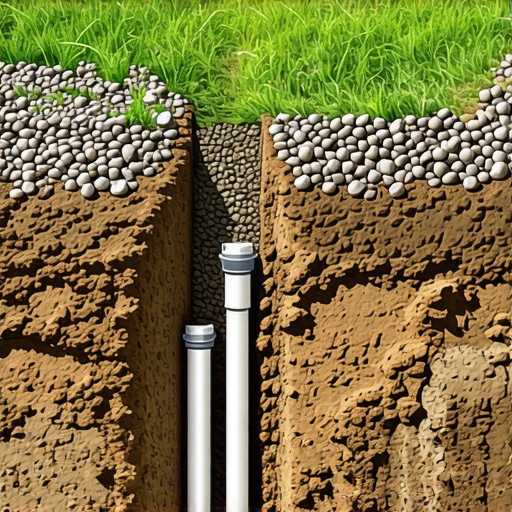
We start by identifying the discharge point. This is usually the curb or a lower part of the property. Use a string line and a line level. Do not trust your eyes. The ground is deceptive. Once the trench is dug, line it with the geotextile, leaving enough on the sides to fold over the top. This is the ‘burrito.’ Drop in 2 inches of stone, then lay your pipe with the holes facing DOWN. Yes, down. Many people think the water falls into the top of the pipe. In reality, the water table rises from the bottom of the trench. As the water level hits the pipe, it enters the holes and is whisked away. If the holes are facing up, the water has to fill the entire trench before it even enters the pipe. That is how you get a swamp.
“Surface drainage alone is insufficient where subsurface saturation creates pore-water pressure exceeding the shear strength of the soil.” – USDA Soil Conservation Service Manual
After the pipe is laid, backfill with the remaining stone to within 2 inches of the surface. Fold the fabric over the top. This creates a sealed envelope of stone and pipe that is protected from the surrounding soil. Top it with a thin layer of decorative river rock or a highly permeable topsoil. Do not pack it down. You want it loose. If you use heavy clay soil to cover the drain, you’ve just built a very expensive underground bathtub that water can’t get into.
The Biological Impact: Saving Your Turf
Excessive soil moisture leads to anaerobic conditions that kill beneficial microbes and promote fungal pathogens like Pythium and Brown Patch. By installing a French drain, you restore the oxygen-to-water ratio in the soil pores, allowing turfgrass roots to respirate and reach the depths necessary for drought resistance.
Turf grass is a living organism. When the soil is saturated, the roots can’t breathe. They rot. You’ll see the grass turn a sickly yellow-brown, and then the moss takes over. Moss loves a side yard because it thrives in the low-oxygen, high-acidity environment created by standing water. Once your drain is in, the biology of your yard will shift. You’ll see the return of earthworms—the natural aerators of the soil. Their tunneling further improves the soil structure. It’s a virtuous cycle. But it starts with removing that excess water. Don’t bother fertilizing a muddy yard. You’re just dumping nitrogen into the groundwater; the plants can’t even process it without oxygen in the root zone.
Pre-Dig Checklist for Side Yard Drainage
- Call 811 to mark underground utility lines (Gas, Water, Electric).
- Identify the discharge point and confirm it does not violate municipal codes or neighbor property rights.
- Calculate the total run length to ensure you have enough fall (elevation change).
- Source ‘clean’ aggregate—avoid any stone with ‘minus’ or ‘dust’ in the description.
- Ensure you have a non-woven geotextile; woven fabric will clog.
Landscape design is 20% plants and 80% engineering. If you focus on the 80%, the 20% becomes easy. A dry side yard is a blank canvas. A muddy side yard is a liability. Take the weekend, spend the $200, and do the manual labor. Your foundation and your lawn will thank you. It is a one-time fix if you do it right. If you do it wrong, you’ll be digging it up in three years. Do it once. Do it right.