Fix Your 2026 Muddy Backyard with Wood Chips
The Physics of the Muddy Yard: Why 2026 is Your Deadline for Proper Remediation
Fixing a muddy backyard with wood chips requires managing hydrostatic pressure and soil saturation. By applying a 4-to-6-inch layer of arborist wood chips, you create a sacrificial layer that absorbs surface runoff while allowing sub-surface aeration to prevent anaerobic soil conditions and root rot. I always drill into my new crew members: if you don’t fix the soil grading first, every plant you put in the ground is just expensive compost. I recently stood in a yard where a homeowner had dumped twelve units of hemlock bark over a standing pond, thinking it would act like a sponge. It did not. Instead, it created a floating mat of organic decay that smelled like a septic failure. The mud was still there, lurking two inches below. You cannot hide from poor drainage. You have to engineer your way out of it. We are going to look at the soil at a microscopic level. Soil is made of sand, silt, and clay. When you have too much clay, the pore space between particles is so small that water cannot move through via gravity. It gets stuck. This is where wood chips enter the conversation as a biological tool rather than just a decorative one.
How Wood Chips Interact with Saturated Soil Structures
To fix a muddy yard, you must understand the difference between surface ponding and subsurface saturation. Wood chips work by increasing the surface area for evaporation and by providing a physical barrier that prevents soil compaction from foot traffic. When you step on wet soil, you squeeze out the air. No air means no microbial life. No life means dead soil. [IMAGE_PLACEHOLDER] Adding wood chips creates a raft. This raft distributes the weight of your boots or your dog’s paws across a wider area, preventing the destruction of the soil’s macro-pores.
“A retaining wall doesn’t fail because of the stone; it fails because of the water trapped behind it.” – Hardscape Engineering Axiom
The Grading Mandate: Why Wood Chips Won’t Save a Bowl
Before you call a tree service for a chip drop, you must ensure your yard has a minimum 2% slope away from the house foundation. That is a 1/4 inch drop for every foot of distance. If your yard is a bowl, wood chips will just turn into a wood-flavored soup. You need to identify the low spots using a line level or a rotating laser. If the water has nowhere to go, wood chips are a temporary bandage on a femoral bleed. You must establish a path for that water. In 2026, we expect higher intensity rainfall events based on current climate models. This means your 20th-century drainage systems are likely undersized. Consider digging a shallow swale before applying your chips. A swale is just a wide, shallow ditch that directs water toward a safe discharge point like a rain garden or the street. Once the grade is set, the chips can do their job of stabilizing the surface.
How deep should wood chips be for mud control?
To effectively remediate a muddy area, apply arborist wood chips to a depth of at least 4 to 6 inches. This thickness is necessary to provide enough structural integrity to support foot traffic and to ensure the decomposition process does not immediately deplete the soil of nitrogen at the root level. Anything less than 4 inches will likely be swallowed by the mud within a single season. I have seen 2-inch applications disappear after one heavy thunderstorm. You are building a road, not a garden bed. Treat it with that level of material volume.
| Material Type | Drainage Rating | Longevity | Best Use Case |
|---|---|---|---|
| Arborist Chips | High | 2-3 Years | Mud remediation, pathways |
| Bark Mulch | Medium | 1 Year | Aesthetic garden beds |
| Crushed Stone | Very High | 10+ Years | High traffic, French drains |
| Playground Chips | High | 2 Years | Under swing sets |
Selecting the Right Bio-Mass: Arborist Chips vs. Store-Bought Mulch
Not all wood is created equal. I despise those bags of dyed mulch you see at big-box stores. They are often made of ground-up pallets and construction waste, treated with chemicals you don’t want in your soil. For mud control, you want arborist wood chips. These are the product of a whole tree going through a chipper. You get a mix of heartwood, sapwood, bark, and leaves. This variety is crucial because it creates a complex matrix of shapes and sizes that lock together. This locking mechanism is what prevents the chips from washing away during a downpour. The green material in arborist chips also jumpstarts the fungal colonization process. Mycelium acts as a biological glue, further stabilizing the ground.
“Wood chips applied as a surface mulch do not significantly deplete soil nitrogen in the short term, as the nitrogen tie-up occurs only at the soil-mulch interface.” – University of Vermont Extension
The Step-by-Step Remediation Process
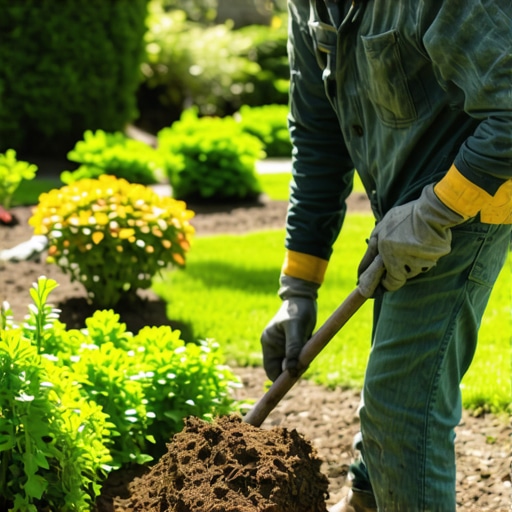
Step one: Mow the existing weeds or grass as short as possible. You want the chips in direct contact with the ground. Step two: Lay down a layer of plain, unprinted cardboard if the mud is particularly deep. This acts as a secondary barrier to keep the chips from sinking. Step three: Spread your arborist chips. Start near the high point of the yard and work your way down. Step four: Tamp the chips down. I don’t mean a light pat. I mean use a plate compactor or at least a heavy hand tamper. You want to knock the air out of the chip layer so it settles into a firm mat. If the tamper literally bounces off the surface, you have reached the correct density. Step five: Monitor the depth. As the bottom layer decays, it will turn into rich soil, but you will lose volume. You will need to add an inch or two every spring to maintain the raft. It is a cycle of renewal.
Will wood chips attract termites to my foundation?
While wood chips provide moisture and cover, they do not typically attract termites more than any other organic material. To mitigate risk, maintain a 6-inch gap of bare ground or gravel between your wood chip layer and your home foundation. This prevents termites from having a hidden bridge into your structure. Never pile chips against siding. This is a basic rule of pest management and building science that keeps your home dry and insect-free.
The Long-Term Nitrogen Cycle and Soil Health
One common myth is that wood chips will kill your plants by stealing all the nitrogen. This only happens if you mix the chips into the soil. As a surface layer, the nitrogen theft is minimal and only affects the top few millimeters of soil. By 2026, the chips you lay today will have broken down into a high-carbon compost that will actually improve the drainage of the underlying clay. This is a long-game strategy. You are using the chips as a sacrificial engine to build better soil structure over time. Do not skip this. If you just dump gravel over mud, the mud eventually rises through the stones. With wood chips, the mud is consumed by the biology of the wood. It is a more elegant, scientific solution to a messy problem.