Build a $50 DIY Potting Bench for Your 2026 Garden
Why You Need a Dedicated Potting Station for 2026 Garden Success
A DIY potting bench serves as a centralized hub for garden design and landscaping tasks, providing an ergonomic surface for seed starting and transplanting. By building your own for $50, you control the structural integrity and rot-resistance of the wood, ensuring a functional workflow that prevents back fatigue and keeps soil amendments organized.
I always drill into my new crew members: if you don’t fix the soil grading first, every plant you put in the ground is just expensive compost. The same hard-nosed logic applies to your workspace. I have seen guys try to pot up five hundred perennials on the back of a truck tailgate or a sagging plastic folding table. It is amateur hour. A potting bench is not a luxury; it is a piece of horticultural equipment. If your station is unstable or at the wrong height, you are going to rush the job. Rushed potting leads to air pockets in the root ball. Air pockets lead to root desiccation. Root desiccation leads to a dead plant and a waste of my time and your money. We build things to last, and that starts with the bench.
“Standard work surface heights for repetitive agricultural tasks should align with the user’s elbow height to minimize musculoskeletal strain and improve efficiency during long-duration planting cycles.” – Ergonomics in Agriculture Manual
Selecting the Right Lumber for a $50 Potting Bench
Choosing the correct lumber species and treatment grade is the difference between a bench that lasts ten years and one that rots by next spring. For a $50 budget, you are looking at pressure-treated pine (ACQ rated) or reclaimed heat-treated (HT) pallets, which offer the necessary tensile strength to support heavy ceramic pots and wet soil bags.
Forget cedar or redwood if you are sticking to a fifty-dollar limit. In the current market, you need to be smart. You are going to use standard 2x4s for the frame and 1x4s for the slats. When you are at the lumber yard, do not just grab the top board. Sight down the edge. If it looks like a hockey stick, put it back. You want straight grain. Wood is a living, breathing material even after it is milled. If you start with warped stock, the internal stresses will tear your fasteners out when the summer humidity hits. I have seen hacks try to use interior-grade spruce for outdoor builds. It will rot. Within six months, the basidiomycetes fungi will turn that spruce into a sponge. Stick to pressure-treated or properly sealed pine.
| Material Type | Estimated Cost | Durability (Years) | Structural Load Cap |
|---|---|---|---|
| Pressure-Treated Pine (2×4) | $35 – $45 | 10-15 | 500+ lbs |
| Reclaimed Pallet Wood (HT) | $0 – $10 | 3-5 | 200 lbs |
| Untreated Whitewood | $25 – $30 | 1-2 | 300 lbs |
| Cedar (Premium) | $120+ | 20+ | 400 lbs |
Step-by-Step Construction of the 2026 Potting Station
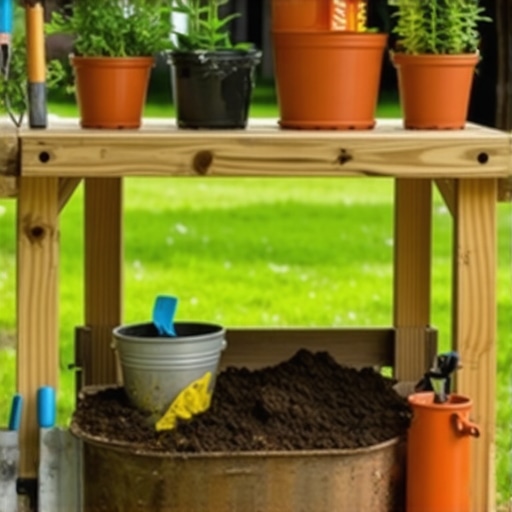
The construction process for a landscaping workstation requires precise fastener placement and joint reinforcement to handle the hydrostatic weight of wet soil. You will need to focus on a 36-inch work height, which is the industry standard for reducing lumbar compression during lawn care prep and seedling management.
- Cut the Legs: Four 2x4s cut to 36 inches. If you want a backboard, make the rear legs 60 inches.
- Frame the Top: Create a 48-inch by 24-inch rectangle using 2x4s. Use 3-inch deck screws.
- Install the Joists: Add a center support joist to prevent the work surface from sagging under the weight of heavy pots.
- Slat the Surface: Use 1×4 pine slats. Leave a 1/8-inch gap between slats. This allows for soil and water drainage. Don’t skip this.
- Lower Shelf: Add a second frame 12 inches from the ground for storing heavy bags of potting mix.
When you are driving your screws, pre-drill every hole. I don’t care if the screw box says ‘self-tapping.’ Pine splits. Especially at the end grain. A split board is a failed structural point. Also, look at the bottom of your legs. Wood wicks moisture from the ground like a straw. If you leave the raw end grain sitting on wet dirt, the bench is toast. I want you to install rubber feet or, at the very least, soak the bottom three inches of the legs in a copper-based wood preservative. This breaks the capillary action of the water.
“Fasteners used in pressure-treated lumber must be hot-dipped galvanized or stainless steel to prevent the copper in the wood treatment from corroding the metal through galvanic reaction.” – ICPI Hardscape Standards
How much weight can a DIY potting bench hold?
A well-built potting bench made from 2×4 pressure-treated pine can easily support 400 to 500 pounds if the load is distributed across the structural joists. This capacity is critical when working with large hardscaping containers or bulk quantities of saturated compost, which can weigh significantly more than dry soil.
What is the best height for a potting bench to prevent back pain?
The ideal height for a gardening workstation is typically 36 inches, though it should be adjusted based on the user’s height to ensure the elbows are at a 90-degree angle. Proper ergonomic design in the garden prevents long-term strain on the lower back, allowing for more efficient landscape maintenance and plant care throughout the growing season.
The Micro-Climate Factor: Protecting Your Investment
In regions with high humidity or heavy freeze-thaw cycles, your bench is under constant attack. If you are in a clay-heavy region like Georgia, don’t just set this bench on the ground. It will sink and tilt. Dig out a small four-inch deep area for each leg and fill it with modified gravel. Compact it. This provides a stable base and ensures drainage away from the wood. This is the same principle we use for retaining walls or paver patios. Water is the enemy of all structures. Manage the water, and the structure stays sound. Every year, check the fasteners. The expansion and contraction of the wood will loosen screws over time. Give them a quarter turn if they’re backing out. Keep it tight. Keep it clean. A pro-grade garden starts with a pro-grade bench. Stop working on the ground like a hack. [{“@context”:”https://schema.org”,”@type”:”Article”,”headline”:”Build a $50 DIY Potting Bench for Your 2026 Garden”,”author”:{“@type”:”Person”,”name”:”Master Landscaper”},”datePublished”:”2024-05-20″,”description”:”Expert guide to building a professional grade potting bench for under $50 using structural engineering principles.”},{“@context”:”https://schema.org”,”@type”:”HowTo”,”name”:”Build a DIY Potting Bench”,”step”:[{“@type”:”HowToStep”,”text”:”Cut 2×4 legs to 36 inches.”},{“@type”:”HowToStep”,”text”:”Assemble the 48×24 inch frame.”},{“@type”:”HowToStep”,”text”:”Install 1×4 slats with 1/8 inch gaps for drainage.”}]}]
![Build a $100 Modern Planter Box for 2026 [DIY]](https://lawnmajesty.com/wp-content/uploads/2026/06/Build-a-100-Modern-Planter-Box-for-2026-DIY.jpeg)
![Build a $200 Tiered Garden for 2026 Slopes [DIY]](https://lawnmajesty.com/wp-content/uploads/2026/06/Build-a-200-Tiered-Garden-for-2026-Slopes-DIY.jpeg)