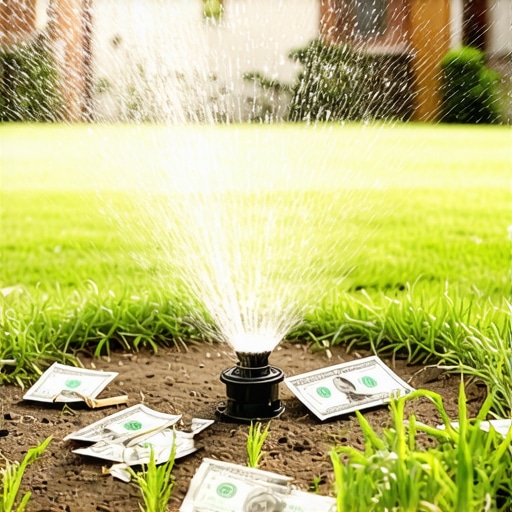
Why Your 2026 Sprinklers Are Wasting $50 a Month
I have spent twenty years digging through heavy clay and sandy loam to know that most homeowners are essentially flushing fifty dollar bills down their storm drains every single month. I recently got called out to a property where the homeowner was in a complete panic because their front lawn was turning a sickly yellow-brown despite their ‘smart’ irrigation system running daily. They thought the grass was thirsty. They were wrong. After a quick soil probe, I showed them the truth: the roots were literally suffocating in anaerobic soil because they had accidentally torched their lawn with a combination of over-saturation and a high-nitrogen fertilizer that had nowhere to go. This is a classic chemical nightmare caused by a fundamental misunderstanding of soil hydrology. They weren’t just wasting water; they were actively killing their investment. Modern irrigation systems in 2026 are marketed as ‘set and forget,’ but without a veteran eye on the specific soil mechanics of your yard, they are just expensive machines for creating fungus.
How Smart Sprinkler Controllers Fail to Save Money
Smart sprinkler controllers waste money when users fail to calibrate them for specific soil texture, slope, and plant transpiration rates. Even the most advanced 2026 models cannot account for hydrostatic pressure or soil compaction without manual data entry and regular physical audits of the root zone. To stop the waste, you must verify your system’s precipitation rate against your soil’s actual infiltration capacity. It is physics, not magic.
The biggest lie in modern lawn care is that technology replaces biology. I see it every week. A client installs a $5,000 irrigation array, sets it to ‘Auto,’ and then wonders why their water bill is $200 higher than their neighbor’s. The problem is usually ‘matched precipitation.’ If your spray heads are putting out 1.5 inches per hour but your soil can only absorb 0.2 inches per hour, you are just paying for water to run off into the gutter. It is a total lack of engineering discipline. I tell my crew every morning: if you don’t respect the soil’s percolation rate, you are just a plumber with a shovel.
“Irrigation efficiency is not measured by how much water is applied, but by how much water is retained within the plant’s effective root zone without causing leaching or runoff.” – Agricultural Extension Irrigation Manual
How much modified gravel do I need for a patio base?
While this seems like a hardscape question, it is vital for drainage near your lawn. You generally need 6 inches of compacted 21A or CR-6 modified gravel for a standard patio, but if your irrigation is poorly aimed, water will collect in this base and cause the pavers to heave during a freeze-thaw cycle. Never allow your sprinkler heads to spray directly against a hardscape edge. The water will find the path of least resistance, which is usually right under your expensive stone work.
What is the best time to water my lawn for maximum efficiency?
The optimal window is between 4:00 AM and 8:00 AM. Watering during the heat of the day leads to 30 percent loss through evaporation before the water even touches the blades. Conversely, watering at night is a death sentence. It leaves the foliage damp for 10 hours, creating a perfect petri dish for Rhizoctonia solani, commonly known as Brown Patch. Don’t do it. It will rot. You need the sun to dry the blades quickly while the roots drink deep.
| Sprinkler Type | Precipitation Rate (in/hr) | Best Use Case | Waste Risk Factor |
|---|---|---|---|
| Fixed Spray Heads | 1.5 – 2.0 | Small turf areas, corners | High (Runoff) |
| Rotary Nozzles | 0.4 – 0.6 | Large lawns, slopes | Low (Precision) |
| Drip Irrigation | N/A | Flower beds, shrubs | Zero (Direct-to-root) |
| Impact Sprinklers | 0.2 – 0.5 | Acreage, rough turf | Medium (Wind Drift) |
The Engineering of a $50 Monthly Saving
You can save $50 monthly by switching to high-efficiency rotary nozzles and implementing a deep, infrequent watering schedule that targets the root flare. By reducing evaporative loss and ensuring head-to-head coverage, you force the turf roots to grow deeper into the profile, making the lawn naturally drought-resistant and reducing the need for expensive supplemental irrigation.
Most people have ‘spray’ heads that mist. In even a 5 mph breeze, that mist is gone. It never hits the grass. I recommend my clients retro-fit their zones with multi-stream rotary nozzles. They throw heavy droplets that resist wind. It is the difference between a pressure washer and a spray bottle. One cleans; the other just makes things damp. Also, check your pressure. If your system is running at 60 PSI but your heads are rated for 30 PSI, they are ‘misting’ and wasting 40 percent of the water. You need a pressure regulator. Don’t skip this. It is a ten-dollar part that saves hundreds over a season.
“A retaining wall doesn’t fail because of the stone; it fails because of the water trapped behind it.” – Hardscape Engineering Axiom
The same logic applies to your lawn. It doesn’t fail because of the grass type; it fails because of how you manage the water. If you have a slope, you must use ‘cycle and soak’ programming. Run the zone for 5 minutes, let it sit for 30, then run it again. This allows the water to actually move through the micropores of the soil instead of sheeting off the top. If you see water on the sidewalk, you are failing the engineering test. Stop the clock. Adjust the nozzles.
5-Step Irrigation Audit for 2026
- The Catch Can Test: Place tuna cans around the yard and run the zone for 15 minutes to measure actual output.
- Pressure Check: Look for ‘fogging’ at the head; if it looks like smoke, your pressure is too high.
- Lateral Line Inspection: Walk the yard when the system is OFF to find soft, mushy spots that indicate a leaking pipe.
- Nozzle Alignment: Ensure every head reaches the base of the next head (Head-to-Head coverage).
- Sensor Calibration: Ensure your rain sensor isn’t clogged with spider webs or debris.
Landscaping is a game of inches and PSI. If you treats your lawn like a chemistry project and an engineering site rather than a hobby, your wallet will feel the difference. Most homeowners are over-watering by 50 percent because they are afraid of a little brown. In reality, a slightly stressed lawn grows deeper roots. Deep roots mean a resilient lawn. Resilient lawns don’t need fifty dollars of extra water every month. It is that simple. Keep your hands in the dirt and your eyes on the meter. Check your heads today. Do it now.
![Stop 2026 Slut Seeding Mistakes [Better Germination]](https://lawnmajesty.com/wp-content/uploads/2026/07/Stop-2026-Slut-Seeding-Mistakes-Better-Germination.jpeg)