
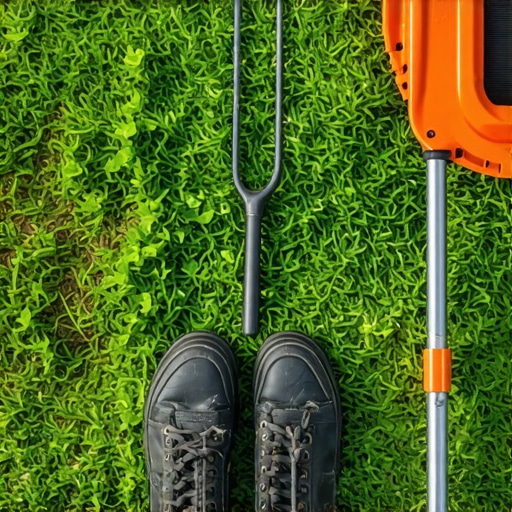
Stop 2026 Lawn Thinning: 3 Soil Aeration Hacks
Stop 2026 Lawn Thinning: 3 Soil Aeration Hacks
You walk across your yard and it feels like concrete. The turf looks pale, the blades are thinning, and when it rains, water pools in stagnant mirrors instead of soaking in. Most homeowners reach for the fertilizer bag, but they are just throwing money into the wind. If your soil bulk density is too high, those expensive nutrients never reach the root zone. You don’t have a nutrient problem; you have a suffocation problem. As a veteran with two decades in the dirt, I can tell you that a lawn is only as good as the gas exchange happening in the top six inches of the rhizosphere. If that soil is compacted, your grass is literally gasping for air.
I always drill into my new crew members: if you don’t fix the soil grading and compaction first, every plant you put in the ground is just expensive compost. Last year, I took an apprentice, Jimmy, out to a site where the client had spent five figures on premium Kentucky Bluegrass sod three years prior. By the time we arrived, it was a patchy, weed-choked mess. Jimmy wanted to spray for crabgrass and throw down high-nitrogen synthetic. I made him take a soil probe instead. The probe wouldn’t go deeper than two inches before hitting a wall of clay as hard as a sidewalk. I told him, ‘Jimmy, you could pour all the Miracle-Gro in the world on this, and it would just wash into the storm drain. We have to open the lungs of this earth first.’ That is the reality of soil mechanics that the big-box stores won’t tell you.
The Critical Physics of Soil Compaction and Turf Failure
Soil compaction occurs when the macropores in the soil profile collapse, increasing bulk density and preventing the movement of oxygen, water, and nutrients to the root system. This mechanical resistance stops root elongation, leading to a shallow, weak root system that cannot survive the heat of a typical summer. In high-traffic areas or heavy clay soils, the bulk density often exceeds 1.6 grams per cubic centimeter, which is the point where most turfgrass roots simply stop growing. You cannot fix this with a rake; you need a strategic mechanical and chemical intervention to reset the soil structure.
“Soil compaction is the most common cause of lawn failure in residential landscapes because it restricts the oxygen required for root respiration and prevents the drainage of excess water.” – Penn State Center for Turfgrass Science
Hack 1: The Double-Pass Crosshatch Mechanical Extraction
The double-pass crosshatch method involves using a commercial-grade hollow-tine aerator to remove soil cores in two perpendicular directions, ensuring at least 20 to 40 holes per square foot. Most DIYers make a single pass and call it a day, but that only addresses about 5 percent of the surface area. To truly reduce bulk density and induce lateral root growth, you need to be aggressive. A single pass leaves too much compacted space between the holes. By crossing your previous path at a 90-degree angle, you increase the fracture points in the soil, allowing the ground to ‘relax’ and expand into the voids you’ve created. This is not about making holes; it is about relieving the hydrostatic and mechanical pressure of the soil matrix.
How deep should aeration plugs be?
For effective compaction relief, your aerator must pull plugs that are at least 2.5 to 3 inches deep. Anything shallower than 2 inches is merely a surface scratch and does not reach the primary root zone where the most significant gas exchange occurs. Ensure the soil is moist but not saturated before starting; dry soil will resist the tines and break your machine, while mud will simply smear the sides of the holes, a phenomenon known as ‘glazing,’ which actually seals the soil off further.
Hack 2: Liquid Surfactant and Humic Acid Pre-Treatment
Liquid aeration hacks involve applying high-concentrate surfactants and humic acids to the soil 48 hours before mechanical aeration to lubricate the soil particles and soften the crust. While liquid aerators are often marketed as a replacement for mechanical aeration, in my firm, we use them as a primer. Humic acid acts as a chelating agent, breaking the ionic bonds of heavy clay and allowing the hollow tines to penetrate significantly deeper. This combination therapy ensures that you aren’t just punching holes but are chemically altering the soil’s ability to retain moisture and move oxygen. This is particularly vital in regions with heavy red clay where mechanical tines often struggle to reach the necessary 3-inch depth.
| Aeration Method | Primary Benefit | Ideal Soil Type | Frequency |
|---|---|---|---|
| Core (Hollow Tine) | Physical removal of compaction | Heavy Clay, High Traffic | Annually (Fall) |
| Liquid Surfactant | Softens soil, increases penetration | Silt, Loam, Pre-Mechanical | Bi-Monthly |
| Solid Spike | Temporary oxygen entry | Sandy Soil only | Not Recommended |
Hack 3: The Calcified Bio-Char Injection Post-Extraction
The most effective way to stop 2026 thinning is to backfill your aeration holes with a mixture of bio-char and calcined clay to prevent the holes from collapsing back into a compacted state. Think of this as ‘stenting’ the soil. If you just leave the holes empty, the surrounding soil will eventually migrate back into the void, and within six months, your compaction levels will be right back where they started. By sweeping a 50/50 mix of bio-char and compost into the holes, you create permanent vertical ‘veins’ of high-carbon, porous material. This provides a permanent home for mycorrhizal fungi and beneficial bacteria, which will then work to naturally aerate the surrounding soil from the inside out through their biological processes.
“A successful turf management program must prioritize the physical properties of the soil over the chemical inputs, as nutrients are useless without the structural capacity for uptake.” – Agronomy Manual of Turfgrass Management
When is the best time to aerate my lawn?
The optimal window for soil aeration is during the peak growth phases of your specific grass type. For cool-season grasses like Fescue or Kentucky Bluegrass, this means early fall (September-October), allowing the roots to recover before the winter dormancy. For warm-season grasses like Bermuda or Zoysia, late spring or early summer is the only time you should touch the soil. Aerating during dormancy is a death sentence; the grass cannot heal the root damage, and you will simply open the door for winter weeds like Poa Annua to take over your yard.
The 2026 Recovery Checklist
- Identify compaction: Use the screwdriver test (if you can’t push it in 4 inches, you have a problem).
- Call 811: Never aerate without marking your irrigation lines and utility cables.
- Pre-soak: Water the lawn with 0.5 inches of water two days prior to the job.
- The Double-Pass: Run the machine in a grid pattern for maximum hole density.
- Top-dress: Apply 1/4 inch of compost or bio-char immediately after pulling plugs.
- Overseed: Use a slice-seeder or broadcast spreader while the holes are still open.
Stop 2026 lawn thinning starts with a commitment to the invisible world beneath your boots. Most people see a lawn as a green carpet; I see it as a complex biological engine that requires air, water, and space to operate. If you ignore the compaction, you are just waiting for the engine to seize. The hacks I’ve shared are the difference between a yard that survives and a yard that thrives. Don’t be the homeowner who spends $500 on fertilizer and $0 on the soil. Take care of the dirt, and the grass will take care of itself. It is that simple. Don’t skip the prep work. Your 2026 self will thank you when the neighbors are staring at their brown patches while your turf is deep green and resilient. The work happens now. Get your hands dirty. Fix the bulk density. Give your roots the oxygen they deserve.
![Kill 2026 Crabgrass without Chemicals [Vinegar Method]](https://lawnmajesty.com/wp-content/uploads/2026/05/Kill-2026-Crabgrass-without-Chemicals-Vinegar-Method.jpeg)
![Why Fertilizer Alone Won't Fix Your Yellow Fescue [Soil Secrets]](https://lawnmajesty.com/wp-content/uploads/2026/05/Why-Fertilizer-Alone-Wont-Fix-Your-Yellow-Fescue-Soil-Secrets.jpeg)