Why Bark Mulch is Better Than Stone for Your Flower Beds
The Hard Truth About Flower Bed Foundation
I always drill into my new crew members: if you don’t fix the soil grading and choice of topcover first, every plant you put in the ground is just expensive compost. Most homeowners see a stone-covered garden bed and think it looks clean. I see a slow-motion execution of the root system. Over twenty years in this industry has taught me that landscaping isn’t just about aesthetics; it is about managing the biological and physical requirements of the rhizosphere. When you choose stone over bark, you are essentially placing your plants in a slow cooker. The difference between a thriving perennial border and a stunted, yellowing mess usually comes down to the three inches of material sitting on top of the dirt. We are going to look at why organic bark mulch is the only professional choice for serious garden design.
The Biological Superiority of Bark Mulch
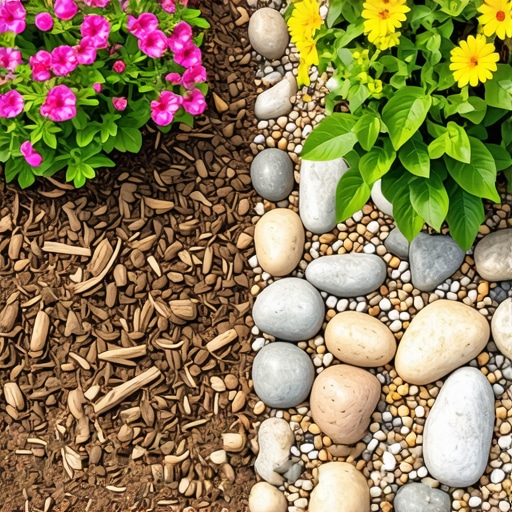
Bark mulch provides nutrient cycling, moisture retention, and soil temperature regulation that inert stone cannot match, fostering a living soil microbiome essential for perennial health. While stone is chemically inactive, bark is a living component of the landscape. As it breaks down, it introduces organic matter into the soil profile. This process improves the cation exchange capacity of your dirt. This means your soil becomes better at holding onto the nutrients you apply through fertilizers. If you use stone, you are effectively sealing off the soil from any natural replenishment. It is a dead system.
“Organic mulches improve the soil environment for plant growth by reducing evaporation, suppressing weeds, and moderating soil temperature fluctuations.” – Penn State Extension
Soil Temperature and Root Respiration
Bark mulch acts as a thermal insulator, preventing root desiccation in summer and frost heaving in winter, whereas stone acts as a heat sink that bakes delicate root systems. This is basic thermodynamics. Stone has a high thermal mass. It absorbs solar radiation all day and continues to radiate that heat into the soil long after the sun goes down. This cooks the fine root hairs responsible for water uptake. In a heatwave, the soil temperature under two inches of white river rock can be 20 degrees hotter than the temperature under dark bark mulch. Bark mulch is porous. It allows the soil to breathe. It keeps the roots cool. If the roots aren’t cool, the plant cannot transpire. If it can’t transpire, it dies. It is that simple.
How deep should mulch be in a flower bed?
For most residential garden beds, a depth of 2 to 3 inches is the industry standard for bark mulch to ensure effective weed suppression and moisture retention without suffocating the soil. Any deeper and you risk creating an anaerobic environment where gas exchange is restricted. Any shallower and sunlight will reach the soil surface, triggering weed seed germination. Don’t eyeball it. Use a depth gauge or a marked finger. Consistency is the hallmark of a professional install.
The Myth of Low Maintenance Stone
While stone appears permanent, it traps windblown organic debris that turns into a fertile seedbed for weeds, requiring labor-intensive cleaning or hazardous herbicide use. Homeowners often ask for stone because they are tired of mulching every year. This is a trap. Within two seasons, dust, leaves, and grass clippings will settle between the stones. This creates a perfect layer of compost on top of your weed fabric. Weeds will grow. Their roots will intertwine with the fabric. Removing them becomes a nightmare. Bark mulch, conversely, can be easily top-dressed. You aren’t fighting the material; you are working with it. Don’t be lazy. Do the work once a year and keep the soil healthy.
| Feature | Bark Mulch (Organic) | Decorative Stone (Inert) |
|---|---|---|
| Soil Nutrient Addition | High (Decomposes into humus) | None (Inert) |
| Thermal Regulation | Excellent (Insulates roots) | Poor (Radiates heat) |
| Weed Suppression | Effective (Smothers seeds) | Temporary (Trap for debris) |
| pH Impact | Slightly Acidic (Great for most) | Neutral to Alkaline (Varies) |
| Installation Cost | Lower ($40-$60 per yard) | Higher ($120-$200 per yard) |
Soil Microbiology and the Mycorrhizal Connection
Decomposing wood chips feed beneficial fungi and bacteria, creating a symbiotic network that helps plants absorb phosphorus and micronutrients, a process completely absent under stone. A healthy garden bed is a crowded city of microbes. Bark mulch provides the carbon source these microbes need to survive. Specifically, it encourages the growth of mycorrhizal fungi. These fungi attach to plant roots and extend their reach, allowing the plant to pull in water from further away. Stone provides none of this. Stone is a desert. When you use stone, you are forcing your plants to rely entirely on whatever liquid fertilizer you remember to dump on them. It is an artificial life support system.
“A retaining wall doesn’t fail because of the stone; it fails because of the water trapped behind it, and a garden fails because of the heat trapped above it.” – Hardscape Engineering Axiom (Adapted)
Is cedar mulch better than pine bark?
Cedar mulch is highly valued for its natural insect-repellent properties and slower decomposition rate compared to pine, making it ideal for beds near the home foundation. However, pine bark is often superior for acid-loving plants like azaleas or blueberries. Choose your mulch based on the specific botanical needs of your plant palette rather than just the color. Check the pH of your soil first. Knowledge is power.
Professional Installation Checklist
Successful mulching requires clearing existing weeds, edging to a depth of 4 inches, and spreading organic matter at a consistent 3 inch depth without burying the plant root flares. Follow these steps for a professional result:
- Edge the bed with a sharp spade to create a 4-inch deep trench. This stops grass runners.
- Remove all existing weeds by the root. Do not just bury them.
- Apply a pre-emergent herbicide if you have a history of heavy weed pressure.
- Spread the mulch evenly. Use a hard rake.
- Pull mulch away from the base of trees and shrubs. No mulch volcanoes.
- Water the mulch lightly after installation to settle the dust and lock it in place.
The Final Verdict on Material Choice
Landscaping is an investment in your property’s value and the local ecology. Stone has its place in hardscaping, such as around fire pits or in French drains for drainage management. But in a planting bed, it is a liability. It compacts the soil. It kills the worms. It stresses the plants. If you want a garden that thrives for decades, use triple-shredded hardwood mulch or high-quality bark nuggets. Your plants will thank you with faster growth and better bloom production. Don’t let a contractor talk you into stone just because it is easier for them to dump out of a truck. Hold your ground. Demand organic.