The Truth About Salt-Tolerant Plants for Coastal Gardens
The Truth About Salt-Tolerant Plants for Coastal Gardens: Engineering a Resilient Landscape
Coastal gardening is not a hobby; it is a battle against corrosive elements. I always drill into my new crew members: if you don’t fix the soil grading and drainage first, every plant you put in the ground is just expensive compost. I have seen countless homeowners spend thousands on nursery stock that looks great on the truck but dies within three weeks because they didn’t account for the physiological drought caused by salt. When you are working within five miles of the ocean, the rules of biology change. You are no longer just dealing with nitrogen and phosphorus; you are dealing with chloride ions, osmotic pressure, and alkaline sand that locks up micronutrients. If you don’t understand the chemistry of the coast, you are lighting your landscaping budget on fire. This guide breaks down the engineering and botanical requirements for a landscape that can actually withstand the coastal environment.
Understanding Salt Spray and Soil Salinity
Salt-tolerant plants or halophytes possess specialized physiological mechanisms like salt glands or succulence to survive high-sodium environments. Coastal landscapes face two threats: aerial salt spray and soil salinity, both of which cause osmotic stress and tissue desiccation in non-adapted species, leading to rapid decline. In the simplest terms, salt pulls water out of the plant. Even if the soil is damp, a plant in high-salinity conditions can die of thirst because the salt prevents the roots from absorbing water. This is known as physiological drought. You will see it as brown, brittle leaf margins or ‘burned’ needles. It is not a disease; it is a mechanical failure of the plant’s ability to regulate water.
How do you neutralize salt in soil?
You cannot ‘neutralize’ salt with a chemical additive; you must physically leach it out of the root zone using deep, low-sodium water applications. In heavy clay coastal soils, this requires gypsum to break the sodium-clay bonds, but in the sandy loams typical of the coast, it requires consistent irrigation that pushes the salt below the top 12 inches of the soil profile. Maintaining a high level of organic matter can help buffer the roots, but only if the drainage is sufficient to prevent the salt from pooling. [IMAGE_PLACEHOLDER_1]
“Coastal plants must endure high winds, salt spray, and poor soil conditions; selecting the right species is more about biology than aesthetics.” – University of Florida IFAS Extension
The Engineering of Coastal Hardscaping and Drainage
Coastal hardscaping requires non-porous materials and engineered drainage to prevent salt-induced spalling and soil saturation. Utilizing Type V sulfate-resistant cement or high-density pavers ensures that the structural integrity remains intact despite the constant exposure to corrosive chloride ions and shifting sand foundations. Many contractors fail to realize that salt doesn’t just kill plants; it eats stone. If you use a porous limestone or a cheap concrete paver near the ocean, the salt will crystallize inside the pores, expanding and shattering the surface from the inside out. This is why we specify high-density porcelain or salt-sealed natural stone for any project within the salt-mist zone. Drainage is equally critical. You need a modified gravel base, typically 6 to 8 inches of compacted 57 stone, topped with a geotextile fabric to prevent the native sand from migrating into your base and causing settling.
How much modified gravel do I need for a patio base?
For a standard coastal patio, you need a minimum of 6 inches of compacted DGA (Dense Graded Aggregate) or clean crushed stone to ensure stability in shifting sands. Calculate your volume by multiplying the square footage by the depth in feet, then add a 20 percent compaction factor to ensure you have enough material to achieve the required 98 percent Proctor density. Most DIY jobs fail because they only use 2 inches of sand, which liquefies during a storm surge and leads to immediate paver failure.
Selecting High-Performance Salt-Tolerant Species
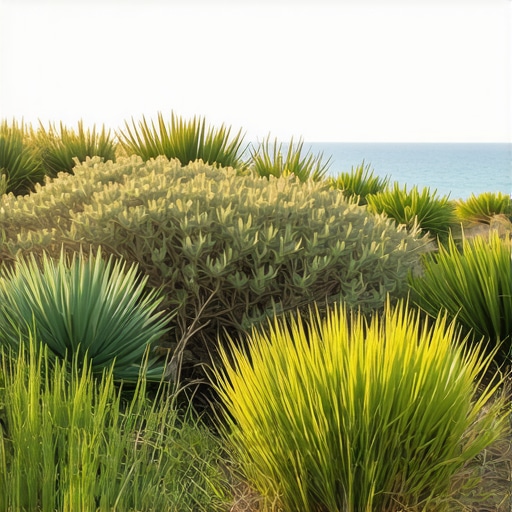
Choosing the right plants involves looking for specific physical traits: thick, waxy cuticles, hairy leaf surfaces, or the ability to store water in fleshy tissues. We categorize these into three zones based on their distance from the mean high-tide line. Zone 1 plants, like Sea Oats or Railroad Vine, can handle direct spray and occasional overwash. Zone 2 plants, like Muhly Grass or Yaupon Holly, can handle the salt mist but need some protection from direct waves. Zone 3 plants are those that are salt-tolerant but prefer the shelter of a building or a secondary dune.
| Plant Category | High Tolerance | Moderate Tolerance |
|---|---|---|
| Trees | Live Oak, Cabbage Palm | Southern Magnolia, Red Cedar |
| Shrubs | Oleander, Sea Grape | Wax Myrtle, Hibiscus |
| Grasses | Muhly Grass, Sea Oats | Fescue (Select Cultivars), Zoysia |
| Groundcover | Shore Juniper | Blanket Flower |
Which plants can handle ocean spray?
Species like Ilex vomitoria (Yaupon Holly), Spartina patens (Saltmeadow Cordgrass), and Coccoloba uvifera (Sea Grape) are engineered by nature to withstand direct salt spray. These plants either excrete salt through their leaves or have a thick, leathery epidermis that prevents the salt from penetrating the cellular structure, making them essential for first-line coastal defense. Avoid anything with soft, thin leaves like Maples or standard Roses, as they will be desiccated within forty-eight hours of a storm event.
“A retaining wall doesn’t fail because of the stone; it fails because of the water trapped behind it.” – Hardscape Engineering Axiom
Soil Modification and the Cation Exchange Capacity
In coastal garden design, the soil is usually 90 percent silica sand. This means it has a very low Cation Exchange Capacity (CEC), essentially the soil’s ability to hold onto nutrients. When you fertilize sandy soil, the rain just washes the nutrients straight through into the groundwater. You must build the soil’s ‘engine’ by adding composted organic matter. However, there is a catch: too much organic matter in a high-salt environment can act like a sponge for sodium. I recommend a 70/30 mix of native sand and high-quality compost. This provides enough CEC to hold nutrients while ensuring the drainage is fast enough to leach out excess salts during heavy rain.
The Seven-Step Installation Protocol for Coastal Zones
To ensure a landscape survives the first year, you must follow a rigid installation protocol. Don’t skip these steps.
- Grade for Egress: Ensure all surface water moves away from the house and planting beds at a 2 percent slope.
- Excavate and Amend: Remove 12 inches of native sand and replace with an engineered soil mix.
- Install Drip Irrigation: Avoid overhead spray which puts salt-laden water directly on the foliage.
- Set the Root Flare: Always plant 1 inch high. Never bury the root flare, or the trunk will rot in the humid coastal air.
- Mulch Heavy: Use 3 to 4 inches of large-format wood chips. Avoid fine mulches that blow away.
- Initial Leaching: After planting, water deeply for two hours to settle the soil and flush any initial salts.
- Wind Protection: Use temporary silt fencing or burlap screens for the first six months to protect new growth.
The Settling-In Period and Maintenance
The first year is the most dangerous. Your plants are trying to establish a root system in a hostile environment. Do not over-fertilize with high-nitrogen salts; this will only increase the osmotic stress. Instead, use slow-release organic fertilizers and focus on micronutrients like Magnesium and Manganese, which are often deficient in alkaline coastal soils. After every major storm or high-wind event, you should perform a ‘freshwater rinse.’ Take a hose and gently wash the salt film off the leaves of your plants. This simple act can be the difference between a thriving garden and a dead one. Landscaping in a coastal zone is about understanding that you are part of a larger ecosystem. Respect the salt, engineer for the wind, and choose plants that have evolved to fight. Anything else is just a temporary installation.
![Low-Maintenance 2026 Front Yard Shrubs [Full Sun]](https://lawnmajesty.com/wp-content/uploads/2026/07/Low-Maintenance-2026-Front-Yard-Shrubs-Full-Sun.jpeg)