The Easiest Way to Install Landscape Fabric That Actually Stays Put
Why Most Landscape Fabric Installations Fail Within Two Years
The easiest way to install landscape fabric that stays put involves preparing a compacted subgrade, overlapping seams by 12 inches, and using 6-inch steel staples driven every 18 inches. Most landscaping failures occur because homeowners skip the excavation phase and use low-quality, non-woven materials that shift under the weight of the aggregate.
I recently got called out to tear up a $30,000 patio that was sinking because the previous contractor used a cheap, big-box store weed barrier instead of a professional-grade geotextile. The fabric had clogged with fine clay particles within months, creating a slick, anaerobic layer of mud that essentially acted as a lubricant for the gravel base. The entire structure was sliding toward the client’s foundation because the hardscaping fundamentals were ignored. When I pulled up the pavers, the smell of stagnant, oxygen-deprived soil was unmistakable. This was a classic case of choosing convenience over engineering. In garden design, if you ignore the physics of water movement and soil separation, the ground will eventually reclaim your investment. You cannot just roll out a piece of plastic and expect it to behave. It requires an understanding of hydrostatic pressure and soil tensile strength.
“A retaining wall doesn’t fail because of the stone; it fails because of the water trapped behind it.” – Hardscape Engineering Axiom
How much landscape fabric do I need for a 10×20 area?
Calculating the material for your lawn care or garden project requires accounting for the 12-inch overlap at every seam. For a 10×20 area, you do not simply buy 200 square feet of material. If you are using 3-foot wide rolls, you will have three seams. Each seam loses one foot of coverage to the overlap. You should purchase at least 260 square feet to ensure you have enough for the overlaps and the perimeter trenching. Never scrimp on the edges. If the fabric does not extend past the edge of your bed or hardscape, weeds will find the gap. It is a biological certainty.
Choosing the Right Fabric Grade for Professional Results
Professionals select landscape fabric based on the specific mechanical requirements of the site, choosing between woven and non-woven geotextiles. For heavy hardscaping like patios, a 4-ounce to 6-ounce non-woven needle-punched fabric is necessary to allow for drainage while providing separation. For garden design, a heavy-duty woven fabric provides the best weed suppression for permanent plantings.
| Fabric Type | Weight (oz/sq yd) | Flow Rate (gpm/sq ft) | Primary Application |
|---|---|---|---|
| Woven Polypropylene | 3.1 to 4.5 | Low | Weed barrier under mulch beds |
| Non-Woven Needle Punched | 4.0 to 8.0 | High | Drainage, Hardscape separation |
| Spun-bond Geotextile | 1.5 to 2.5 | Medium | Short-term annual garden beds |
You must understand the microscopic reality of the soil. Clay particles are incredibly small, often less than 0.002mm. If you use a fabric with a pore size that is too large, these ‘fines’ will migrate into your gravel base, a process known as piping. This ruins the structural integrity of your landscaping. Conversely, if the pores are too small and the fabric is not needle-punched, the fabric will ‘blind’ or clog, leading to surface ponding and root rot. I see this constantly with ‘mow-and-blow’ hacks who throw down cheap plastic liners. They are literally suffocating the soil microbiology.
The Ground-Up Installation Process for Landscape Fabric
Successful landscaping starts with a cleared, compacted subgrade excavated to a depth of at least 4 inches. You must remove all organic matter, including grass and roots, and level the soil to ensure the landscape fabric lays flat against the earth without air pockets. Air pockets are the enemy: they allow for soil movement and provide a home for rodents.
- Excavation: Remove 4 to 6 inches of topsoil. You need to reach the subsoil, which has higher structural density than the organic-rich A-horizon.
- Compaction: Use a plate compactor or a hand tamper. The ground should be firm enough that a boot heel does not leave a deep impression.
- Grading: Ensure the subgrade slopes away from foundations at a rate of at least 1 inch per 10 feet.
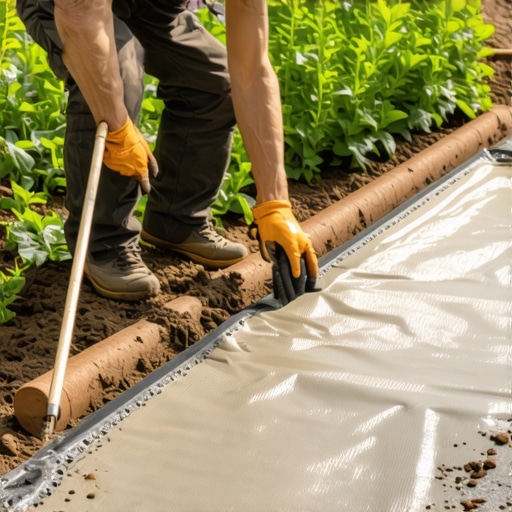
- Fabric Layout: Roll the fabric out, keeping it taut. Use the ‘Trench and Tuck’ method at the edges, burying the fabric 3 inches deep into a perimeter trench.
- Securing: Drive 6-inch steel staples in a ‘W’ pattern. One staple every 18 inches along the seams and every 2 feet in the center.
The tamper should literally bounce off the compacted base when you are done. If it feels soft, keep tamping. Don’t skip this. I tell my crew that every minute spent on subgrade preparation saves ten hours of warranty work later. When you roll out the fabric, ensure the ‘fuzzy’ side of the non-woven material faces down. This increases the friction between the fabric and the soil, preventing the fabric from sliding during the aggregate pour. It is these small, technical details that separate a professional install from a weekend DIY disaster.
“Soil separation is the primary function of geotextiles in residential applications to prevent the intermixing of subgrade soils and aggregate bases.” – ICPI Tech Spec 1
Should I use landscape fabric under pavers or gravel?
Yes, you should use non-woven landscape fabric under pavers and gravel to act as a separation layer. This prevents the heavy gravel from sinking into the soft soil over time, a process driven by freeze-thaw cycles and hydrostatic pressure. Without the fabric, your beautiful hardscaping will eventually become a series of uneven, tripping hazards as the base materials migrate downward into the subgrade.
Managing Drainage and Hydrostatic Pressure in Hardscaping
High-quality hardscaping requires managing water movement to prevent frost heave and settling through the use of permeable fabric. Landscape fabric acts as a filter, allowing water to pass into the water table while holding back the soil particles that would otherwise clog your drainage pipes and gravel. This balance is critical in regions with heavy clay or high rainfall.
Think about the physics. When it rains, the water saturates the soil. This water has weight and exerts pressure in all directions. If your fabric is not permeable, that pressure builds up under your patio or behind your wall. This is hydrostatic pressure. It will lift a 200-pound paver like it is a piece of cork. By using a needle-punched non-woven geotextile, you provide an escape route for that water. The water flows through the fabric into your gravel base and out through your French drains or weep holes. This keeps the subgrade dry and stable. In lawn care, this same principle applies to French drains. If you don’t wrap your perforated pipe in fabric, the pipe will be full of silt within two seasons. It will rot. Don’t skip this. Use a 4-ounce fabric for most residential drainage applications. Anything lighter will tear during the backfilling process. Anything heavier might restrict the flow rate too much for high-volume storm runoff.
![5 Low-Maintenance 2026 Front Yard Layouts [DIY]](https://lawnmajesty.com/wp-content/uploads/2026/06/5-Low-Maintenance-2026-Front-Yard-Layouts-DIY.jpeg)