5 2026 Evergreen Hedges That Grow 3 Feet Per Year
5 High-Performance 2026 Evergreen Hedges for 3-Foot Annual Growth
Planning a privacy screen is a project of biological engineering, not a weekend hobby. Most homeowners fail because they prioritize the top growth without understanding the mechanical requirements of the root system or the chemical composition of their soil. If you want three feet of growth per year, you cannot rely on big-box store saplings and cheap mulch. You need high-caliper nursery stock and a dedicated irrigation strategy. 80 percent of your success is determined before the first hole is dug.
The Critical Foundation of Hedge Engineering
Proper hedge installation requires a deep understanding of soil compaction, drainage rates, and root flare visibility to ensure a 3-foot annual growth rate. You must conduct a percolation test to verify that your planting site can handle the hydraulic load of frequent watering without drowning the rhizosphere. I always drill into my new crew members: if you don’t fix the soil grading first, every plant you put in the ground is just expensive compost. I have seen countless $20,000 installations fail within 24 months because the contractor ignored the Cation Exchange Capacity (CEC) of the soil or buried the root flares under six inches of ‘volcano mulch.’ Dirt is a living matrix, and if you treat it like a static base, your plants will die. It is that simple. Don’t skip the soil test. You need to know your pH. Most of these fast-growing evergreens prefer a pH between 6.0 and 7.0. If you are sitting at an 8.2, you are fighting a losing battle against iron chlorosis before you even start.
“The depth of the planting hole should be no deeper than the root ball, but the width should be at least twice the diameter of the root system to encourage lateral expansion.” – Penn State Extension Arboriculture Manual
1. Thuja ‘Green Giant’ (Arborvitae)
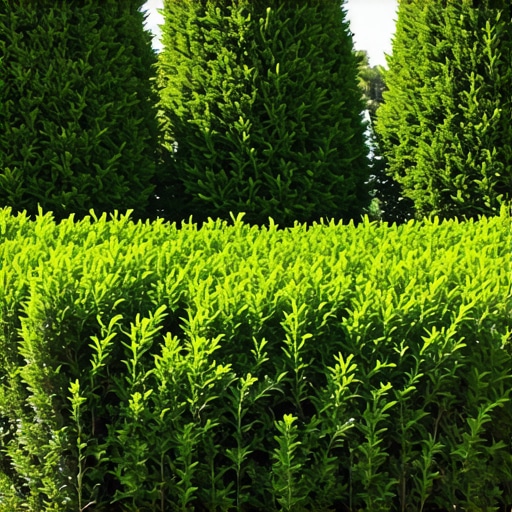
Thuja ‘Green Giant’ is a sterile hybrid reaching 3 feet of annual growth in optimal conditions. This evergreen hedge thrives in USDA zones 5 through 8, requiring well-drained soil and full sun to maintain its conical shape and dense foliage for year-round privacy screening. This tree is the workhorse of the industry. It is resistant to most pests and, unlike its cousin the ‘Emerald Green,’ it can handle heavy snow loads without splitting. It needs space. You cannot cram these on 2-foot centers and expect them to thrive. They need 5 to 6 feet of clearance to allow for proper airflow. Lack of airflow leads to fungal pathogens. Pass on the 1-gallon pots. Buy the 7-gallon or 15-gallon containers. You are buying time.
How far apart should I plant Green Giant Arborvitae for privacy?
For a dense, integrated screen, plant Green Giant Arborvitae on 5-foot to 6-foot centers. This spacing allows the lateral branches to knit together without causing premature needle drop due to sunlight competition or restricted airflow in the lower canopy layers. If you plant them too close, you create a humid microclimate that invites bagworms and spider mites. I have seen rows of these wiped out because the homeowner wanted an instant wall and ignored the biology of the plant. Give them room to breathe.
2. Cupressus × leylandii (Leyland Cypress)
Leyland Cypress provides rapid 3-foot vertical growth and creates a thick visual barrier quickly. However, it requires precise horticultural management to avoid Seiridium canker and root rot. This species is best for large landscapes where airflow is maximized and soil drainage is superior. Many hacks will tell you this is a ‘plant and forget’ tree. They are wrong. Leylands are heavy feeders. They require a balanced 10-10-10 fertilizer in early spring to sustain that 36-inch vertical push. They also have a shallow root system. In high-wind areas, a Leyland without a broad root base is just a sail waiting to be tipped over. You must excavate a wide, shallow planting area to encourage lateral root anchoring. If your soil is heavy clay, skip the Leyland. It will rot.
3. Ilex x ‘Nellie R. Stevens’ (Holly)
Nellie R. Stevens Holly is a vigorous broadleaf evergreen capable of 2 to 3 feet of growth annually when properly irrigated and fertilized. It produces dense, prickly foliage and red berries, making it an ideal security hedge for USDA zones 6 through 9. This isn’t your grandma’s garden holly. This is a beast. It handles pruning exceptionally well, meaning you can box it out into a formal hedge or let it go natural. It is also remarkably drought-tolerant once established, but ‘established’ means two full growing seasons of deep watering. I prefer these for urban environments because they handle air pollution and poor soil better than conifers. They are tough. They are reliable.
What is the fastest growing evergreen for privacy?
The Green Giant Arborvitae remains the fastest-growing evergreen, often exceeding 3 feet per year, followed closely by the Leyland Cypress. However, the Nellie R. Stevens Holly offers superior structural integrity and pest resistance in southern climates with higher heat indexes and humidity levels. While the internet tells you to water every day, turf grass and hedges actually need deep, infrequent watering, exactly 1 inch per week, to force roots to chase the water down.
4. Thuja plicata ‘Virescens’ (Western Red Cedar)
Thuja plicata ‘Virescens’ is a narrow evergreen cultivar that maintains a slender profile while achieving 2 to 3 feet of vertical growth per year. It is highly deer-resistant and maintains a deep green color throughout the winter months in USDA zones 5 through 8. If you have a narrow side yard, this is your solution. It doesn’t have the massive footprint of a Green Giant, but it gives you the height. The ‘Virescens’ is also less prone to winter bronzing. Most evergreens turn a sickly brown-orange in February; this one stays green. It requires a loamy soil. If you have sandy soil, you must amend it with organic matter to increase water retention. It will not tolerate drying out during the first year.
5. Cupressus glabra ‘Murray’ (Murray Cypress)
Murray Cypress is an improved Leyland alternative that offers 3-foot annual growth with significantly better disease resistance and branch strength. It thrives in various soil types, including heavy clay, and is hardy in USDA zones 6 through 10. This is what the Leyland Cypress should have been. It has a stronger central leader, meaning it won’t fall apart in a snowstorm. We are seeing more of these in the trade for 2026 because they simply out-compete the older cultivars. It still needs a full sun exposure. If you put this in the shade, it will become leggy and thin. You want density. Density requires photosynthesis.
“A retaining wall doesn’t fail because of the stone; it fails because of the water trapped behind it.” – Hardscape Engineering Axiom
The same logic applies to your hedge. Your hedge fails because of the water, or lack thereof, at the root level. You need to manage the hydrology of your property before you plant. If you have a low spot that stays soggy, none of these trees will survive without a French drain or a raised berm. You cannot fight physics.
| Species | Growth Rate | Soil Preference | USDA Zone | Mature Width |
|---|---|---|---|---|
| Green Giant | 3-5 ft | Well-drained | 5-8 | 12-20 ft |
| Leyland Cypress | 3 ft | Moist/Well-drained | 6-10 | 15-25 ft |
| Nellie Stevens | 2-3 ft | Acidic/Neutral | 6-9 | 10-15 ft |
| Virescens | 2-3 ft | Loamy | 5-8 | 8-12 ft |
| Murray Cypress | 3-4 ft | Versatile | 6-10 | 10-20 ft |
The Professional Installation Checklist
- Site Analysis: Measure sun exposure (minimum 6 hours) and test soil pH.
- Utility Check: Call 811 before digging. Do not hit a gas line for a tree.
- Hole Preparation: Dig twice as wide as the root ball. Never deeper.
- Root Management: Remove all twine, wire baskets, and non-biodegradable burlap.
- The Root Flare: Ensure the point where the roots meet the trunk is at or slightly above grade.
- Initial Hydration: Saturate the hole during backfilling to eliminate air pockets.
- Mulching: Apply 2-3 inches of organic mulch, keeping it 4 inches away from the trunk.
Maintenance in the first year is non-negotiable. You are not just watering a plant; you are managing a biological transition. Use a drip irrigation system. Overhead watering is a waste of resources and a recipe for needle blight. You need to deliver water directly to the root zone. Check your soil moisture with a finger test. If it is dry two inches down, water it. If it is muddy, stop. Most homeowners kill their hedges with ‘kindness’ by over-watering in clay soil, creating a bathtub effect that suffocates the roots. Don’t be that homeowner. Follow the science, buy quality stock, and respect the soil. That is how you get a 10-foot wall in three years.