The Best Way to Clean a Slimy Stone Birdbath Fast
The Anatomy of the Slime: A Forensic Autopsy of Your Birdbath
To clean a slimy stone birdbath fast, you must physically disrupt the biofilm using a stiff-bristled nylon brush and apply a 9:1 water-to-vinegar solution to neutralize the algal spores embedded within the porous stone matrix. This process requires less than fifteen minutes but must be executed with precision to prevent the degradation of the stone’s structural integrity. I always drill into my new crew members: if you don’t understand the soil and the water chemistry first, every feature you put in the ground is just expensive compost. I recently stood over a $2,000 hand-carved limestone basin that a homeowner had absolutely decimated with a pressure washer and undiluted bleach. The stone was spalling, the surface was pitted, and the algae was actually growing deeper into the new crevices. They wanted a quick fix, but they forgot that stone is a breathing, porous material, not a piece of plastic. When you see that green or black slick, you aren’t just looking at ‘dirt.’ You are looking at a complex biological colony of cyanobacteria and green algae that has anchored itself into the microscopic voids of the stone. This is the same biological reality we face when managing drainage on a hardscape install or preventing moss on a north-facing paver patio. If you don’t kill the root of the colony, it comes back in forty-eight hours.
“Algal growth in birdbaths is primarily driven by nitrogen and phosphorus inputs from bird droppings, coupled with direct sunlight which facilitates photosynthesis.” – Agricultural Extension Research
The Biology of the Biofilm
Why does it get slippery? That’s the extracellular polymeric substance (EPS). It’s a protective slime layer that the bacteria and algae secrete to stay hydrated and stick to the stone. In garden design, we often focus on the aesthetics of water features, but the microbiology is what dictates the maintenance schedule. If your birdbath is carved from cast stone or natural limestone, it has a high absorption rate. This means the slime isn’t just on the surface; it’s tethered. Using a standard garden hose won’t cut it. You need mechanical agitation to break the EPS layer. If you ignore this, the birdbath becomes a vector for avian diseases like Mycoplasma or Salmonella, which can decimate local bird populations faster than a neighbor’s outdoor cat. Professional lawn care and landscaping isn’t just about the grass; it’s about the health of the entire ecosystem.
The Step-by-Step Remediation Process
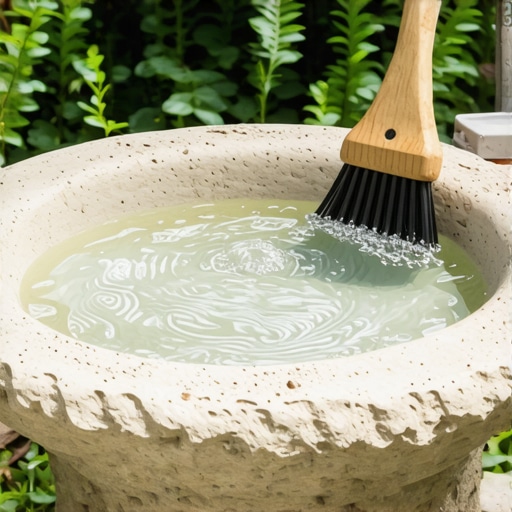
Cleaning a birdbath efficiently requires a specific sequence to ensure the biological load is removed without leaving toxic residues that harm the local fauna. Use the following protocol to restore the stone surface to a neutral state. First, evacuate the stagnant water. Don’t just dump it on your high-end turf; the concentrated nitrates and potential pathogens can cause localized fungal issues in the grass. Dump it into a mulch bed where the soil microbes can process it. Second, use a stiff nylon brush—never steel, as it will leave metal particles that rust and stain the stone—to scrub the dry surface. This is the most important step. You have to break the physical bond of the biofilm. Third, apply your cleaning agent. I recommend a 10% solution of white distilled vinegar. It’s acidic enough to kill the algae but won’t ruin the pH of your soil when you rinse it off. Let it sit for exactly five minutes. Don’t let it dry. If it dries, the salts in the vinegar will crystallize in the stone pores. Rinse it with a high-volume, low-pressure stream. High pressure (over 1500 PSI) will open up the stone’s pores, making it even easier for algae to return next week.
How much vinegar should I use for a birdbath?
For a standard 24-inch stone birdbath, use one cup of white distilled vinegar mixed with nine cups of clean water to create a 10% solution that effectively kills algae and bacteria without etching the calcium carbonate found in most cast stone or limestone features. This ratio is the industry standard for a ‘soft wash’ in hardscaping. It’s strong enough to break down the cellular walls of the algae but mild enough that it won’t cause the stone to flake or ‘sugar.’ If the birdbath is exceptionally foul, you can bump the ratio to 20%, but no higher. We aren’t trying to pickle the stone; we are trying to sanitize it.
Can I use a pressure washer on a stone birdbath?
You should avoid using a pressure washer on stone birdbaths because the concentrated water jets can cause micro-pitting and surface spalling, which increases the surface area for biofilm re-colonization and permanently damages the finish of the stone. I’ve seen guys try to blast the green off, and all they do is create a better habitat for the algae to hide in. A garden hose with a jet nozzle is plenty. If you can’t get it clean with a hose and a brush, your chemical dwell time was too short. Patience beats PSI every single time in professional landscaping.
Material Comparison and Agent Efficacy
Not all stones react the same way to cleaning agents. If you are dealing with a granite basin, you have more leeway because granite is an igneous rock with very low porosity. If you have a cast stone or concrete basin, you are basically dealing with a hard sponge. The table below outlines the professional consensus on cleaning agents based on stone type and environmental impact.
| Cleaning Agent | Efficacy | Stone Safety (Porous) | Bird Safety | Residual Effect |
|---|---|---|---|---|
| White Vinegar | High | Excellent | Safe after rinse | Neutralizes quickly |
| Hydrogen Peroxide (3%) | Very High | Good | Safe | Breaks down to water/oxygen |
| Bleach (Sodium Hypochlorite) | Extreme | Poor (Causes Spalling) | Toxic Residue Risk | High pH shift |
| Commercial Algaecide | Moderate | Variable | Low (Check Label) | Long-lasting toxins |
Engineering the Environment to Prevent Algal Blooms
Prevention is a matter of civil engineering and site placement. Most homeowners put their birdbaths in the middle of a sunny lawn because it looks good. This is a mistake. High UV exposure plus the nitrogen in bird droppings equals an algae explosion. If you want to keep it clean longer, you have to manage the light and the temperature. Shade is your best friend. A birdbath in partial shade will stay 10-15 degrees cooler, which significantly slows the metabolic rate of the algae. Furthermore, you need to consider the drip line of trees. Don’t place the basin directly under an oak or maple where sap and leaf litter will fall in. That’s just free food for the biofilm. In my firm, when we do a garden design, we treat the birdbath like any other hardscape feature: it needs a stable, level base—usually 2 inches of compacted modified gravel—to prevent shifting and cracking, and it needs to be positioned for easy maintenance access.
“A retaining wall doesn’t fail because of the stone; it fails because of the water trapped behind it. Similarly, a birdbath fails not because of the birds, but because of the stagnant conditions we allow to persist.” – Hardscape Engineering Axiom
The Maintenance Checklist
- Daily: Quick rinse and refill to prevent mosquito larvae (3-day cycle).
- Weekly: Surface scrub with a stiff brush to disrupt the EPS layer.
- Monthly: Deep clean with a 10% vinegar solution or 3% hydrogen peroxide.
- Seasonal: Check for structural cracks or surface erosion (spalling).
- Winter: Drain and cover. Ice expansion in porous stone is the #1 killer of birdbaths in the North.
Professional Insight on Long-Term Stone Care
If the stone is already starting to degrade, you can’t just clean it; you have to stabilize it. After a deep clean and a full 24-hour dry period, consider applying a breathable silane-siloxane sealer. This isn’t like painting it with plastic. It’s a chemical bond that enters the pores and makes them hydrophobic—meaning water (and slime) can’t get a grip—but it still allows water vapor to escape so the stone doesn’t crack during a freeze-thaw cycle. This is the same stuff we use on high-end paver driveways and pool decks. It’s a professional-grade move that turns a weekly chore into a monthly five-minute task. Don’t use a cheap ‘wet-look’ sealer from a big-box store. Those will yellow and peel, leaving you with a mess that requires chemical stripping. Spend the money on a professional penetrating sealer. Your birdbath will thank you. And for the love of all that is holy, keep the bleach in the laundry room. It’s a landscape killer. It kills the beneficial soil microbes, it kills the stone, and it sure as hell isn’t good for the birds.
![Why Your 2026 Pond Pump is Making Noise [Easy Fix]](https://lawnmajesty.com/wp-content/uploads/2026/07/Why-Your-2026-Pond-Pump-is-Making-Noise-Easy-Fix.jpeg)
![Build a $60 Solar Powered Bird Bath [2026 DIY]](https://lawnmajesty.com/wp-content/uploads/2026/06/Build-a-60-Solar-Powered-Bird-Bath-2026-DIY.jpeg)